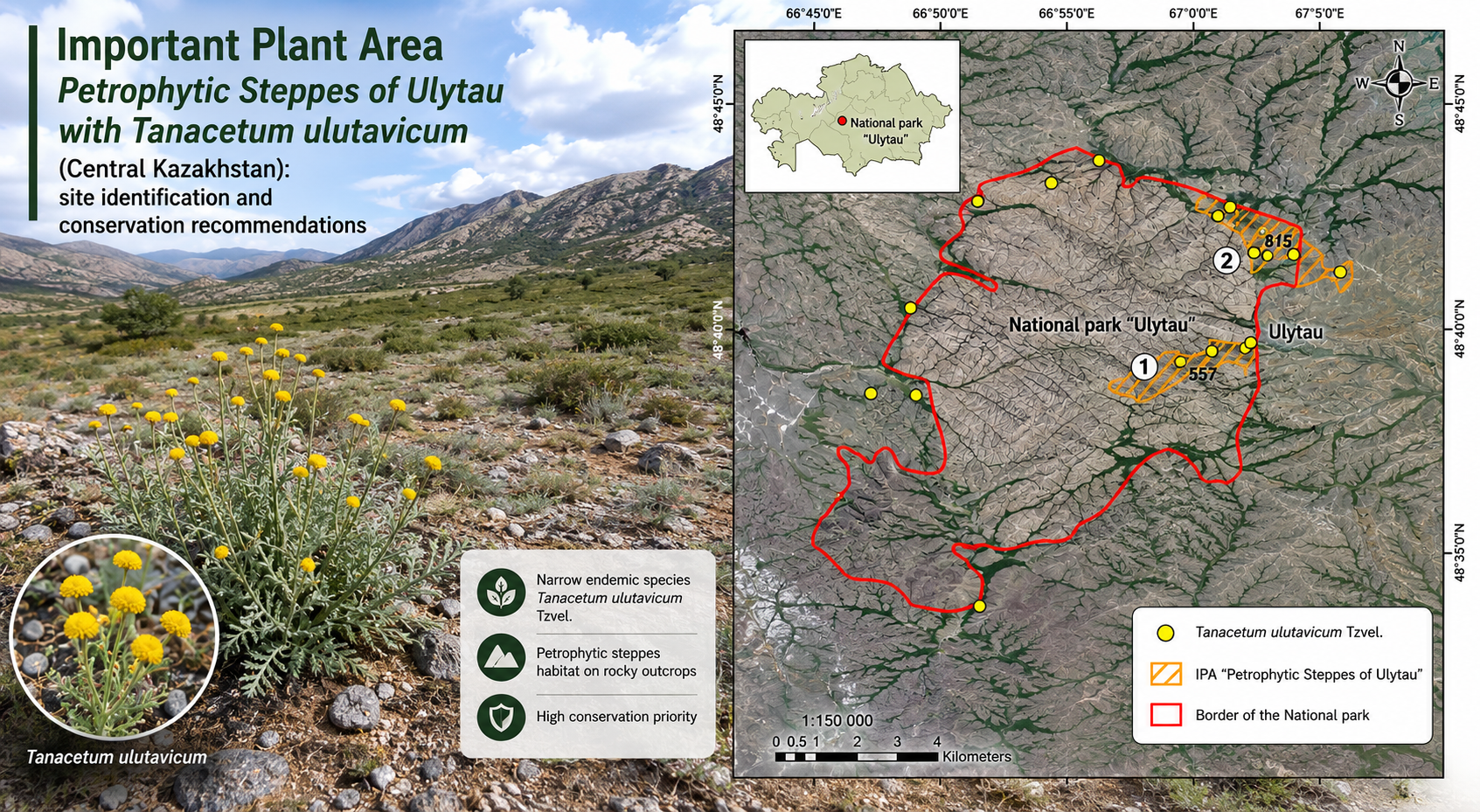
Important Plant Area “Petrophytic Steppes of Ulytau with Tanacetum ulutavicum” (Central Kazakhstan): site identification and conservation recommendations
DOI:
https://doi.org/10.31489/2026feb2/125-136Keywords:
Ulytau, Important Plant Area (IPA), petrophytic steppes, endemics, Tanacetum ulutavicum, plant conservation, Ulytau State National Nature ParkAbstract
Field surveys conducted in 2025 in the Ulytau low-mountain massif (Ulytau Region, Kazakhstan) support the identification of the Important Plant Area (IPA) “Petrophytic Steppes of Ulytau with Tanacetum ulutavicum.” The site comprises two polygons totaling 1,372 ha (557 and 815 ha), located largely within Ulytau State Na-tional Nature Park, at elevations of 508–1,140 m a.s.l., and includes a mosaic of petrophytic communities on rocky substrates. The primary conservation target is the narrow-range endemic Tanacetum ulutavicum Tzvelev (Red Data Book of Kazakhstan), occurring in discrete population patches of 207–1,200 m² with densities of 0.06–3 individuals per m². Communities supporting this species show high floristic richness (82 vascular plant species) and concentrate multiple taxa of conservation concern, including several rare and regionally significant species. The site meets the Kazakhstan-adapted IPA subcriteria A3 and A4 (endemic and subendemic species) and B2 and B3 (assemblages of high conservation and socio-economic value). Principal threats include grazing pressure, trampling, unregulated recreation, and localized substrate disturbance. Formal boundary delineation, long-term population monitoring, and regulation of grazing and visitor use are recommended to ensure effective conservation management.
References
1 Anderson, S. (2002). Identifying and conserving Important Plant Areas. Salisbury, UK: Plantlife International.
2 Darbyshire, I., Anderson, A., Asatryan, A., Byfield, A., Cheek, M., Clubbe, C., & Radford, E. A. (2017). Important Plant Areas: Revised selection criteria for a global approach to plant conservation. Biodiversity and Conservation, 26, 1767–1800. DOI: https://doi.org/10.1007/s10531-017-1336-6
3 (2018). Plantlife. Identifying and conserving Important Plant Areas (IPAs) around the world: Guide for botanists, conserva-tionists, site managers, community groups, and policy makers. Salisbury, UK: Plantlife International.
4 (2004). Plantlife International. Important Plant Areas: Target 5 of the Global Strategy for Plant Conservation. Salisbury, UK: Plantlife International. 24 p.
5 Ishmuratova, M. Yu., Myrzaly, G. Zh., Ivlev, V. I., & Matveev, A. N. (2016). Flora gor Ulytau (Tsentralnyi Kazakhstan) [Flora of the Ulytau Mountains (Central Kazakhstan)]. Karaganda [in Russian].
6 Ishmuratova, M. Yu., Tleukenova, S. U., Dodonova, A. Sh., & Gavrilkova, E. A. (2016). Endemichnye vidy rastenii flory Ka-ragandinskoi oblasti (Tsentralnyi Kazakhstan): monografiia [Endemic plant species of the flora of Karaganda Region (Central Ka-zakhstan): monograph]. Karaganda [in Russian].
7 Kubentaev, S. A., Alibekov, D. T., Tustubaeva, Sh. T., & Kubentaeva, B. B. (2024). Chek-list redkikh rastenii flory Ulytauskoi oblasti [Checklist of rare plants of the flora of Ulytau Region]. Vestnik Karagandinskogo universiteta. Seriia «Biologiia. Meditsina. Geografiia» — Bulletin of the Karaganda University. “Biology. Medicine. Geography” Series, 29, 3(115), 113–121 [in Russian].
8 Myrzaly, G. Zh., Ishmuratova, M. Yu., Ivlev, V. I., & Matveev, A. N. (2014). Analiz flory gor Ulytau [Analysis of the flora of the Ulytau Mountains]. Vestnik Karagandinskogo universiteta. Seriia «Biologiia. Meditsina. Geografiia» — Bulletin of the Karaganda University. “Biology. Medicine. Geography” Series, 4, 45–52 [in Russian].
9 Kupriyanov, A. N., & Khrustaleva, I. A. (2017). Osobennosti flory Bolshogo Ulytau [Features of the flora of Bolshoy Ulytau]. Materialy VI Mezhdunarodnoi nauchnoi konferentsii, posviashchennoi 100-letiiu so dnia rozhdeniia A.V. Polozhii — Proceedings of the VI International Scientific Conference dedicated to the 100th anniversary of A.V. Polozhiy (pp. 67–69). Tomsk [in Russian].
10 Ishmuratova, M. Yu., Ivlev, V. I., Myrzaly, G. Zh., & Matveev, A. N. (2019). Novye svedeniia o flore gor Ulytau (Tsentralnyi Kazakhstan) [New data on the flora of the Ulytau Mountains (Central Kazakhstan)]. Problemy botaniki Yuzhnoi Sibiri i Mongolii: materialy XIII Mezhdunarodnoi nauchno-prakticheskoi konferentsii — Problems of Botany of Southern Siberia and Mongolia: Proceedings of the XIII International Scientific-Practical Conference (pp. 93-94) [in Russian].
11 (2014). Krasnaia kniga Kazakhstana [Red Data Book of Kazakhstan]. Vol. 2, Part 2. Rasteniia [Plants]. Astana [in Russian].
12 Artemov, I. I., Korolyuk, A. Yu., Lashchinskiy, N. N., & Smelyanskiy, I. E. (2007). Kriterii vydeleniia kliuchevykh botani-cheskikh territorii v Altae-Saianskom ekoregione [Criteria for identifying Important Plant Areas in the Altai–Sayan ecoregion]. No-vosibirsk: Sibirskii ekologicheskii tsentr [in Russian].
13 Dimeyeva, L. A., Kudabaeva, G. M., & Veselova, P. V. (2013). Rol kliuchevykh botanicheskikh territorii v realizatsii strategii sokhraneniia bioraznoobraziia Kazakhstana [The role of Important Plant Areas in the implementation of biodiversity conservation strategies in Kazakhstan]. Trudy XIII sezda Rossiiskogo Botanicheskogo Obshchestvo — Proceedings of the XIII Congress of the Russian Botanical Society (Vol. 3, pp. 17-18) [in Russian].
14 Dubynin, A. V., & Dimeyeva, L. A. (2025). Kliuchevye botanicheskie territorii Kazakhstana: adaptatsiia kriteriev vydeleniia [Important Plant Areas of Kazakhstan: Adaptation of selection criteria]. Aktualnye voprosy sokhraneniia biologicheskogo raznoobraziia i ratsionalnogo prirodopolzovaniia. Introduktsiia rastenii: materialy Mezhdunarodnoi konferentsii — Current issues of biodiversity conservation and rational nature use. Plant introduction: Proceedings of the international conference (pp. 277–292). Ridder [in Russian].
15 Maslovskiy, O. M., Pronkina, G.A., Parfenov, V.I., & Pugachevskiy, A.V. (2005). Kliuchevye botanicheskie territorii Belarusi [Important Plant Areas of Belarus]. Minsk–Moscow: Predstavitelstvo Mezhdunarodnogo Soiuza Okhrany Prirody dlia Rossii i stran SNG [in Russian].
16 Kupriyanov, A. N. (2020). Konspekt flory Kazakhskogo melkosopochnika [Synopsis of the flora of the Kazakh uplands]. No-vosibirsk: Akademicheskoe izdatelstvo «Geo» [in Russian].
17 Dubynin, A. V., Epiktetov, V. G., Dimeyeva, L.A., & Kurmantaeva, A.A. (2025). «Landshafty Chu-Iliiskikh gor»: pervyi opyt vydeleniia kliuchevoi botanicheskoi territorii po obnovlennym kriteriiam [“Chu-Ili Mountains Landscapes”: the First experience in Kazakhstan of designating in important Plant Area under updated criteria]. Problemy i perspektivy sokhraneniia bioraznoobraziia Tsentralnoi Azii. Mezhdunarodnoi konferentsii. Plenarnye doklady (6–8 noiabria) — Challenges and Prospects for Diodiversity Conservation in Central Asia. International scientific and practical conference. Plenary Reports (6–8 November). Almaty [in Russian].
18 Pavlov, P. N. (Ed.). (1956–1966). Flora Kazakhstana [Flora of Kazakhstan] (Vols. 1–9). Alma-Ata: Izdatelstvo Akademii Nauk Kazakhskoi SSR [in Russian].
19 Myrzaly, G. Zh., Ivlev, V. I., Ishmuratova, M. Yu., & Matveev, A. N. (2016). Opredelitel sosudistykh rastenii gor Ulytau [Identification guide to vascular plants of the Ulytau Mountains]. Zhezkazgan [in Russian].
20 Ishmuratova, M. Yu., Tleukenova, S. U., Gavrilkova, E. A., & Dodonova, A. Sh. (2017). Opredelitel sosudistykh rastenii Tsentralnogo Kazakhstana [Identification guide to vascular plants of Central Kazakhstan]. Karaganda: TOO «Poligrafist» [in Russian].
21 Plantarium (n.d.). www.plantarium.ru. Retrieved from https://www.plantarium.ru/page/view/item/42736.html [in Russian].
22 KazFlora (n.d.). www.kazflora.kz. Retrieved from https://kazflora.kz/catalog/? ELEMENT_ID=122858 [in Russian].
23 (2025). Plants of the World Online (POWO). (n.d.). www.powo.science.kew.org. Retrieved from https://powo.science.kew.org/taxon/urn: lsid: ipni.org: names:252559-1
24 Komarov, V. L. (Ed.). (1961). Flora SSSR [Flora of the USSR]. Vol. 26. Slozhno-tsvetnye (Asteraceae) [Difficult-colored (Asteraceae)]. Moscow–Leningrad: Izdatelstvo Akademii Nauk SSSR [in Russian].
25 Storozhenko, D. M. (1967). Pochvy Karagandinskoi oblasti [Soils of Karaganda Region]. Pochvy Kasakhskoi SSR — Soils of the Kazakh SSR (Vols. 1–16, Vol. 8). Alma-Ata: Izdatelstvo Akademii Nauk Kazakhskoi SSR [in Russian].
26 Izbassarova, Z., Dimeyeva, L., & Dubynin, A. (2026). Checklist of vascular plant species in communities hosting the narrow-range Kazakh endemic Tanacetum ulutavicum Tzvelev (Version 1.1) [Dataset]. Wings — Animal and Plant Conservation and Protec-tion Fund. https://doi.org/10.15468/n765pf
27 Izbassarova, Z., Dimeyeva, L., & Dubynin, A. (2026). Occurrence records of Tanacetum ulutavicum Tzvelev from the Ulytau Mountains (Kazakhstan), supporting IUCN Red List assessment. Wings — Animal and Plant Conservation and Protection Fund. Occurrence Dataset. https://doi.org/10.15468/vr777q
28 Grudzinskaya, L. M., Gemedzhieva, N. G., Nelina, N. V., & Karzhaubekova, Zh. Zh. (2014). Annotirovannyi spisok le-karstvennykh rastenii Kazakhstana: Spravochnoe izdanie [Annotated list of medicinal plants of Kazakhstan: A reference edition]. Trudy Instituta botaniki i fitointroduktsii — Proceedings of the Institute of Botany and Phytointroduction, 20(1), 200 [in Russian].