The influence of explant type and plant growth regulators on callus induction of Malus niedzwetzkyana
DOI:
https://doi.org/10.31489/2026feb3/183-191Keywords:
callus, Malus niedzwetzkyana,, plant growth regulators, Murashige-Skoog medium, in vitro,, auxin, cytokininAbstract
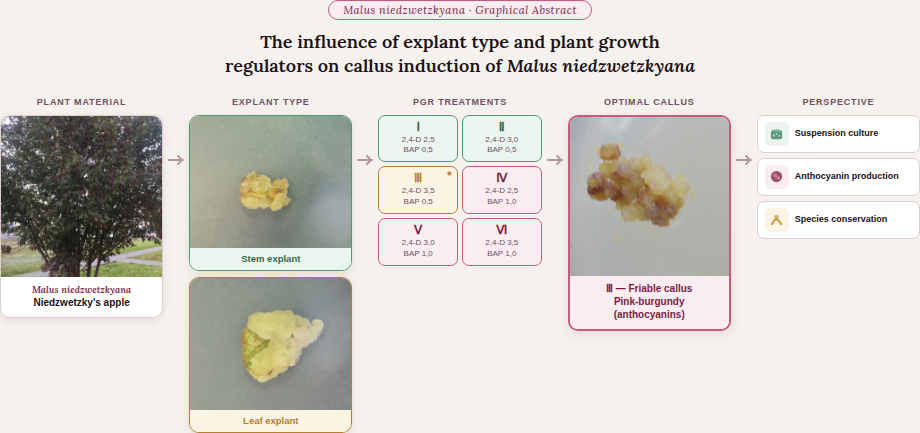
Malus niedzwetzkyana is a rare and valuable wild species characterised by a high anthocyanin content. This species is of considerable interest as a promising source of bioactive compounds. In this study, we investigated the effect of explant type on callus induction and its morphological characteristics. Stems and leaves from 40-day-old plants grown in vitro on Murashige-Skoog (MS) medium were used as explants. The results showed that stem explants demonstrated a higher ability to form callus compared to leaf explants - 100% and 86.7%, respectively. MS medium with various concentrations of 2,4-dichlorophenoxyacetic acid (2,4-D) (2.5; 3.0; 3.5 mg/l) and 6-benzylaminopurine (BAP) (0.5; 1.0 mg/l) had a significant effect on diameter, fresh and dry weight, as well as dry matter (p < 0.001). The combination of MS medium with 2,4-D at a concentration of 3.5 mg/L and BAP at 0.5 mg/L proved optimal, as it resulted in the formation of a uniform, loose callus of a pinkish burgundy colour. Thus, our results provide a basis to produce suspension cultures and the biotechnological production of biologically active substances from Malus niedzwetzkyana.
References
1 Efferth T. Biotechnology applications of plant callus cultures / T. Efferth // Engineering. — 2019. — Vol. 5, No. 1. — P. 50–59. https://doi.org/10.1016/j.eng.2018.11.006
2 Kolchenko M. Wild Malus niedzwetzkyana Dieck ex Koehne as a genetic resource for fire blight resistance / M. Kolchenko, A. Nurtaza, A. Pozharskiy, D. Dyussembekova, A. Kapytina, G. Nizamdinova, M. Khusnitdinova, A. Taskuzhina, A. Kakimzhanova, D. Gritsenko // Horticulturae. — 2023. — Vol. 9, No. 10. — P. 1066. https://doi.org/10.3390/horticulturae9101066
3 Khoo H.E. Anthocyanidins and anthocyanins: Colored pigments as food, pharmaceutical ingredients, and the potential health benefits / H.E. Khoo, A. Azlan, S.T. Tang, S.M. Lim // Food & Nutrition research. — 2017. — Vol. 61, No. 1. — P. 1361779. https://doi.org/10.1080/16546628.2017.1361779
4 Мамонов Л.К. Степень изученности видов, родов и семейств флоры Казахстана и перспективы дальнейших исследова-ний / Л.К. Мамонов, Р.А. Музычкина, Н.Г. Гемеджиева, Ю.И. Васильев, Г.Т. Ситпаева, Н.А. Рябушкина, Г.С. Муканова // Введение в фитохимические исследования и выявление биологической активности веществ растений. — Алматы, 2008. — С. 24.
5 Babich O. Evaluation of the conditions for the cultivation of callus cultures of Hyssopus officinalis regarding the yield of poly-phenolic compounds / O. Babich, S. Sukhikh, A. Pungin, L. Astahova, E. Chupakhin, D. Belova, A. Prosekov, S. Ivanova // Plants. — 2021. — Vol. 10, No. 5. — P. 915. https://doi.org/10.3390/plants10050915
6 Sidik N.J. A Mini review of plant tissue culture: the role of media optimization, growth regulators in modern agriculture, callus induction and the applications / N.J. Sidik, H.M. Agha, A.A. Alkamil, M. M.S. Alsayadi, A.A. Mohammed // AUIQ Complementary Biological System. — 2024. — Vol. 1, No. 2. — P. 96–109. https://doi.org/10.70176/3007-973X.1019
7 Osman N.I. Effects of variations in culture media and hormonal treatments upon callus induction potential in endosperm explant of Barringtonia racemosa L. / N.I. Osman, N.J. Sidik, A. Awal // Asian Pacific Journal of Tropical Biomedicine. — 2016. — Vol. 6, No. 2. — P. 143–147. https://doi.org/10.1016/j.apjtb.2015.10.007
8 Nurtaza A. Micropropagation of the endangered species Malus niedzwetzkyana for conservation biodiversity in Kazakhstan / A. Nurtaza, G. Magzumova, A. Yessimseitova, V. Karimova, A. Shevtsov, D. Silayev, V. Lutsay, Y. Ramankulov, A. Kakimzhanova // In Vitro Cellular & Developmental Biology. — 2021. — Vol. 57, No. 6. — P. 965–976. https://doi.org/10.1007/s11627-021-10174-4
9 Murashige T. (1962). A revised medium for rapid growth and bio assays with tobacco tissue cultures / T. Murashige, F. Skoog // Physiologia plantarum. — 1962. — Vol. 15, No. 3. https://doi.org/10.1111/j.1399-3054.1962.tb08052.x
10 Rahayu S. The effect of types and concentrations of auxins on callus induction of Centella asiatica / S. Rahayu, I. Roostika, N. Bermawie // Nusantara Bioscience. — 2016. — Vol. 8, No. 2. — P. 283-7. https://doi.org/10.13057/nusbiosci/n080224
11 Zhang Y. An efficient in vitro regeneration system from different wild apple (Malus sieversii) explants / Y. Zhang, T.A. Bozorov, D.X. Li, P. Zhou, X.J. Wen, Y. Ding, D.Y. Zhang // Plant Methods. — 2020. — Vol. 16, No. 1. — P. 56. https://doi.org/10.1186/s13007-020-00599-0
12 Kaňuková Š. Establishment of stem cell-like cells of Sida hermaphrodita (L.) rusby from explants containing cambial meristems / Š. Kaňuková, M. Gubišová, L. Klčová, D. Mihálik, J. Kraic // International Journal of Molecular Sciences. — 2022. — Vol. 23, No. 14. — P. 7644. https://doi.org/10.3390/ijms23147644
13 Song W. Improvement of culture conditions and plant growth regulators for in vitro callus induction and plant regeneration in Paeonia lactiflora Pall / W. Song, Y. Song, X. Liu, X. Zhang, R. Xin, S. Duan, S. Guan, X. Sun // Plants. — 2023. — Vol. 12,
No. 23. — P. 3968. https://doi.org/10.3390/plants12233968
14 Hazrati R. Factors affecting the growth, antioxidant potential, and secondary metabolites production in hazel callus cultures / R. Hazrati, N. Zare, R. Asghari-Zakaria, P. Sheikhzadeh, M. Johari-Ahar // AMB Express. — 2022. — Vol. 12, No. 1. — P. 109. https://doi.org/10.1186/s13568-022-01449-z
15 Rahmati Z. et al. Optimization of culture medium for in vitro callogenesis in Taxus baccata L. and T. berevifolia Nutt / Z. Rahmati, V. Payam Nour, K. Ghasemi Bezdi, P. Ebrahimi // Forest and Wood Products. — 2017. — Vol. 70, No. 3. — P. 381–391.
16 Guo G. Explant, medium, and plant growth regulator (PGR) affect induction and proliferation of callus in Abies koreana / G. Guo, B.R Jeong // Forests. — 2021. — Vol. 12, No. 10. — P. 1388. https://doi.org/10.3390/f12101388
17 Menbari A. Establishment of callus and cell suspension cultures of Granny Smith apple fruit and antityrosinase activity of their extracts / A. Menbari, B. Bahramnejad, M. Abuzaripoor, E. Shahmansouri, M. A. Zarei // Scientia Horticulturae. — 2021. — Vol. 286. — P. 110222. https://doi.org/10.1016/j.scienta.2021.110222