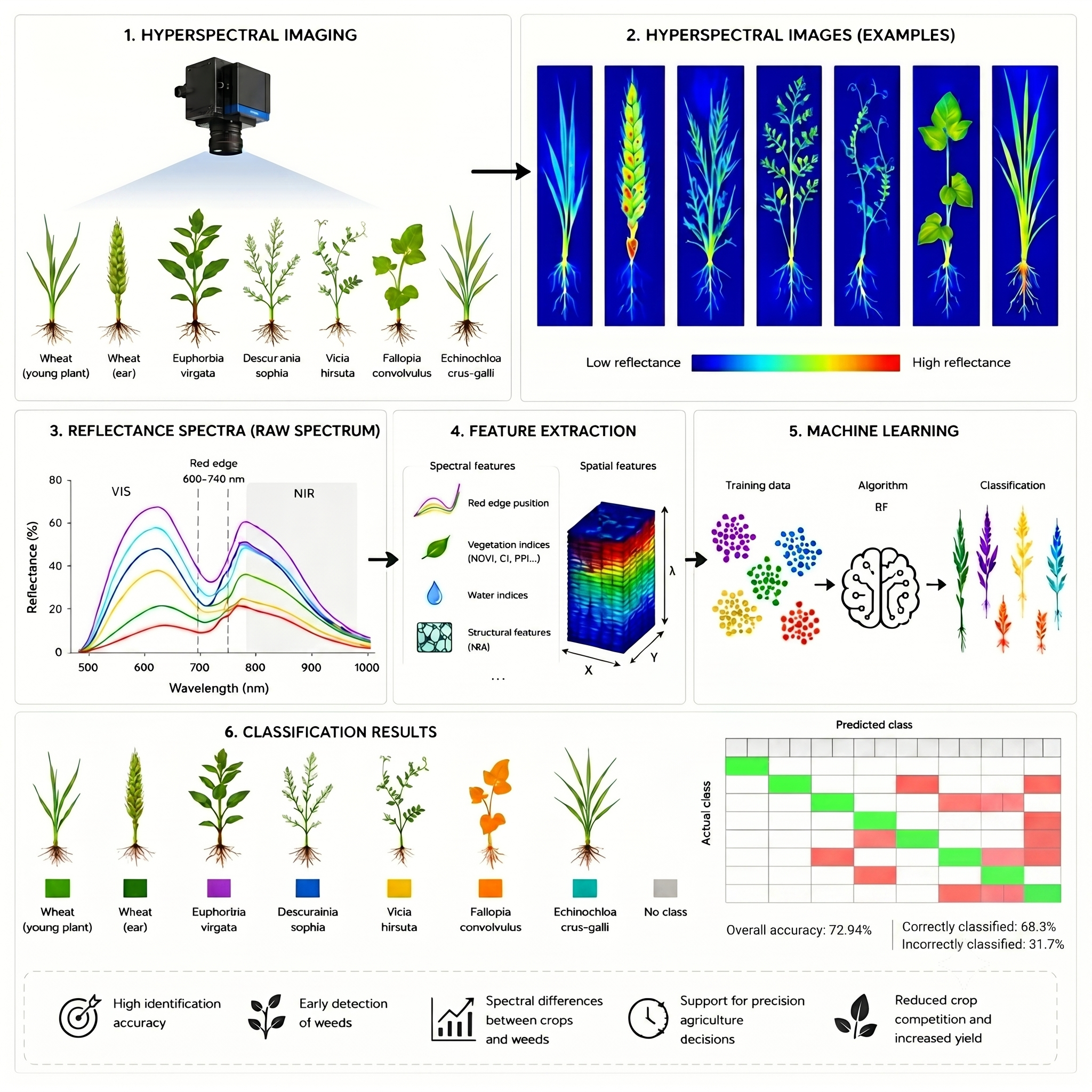
Species identification of crops and weeds in wheat fields using hyperspectral data and machine learning algorithms
DOI:
https://doi.org/10.31489/2026feb3/137-151Keywords:
hyperspectral sensing, spring wheat, weeds, machine learning, species identification, species differentiation, spectral signatures, precision agricultureAbstract
Based on establishing the relationship between the morphological and anatomical properties of plant tissues and the recognition efficiency of the machine learning algorithm, a comprehensive assessment of the limitations of ML algorithms (using Random Forest as an example) in the multiclass identification of crops and weeds in the agroecosystems of northeastern Kazakhstan was carried out for the first time. The study substantiates the principal biological causes manifested in the optical overlap of classes in the hyperspectral feature space. Data collection was performed with a hyperspectral sensor in the VIS-NIR range. The analysis of spectral profiles was carried out based on variance distribution assessment using principal component analysis and the construction of reflectance curves. Classification of the extracted data was performed using the Random Forest algorithm. Spring wheat (Triticum aestivum) crops at different phenological phases and five dominant weed species (Euphorbia virgata, Descurainia sophia, Vicia hirsuta, Fallopia convolvulus, Echinochloa crus-galli) were selected as research objects. The algorithm demonstrated "crop-weed" segregation efficiency with an overall classification accuracy on test data of 72.94%. High identification accuracy was revealed for wheat (MCC=0.994) due to its spectral stability and pronounced red edge features (680-730 nm). Reduced accuracy in intra-class weed separation is driven by species-specific anatomy: thick cuticles in Euphorbia virgata increase reflectance, complex structure in Vicia hirsuta causes spectral dispersion, and mesophyll similarity between Echinochloa crus-galli and grasses leads to optical overlap with crop features. Thus, the model enables reliable crop-weed differentiation, a key requirement for precision agriculture and targeted agrochemical application.
References
1 Kettlewell P. Wheat area expansion into northern higher latitudes and global food security / P. Kettlewell, R. Byrne, S. Jeffery // Agriculture, Ecosystems & Environment. – 2023. – Vol. 351. – P. 108499. https://doi.org/10.1016/j.agee.2023.108499
2 Gooding M.J. Wheat / M.J. Gooding // ICC Handbook of 21st Century Cereal Science and Technology. – Academic Press, 2023. – P. 121-130.
3 Mensah B. Advances in weed identification using hyperspectral imaging: A comprehensive review of platform sensors and deep learning techniques / B. Mensah, N. Rai, K. Betitame, X. Sun // Journal of Agriculture and Food Research. – 2024. – Vol. 18. – P. 101388. https://doi.org/10.1016/j.jafr.2024.101388
4 Liu T. Harnessing UAVs and deep learning for accurate grass weed detection in wheat fields: a study on biomass and yield implications / T. Liu, Y. Zhao, H. Wang, W. Wu, T. Yang, W. Zhang, S. Zhu, C. Sun, Z. Yao // Plant Methods. – 2024. – Vol. 20. https://doi.org/10.1186/s13007-024-01272-6
5 Zhang Y. Early weed identification based on deep learning: A review / Y. Zhang, M. Wang, D. Zhao, C. Liu, Z. Liu // Smart Agricultural Technology. – 2023. – Vol. 3. – P. 100123. https://doi.org/10.1016/j.atech.2022.100123
6 Che’Ya N.N. Assessment of Weed Classification Using Hyperspectral Reflectance and Optimal Multispectral UAV Imagery / N.N. Che’Ya, E. Dunwoody, M. Gupta // Agronomy. – 2021. – Vol. 11(7). – P. 1435. https://doi.org/10.3390/agronomy11071435
7 FAO (Food and Agriculture Organization of the United Nations) [Electronic resource]. – Available at: https://www.fao.org/home/en/
8 Danilov R. Identification of the Spectral Patterns of Cultivated Plants and Weeds: Hyperspectral Vegetation Indices / R. Danilov, O. Kremneva, A. Pachkin // Agronomy. – 2023. – Vol. 13(3). – P. 859. https://doi.org/10.3390/agronomy13030859
9 Pantazi X.-E. Active learning system for weed species recognition based on hyperspectral sensing / X.-E. Pantazi, D. Moshou, C. Bravo // Biosystems Engineering. – 2016. – Vol. 146. – P. 193-202. https://doi.org/10.1016/j.biosystemseng.2016.01.014
10 Rai N. Applications of deep learning in precision weed management: A review / N. Rai, Y. Zhang, B.G. Ram, L. Schumacher, R.K. Yellavajjala, S. Bajwa, X. Sun // Computers and Electronics in Agriculture. – 2023. – Vol. 206. – P. 107698. https://doi.org/10.1016/j.compag.2023.107698
11 Ronay I. Weed Species Identification: Acquisition, Feature Analysis, and Evaluation of a Hyperspectral and RGB Dataset with Labeled Data / I. Ronay, R.N. Lati, F. Kizel // Remote Sensing. – 2024. – Vol. 16(15). – P. 2808. https://doi.org/10.3390/rs16152808
12 Luo T. Classification of weed seeds based on visual images and deep learning / T. Luo, J. Zhao, Y. Gu, S. Zhang, X. Qiao, W. Tian, Y. Han // Information Processing in Agriculture. – 2023. – Vol. 10(1). – P. 40-51. https://doi.org/10.1016/j.inpa.2021.10.002
13 Vasileiou M. Transforming weed management in sustainable agriculture with artificial intelligence: A systematic literature review towards weed identification and deep learning / M. Vasileiou, L.S. Kyrgiakos, C. Kleisiari, G. Kleftodimos, G. Vlontzos, H. Belhouchette, P.M. Pardalos // Crop Protection. – 2024. – Vol. 176. – P. 106522. https://doi.org/10.1016/j.cropro.2023.106522
14 Ram B.G. A systematic review of hyperspectral imaging in precision agriculture: Analysis of its current state and future prospects / B.G. Ram, P. Oduor, C. Igathinathane, K. Howatt, X. Sun // Computers and Electronics in Agriculture. – 2024. – Vol. 222. – P. 109037. https://doi.org/10.1016/j.compag.2024.109037
15 Mishra P. Close-range hyperspectral imaging of whole plants for digital phenotyping: Recent applications and illumination correction approaches / P. Mishra, S. Lohumi, H.A. Khan, A. Nordon // Computers and Electronics in Agriculture. – 2020. – Vol. 178. – P. 105780. https://doi.org/10.1016/j.compag.2020.105780
16 Kiani S. Crop Detection and Positioning in the Field Using Discriminant Analysis and Neural Networks Based on Shape Features / S. Kiani, A. Jafari // Journal of Agricultural Science and Technology. – 2012. – Vol. 14. – P. 755-765.
17 Gutjahr C. Decision rules for site-specific weed management / C. Gutjahr, R. Gerhards // Precision Crop Protection – the Challenge and Use of Heterogeneity. – Dordrecht: Springer Netherlands, 2010. – P. 223-239. https://doi.org/10.1007/978-90-481-9277-9_14
18 Li Y. Identification of Weeds Based on Hyperspectral Imaging and Machine Learning / Y. Li, M. Al-Sarayreh, K. Irie, D. Hackell, G. Bourdot, M.M. Reis, K. Ghamkhar // Frontiers in Plant Science. – 2021. – Vol. 11. – P. 611622. https://doi.org/10.3389/fpls.2020.611622
19 Smith A.M. Weed-Crop Discrimination Using Remote Sensing: A Detached Leaf Experiment / A.M. Smith, R.E. Blackshaw // Weed Technology. – 2003. – Vol. 17(4). – P. 811-820. https://doi.org/10.1614/WT02-179
20 Liu B. Crop/Weed Discrimination Using a Field Imaging Spectrometer System / B. Liu, R. Li, H. Li, G. You, S. Yan, Q. Tong // Sensors. – 2019. – Vol. 19(23). – P. 5154. https://doi.org/10.3390/s19235154
21 Wieme J. Application of hyperspectral imaging systems and artificial intelligence for quality assessment of fruit, vegetables and mushrooms: A review / J. Wieme, K. Mollazade, I. Malounas, M. Zude-Sasse, M. Zhao, A. Gowen, D. Argyropoulos, S. Fountas, J. Van Beek// Biosystems Engineering. – 2022. – Vol. 222. – P. 156-176. https://doi.org/10.1016/j.biosystemseng.2022.07.013
22 Moghimi A. Aerial hyperspectral imagery and deep neural networks for high-throughput yield phenotyping in wheat / A. Moghimi, C. Yang, J.A. Anderson // Computers and Electronics in Agriculture. – 2020. – Vol. 172. – P. 105299. https://doi.org/10.1016/j.compag.2020.105299
23 Cheng Y. Genome-wide association study of wheat chlorophyll dynamics under drought and irrigation using multispectral UAV phenotyping / Y. Cheng, W. He, F. Zheng, F. Zhang, B. Bai, N. Sun, W. Wang, H. Geng // Frontiers in Plant Science. – 2025. – Vol. 16. – P. 1607862. https://doi.org/10.3389/fpls.2025.1607862
24 Railyan V.Ya. Red edge structure of canopy reflectance spectra of triticale / V.Ya. Railyan, R.M. Korobov // Remote Sensing of Environment. – 1993. – Vol. 46, № 2. – P. 173-182. https://doi.org/10.1016/0034-4257(93)90093-D
25 Filella I. The red edge position and shape as indicators of plant chlorophyll content, biomass and hydric status / I. Filella, J. Penuelas // International Journal of Remote Sensing. – 1994. – Vol. 15, № 7. – P. 1459-1470. https://doi.org/10.1080/01431169408954177
26 Horler D.N.H. Red edge measurements for remotely sensing plant chlorophyll content / D.N.H. Horler, M. Dockray, J. Barber, A.R. Barringer // Advances in Space Research. – 1983. – Vol. 3, № 2. – P. 273-277. https://doi.org/10.1016/0273-1177(83)90130-8
27 Mutanga O. Red edge shift and biochemical content in grass canopies / O. Mutanga, A.K. Skidmore // ISPRS Journal of Photogrammetry and Remote Sensing. – 2007. – Vol. 62, № 1. – P. 34-42. https://doi.org/10.1016/j.isprsjprs.2007.02.001
28 Clevers J.G. Remote estimation of crop and grass chlorophyll and nitrogen content using red-edge bands on Sentinel-2 and -3 / J.G. Clevers, A. Gitelson // International Journal of Applied Earth Observation and Geoinformation. – 2013. – Vol. 23. – P. 344-351. https://doi.org/10.1016/j.jag.2012.10.008