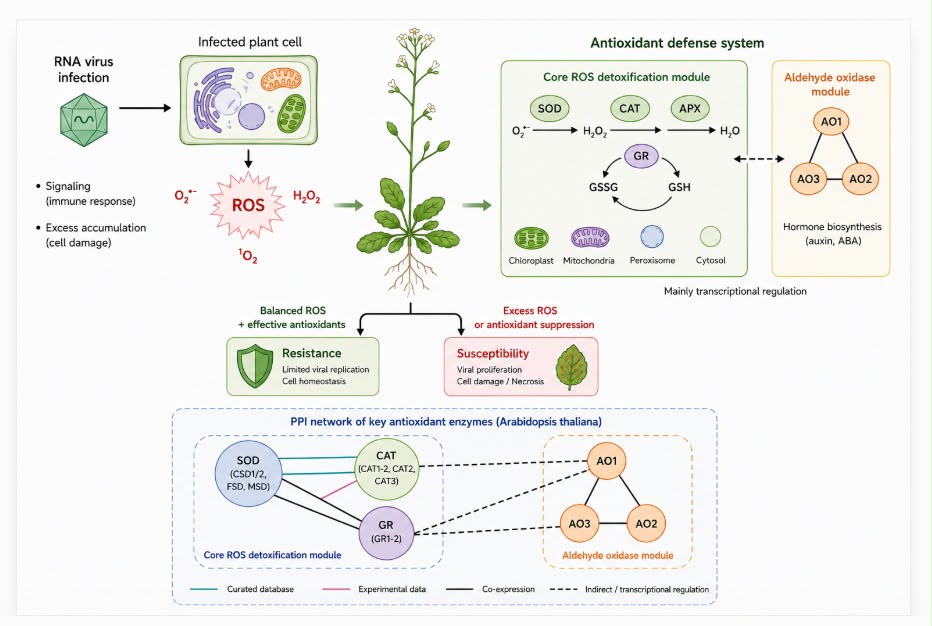
Antioxidant defense in plants during RNA virus infection: the role of key enzymes
Antioxidant defense in plants during RNA virus infection
DOI:
https://doi.org/10.31489/2026feb3/152-169Keywords:
oxidative stress, plant antioxidant system, viral infection, plant immunityAbstract
In recent decades, the problem of resistance of agricultural crops to biotic stressors has acquired particular relevance in the context of ensuring global food security. Among biotic factors, viral infections occupy a special position, causing significant yield losses and disrupting the physiological processes of plants. RNA viruses are characterized by high adaptability and the capacity to effectively modify the cellular metabolism of the host, a process accompanied by disruption of redox homeostasis. The generation of reactive oxygen species constitutes one of the key stages of this process and is characterized by functional duality, whereby reactive oxygen species act as signaling molecules that initiate defense responses, while their excessive accumulation leads to damage of cellular components. Alterations in redox homeostasis are accompanied by activation of the plant antioxidant system, which encompasses both enzymatic and non-enzymatic defense mechanisms. Despite considerable advances in the study of redox processes in plants, the integration of redox regulation mechanisms and the functioning of the antioxidant system under conditions of viral infection remains insufficiently described to date and requires further analysis. In this regard, the aim of the present review is to systematize and analyze current understanding of the role of reactive oxygen species and key enzymes of the antioxidant system in the regulation of the immune response in plants infected with RNA viruses.
References
1 Panda, S. K. & al. (2024). Functionality of reactive oxygen species (ROS) in plants: toxicity and control in poaceae crops exposed to abiotic stress. Plants, 13(15), 2071. https://doi.org/10.3390/plants13152071
2 Mittler, R. & al. (2022). Reactive oxygen species signalling in plant stress responses. Nat Rev Mol Cell Biol, 23(10), 663–679. https://doi.org/10.1038/s41580-022-00499-2
3 Chandimali, N. & al. (2025). Free radicals and their impact on health and antioxidant defenses: a review. Cell Death Discovery, 11(19). https://doi.org/10.1038/s41420-024-02278-8
4 Hasanuzzaman, M. & al. (2020). Reactive oxygen species and antioxidant defense in plants under abiotic stress: revisiting the crucial role of a universal defense regulator. Antioxidants, 9(8), 681. https://doi.org/10.3390/antiox9080681
5 Sahu, P. K. & al. (2022). ROS generated from biotic stress: Effects on plants and alleviation by endophytic microbes. Front. Plant Sci., 13, 1042936. https://doi.org/10.3389/fpls.2022.1042936
6 Xu, Y. & al. (2024). The role of reactive oxygen species in plant-virus interactions. Plant Cell Rep, 43(8), 197. https://doi.org/10.1007/s00299-024-03280-1
7 Zhang, Q. & al. (2025). Replication organelles of plant positive-strand RNA viruses: a boost in knowledge following new imaging approaches. Annual Review of Phytopathology, 63, 451–476. https://doi.org/10.1146/annurev-phyto-121823-032017
8 Nguyen-Dinh, V. & Herker, E. (2021). Ultrastructural features of membranous replication organelles induced by positive-stranded RNA viruses. Cells, 10(9), 2407. https://doi.org/10.3390/cells10092407
9 Garcia-Ruiz, H. (2018). Susceptibility genes to plant viruses. Viruses, 10(9), 484. https://doi.org/10.3390/v10090484
10 Wang, L. & al. (2019). NADPH oxidases, essential players of hormone signalings in plant development and response to stresses. Plant Signaling & Behavior, 14(10), 1657343. https://doi.org/10.1080/15592324.2019.1657343
11 Dumont, S. & Rivoal, J. (2019). Consequences of oxidative stress on plant glycolytic and respiratory metabolism. Front. Plant Sci., 10, 853. https://doi.org/10.3389/fpls.2019.00166
12 Zhou, Y. & al. (2017). Genome-wide identification and transcriptional expression analysis of cucumber superoxide dismutase (SOD) family in response to various abiotic stresses. International Journal of Genomics, 2017, 7243973. https://doi.org/10.1155/2017/7243973
13 Rajput, V. D. & al. (2015). Effects of high salinity on physiological and anatomical indices in the early stages of Populus euphratica growth. Russ J Plant Physiol, 62(2), 229–236. https://doi.org/10.1134/S1021443715020168
14 Zhou, Y. & al. (2018). Genome-wide identification of glutathione peroxidase (GPX) gene family and their response to abiotic stress in cucumber. 3 Biotech, 8(3), 159. https://doi.org/10.1007/s13205-018-1185-3
15 Jaleel, C. A. & al. (2009). Antioxidant defense responses: physiological plasticity in higher plants under abiotic constraints. Acta Physiol Plant, 31(3), 427–436. https://doi.org/10.1007/s11738-009-0275-6
16 Das, K. & Roychoudhury, A. (2014). Reactive oxygen species (ROS) and response of antioxidants as ROS-scavengers during environmental stress in plants. Front. Environ. Sci., 2, 53. https://doi.org/10.3389/fenvs.2014.00053
17 Barata-Soares, A. D. & al. (2004). Ascorbic acid biosynthesis: a precursor study on plants. Braz. J. Plant Physiol., 16, 147–154. https://doi.org/10.1590/S1677-04202004000300004
18 Sharma, P. & al. (2012). Reactive oxygen species, oxidative damage, and antioxidative defense mechanism in plants under stressful conditions. Journal of Botany, 2012, 217037. https://doi.org/10.1155/2012/217037
19 Tausz, M. & al. (2004). The glutathione system as a stress marker in plant ecophysiology: is a stress-response concept valid? J Exp Bot, 55(404), 1955–1962. https://doi.org/10.1093/jxb/erh194
20 Hasanuzzaman, M. & al. (2019). Regulation of ascorbate-glutathione pathway in mitigating oxidative damage in plants under abiotic stress. Antioxidants, 8(9), 384. https://doi.org/10.3390/antiox8090384
21 Mandal, M. & al. (2022). Reactive oxygen species (ROS) and reactive nitrogen species (RNS) in plants– maintenance of structural individuality and functional blend. Advances in Redox Research, 5, 100039. https://doi.org/10.1016/j.arres.2022.100039
22 Rodrigues de Queiroz, A. & al. (2023). The effects of exogenously applied antioxidants on plant growth and resilience. Phytochem Rev, 22(2), 407–447. https://doi.org/10.1007/s11101-023-09862-3
23 Chai, Y.-C. & Mieyal, J. J. (2023). Glutathione and glutaredoxin–key players in cellular redox homeostasis and signaling. Antioxidants, 12(8), 1553. https://doi.org/10.3390/antiox12081553
24 Havaux, M. (2014). Carotenoid oxidation products as stress signals in plants. The Plant Journal, 79(4), 597–606. https://doi.org/10.1111/tpj.12386
25 Castro, J. L. S. & al. (2018). Ascorbic acid toxicity is related to oxidative stress and enhanced by high light and knockdown of chloroplast ascorbate peroxidases in rice plants. Theor. Exp. Plant Physiol., 30(1), 41–55. https://doi.org/10.1007/s40626-018-0100-y
26 Fujiwara, A. & al. (2016). Ascorbic acid accumulates as a defense response to Turnip mosaic virus in resistant Brassica rapa cultivars. J Exp Bot, 67(14), 4391–4402. https://doi.org/10.1093/jxb/erw223
27 Otulak-Kozieł, K. & al. (2022). Glutathione modulation in PVYNTN susceptible and resistant potato plant interactions. International Journal of Molecular Sciences, 23(7), 3567. https://doi.org/10.3390/ijms23073797
28 Shukla, K. & al. (2025). Phytohormones and emerging plant growth regulators in tailoring plant immunity against viral infections. Physiologia Plantarum, 177(2), e70171. https://doi.org/10.1111/ppl.70171
29 Ighodaro, O. M. & Akinloye, O. A. (2018). First line defence antioxidants-superoxide dismutase (SOD), catalase (CAT) and glutathione peroxidase (GPX): Their fundamental role in the entire antioxidant defence grid. Alexandria Journal of Medicine, 54(4), 287–293. https://doi.org/10.1016/j.ajme.2017.09.001
30 Saxena, P. & al. (2022). Superoxide dismutase as multipotent therapeutic antioxidant enzyme: role in human diseases. Biotechnol Lett, 44(1), 1–22. https://doi.org/10.1007/s10529-021-03200-3
31 Fink, R. C. & Scandalios, J. G. (2002). Molecular evolution and structure–function relationships of the superoxide dismutase gene families in angiosperms. Archives of Biochemistry and Biophysics, 399(1), 19–36. https://doi.org/10.1006/abbi.2001.2739
32 Stephenie, S. & al. (2020). An insight on superoxide dismutase (SOD) from plants for mammalian health enhancement. Journal of Functional Foods, 68, 103917. https://doi.org/10.1016/j.jff.2020.103917
33 Dehury, B. & al. (2013). In silico analyses of superoxide dismutases (SODs) of rice (Oryza sativa L.). J. Plant Biochem. Biotechnol., 22(1), 150–156. https://doi.org/10.1007/s13562-012-0121-6
34 Leitch, J. M. & al. (2012). Post-translational modification of Cu/Zn superoxide dismutase under anaerobic conditions. Biochemistry, 51(2), 677–685. https://doi.org/10.1021/bi201353y
35 Lin, K.-Y. & al. (2022). MiR398-regulated antioxidants contribute to Bamboo mosaic virus accumulation and symptom manifestation. Plant Physiology, 188(1), 593–607. https://doi.org/10.1093/plphys/kiab451
36 Bowler, C. & al. (1992). Superoxide dismutase and stress tolerance. Annual Review of Plant Biology, 43, 83–116. https://doi.org/10.1146/annurev.pp.43.060192.000503
37 Wang, P. & al. (2024). Reactive oxygen species: Multidimensional regulators of plant adaptation to abiotic stress and development. Journal of Integrative Plant Biology, 66(3), 330–367. https://doi.org/10.1111/jipb.13601
38 Mishra, N. & al. (2023). Achieving abiotic stress tolerance in plants through antioxidative defense mechanisms. Frontiers in Plant Science, 14, 1110622. https://doi.org/10.3389/fpls.2023.1110622
39 Wang, W. & al. (2019). The catalase gene family in cotton: genome-wide characterization and bioinformatics analysis. Cells, 8(2), 86. https://doi.org/10.3390/cells8020086
40 Zandi, P., & Schnug, E. (2022). Reactive oxygen species, antioxidant responses and implications from a microbial modulation perspective. Biology, 11(2), 155. https://doi.org/10.3390/biology11020155
41 Inaba, J. & al. (2011). Virus-induced necrosis is a consequence of direct protein-protein interaction between a viral RNA-silencing suppressor and a host catalase. Plant Physiol., 156(4), 2026–2036. https://doi.org/10.1104/pp.111.180042
42 Jiao, Z. & al. (2022). Advances in research on maize lethal necrosis, a devastating viral disease. Phytopathol Res, 4(1), 14. https://doi.org/10.1186/s42483-022-00117-1
43 Kozieł, E. & al. (2024). Glutathione-the “master” antioxidant in the regulation of resistant and susceptible host-plant virus-interaction. Front. Plant Sci., 15, 1373801. https://doi.org/10.3389/fpls.2024.137380
44 Otulak-Kozieł, K. & al. (2023). Glutathione contribution in interactions between Turnip mosaic virus and Arabidopsis thaliana mutants lacking respiratory burst oxidase homologs D and F. International Journal of Molecular Sciences, 24(8), 7128. https://doi.org/10.3390/ijms24087128
45 Sofy, A. R. & al. (2020). Improving regulation of enzymatic and non-enzymatic antioxidants and stress-related gene stimulation in Cucumber mosaic cucumovirus-infected cucumber plants treated with glycine betaine, chitosan and combination. Molecules, 25(10), 2341. https://doi.org/10.3390/molecules25102341
46 Otulak-Kozieł, K. & al. (2022). AtGSTU19 and AtGSTU24 as moderators of the response of Arabidopsis thaliana to Turnip mosaic virus. International Journal of Molecular Sciences, 23(19), 11531. https://doi.org/10.3390/ijms231911531
47 Sharma, N. & al. (2021). Genomic dissection of ROS detoxifying enzyme encoding genes for their role in antioxidative defense mechanism against Tomato leaf curl New Delhi virus. Genomics, 113(3), 889–899. https://doi.org/10.1016/j.ygeno.2021.01.022
48 Seo, M. & al. (1998). Higher activity of an aldehyde oxidase in the auxin-overproducing superroot1 mutant of Arabidopsis thaliana. Plant Physiol., 116(2), 687–693. https://doi.org/10.1104/pp.116.2.687
49 Koshiba, T. & al. (1996). Purification and properties of flavin- and molybdenum-containing aldehyde oxidase from coleoptiles of maize. Plant Physiol., 110(3), 781–789. https://doi.org/10.1104/pp.110.3.781
50 Jiao, Z. & al. (2022). Advances in research on maize lethal necrosis, a devastating viral disease. Phytopathol Res, 4(1), 14. https://doi.org/10.1186/s42483-022-00117-1
51 Ori, N. & al. (1997). TAO1, a representative of the molybdenum cofactor containing hydroxylases from tomato. Journal of Biological Chemistry, 272(2), 1019–1025. https://doi.org/10.1016/S0021-9258(19)77568-1
52 Srivastava, S. & al. (2017). Aldehyde oxidase 4 plays a critical role in delaying silique senescence by catalyzing aldehyde detoxification. Plant Physiology, 173(4), 1977–1997. https://doi.org/10.1104/pp.16.01939
53 Apel, K. & Hirt, H. (2004). Reactive oxygen species: metabolism, oxidative stress, and signal transduction. Annual Review of Plant Biology, 55, 373–399. https://doi.org/10.1146/annurev.arplant.55.031903.141701
54 Verchot, J. (2011). Wrapping membranes around plant virus infection. Current Opinion in Virology, 1(5), 388–395. https://doi.org/10.1016/j.coviro.2011.09.009
55 Schoelz, J. E. & al. (2011). Intracellular Transport of Plant Viruses: Finding the Door out of the Cell. Molecular Plant, 4(5), 813–831. https://doi.org/10.1093/mp/ssr070
56 Keurentjes, J. J. B. & al. (2011). Redefining plant systems biology: from cell to ecosystem. Trends in Plant Science, 16(4), 183–190. https://doi.org/10.1016/j.tplants.2010.12.002
57 Gill, S. S. & Tuteja, N. (2010). Reactive oxygen species and antioxidant machinery in abiotic stress tolerance in crop plants. Plant Physiology and Biochemistry, 48(12), 909–930. https://doi.org/10.1016/j.plaphy.2010.08.016