Search for promising medicinal plants of the Rosaceae family in the flora of the Mangistau Region
DOI:
https://doi.org/10.31489/2026feb2/215-222Keywords:
Rosaceae family, medicinal plants, summary, life forms, ecological groups, distribution, potential for medical useAbstract
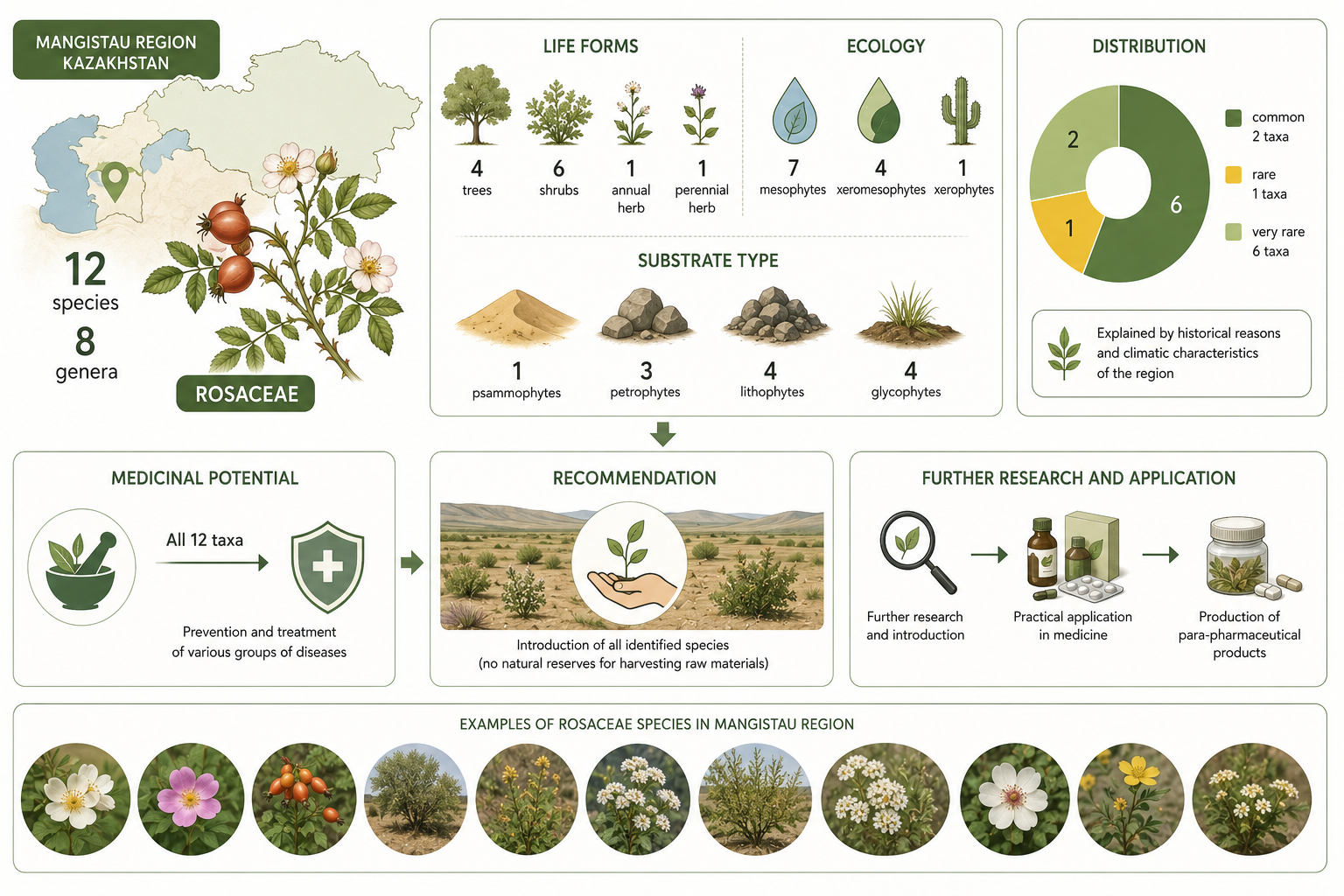
The study of medicinal plants in the regions of Kazakhstan is of great importance for the search for new sources of medicinal raw materials. The Mangistau Region is the least studied area in Kazakhstan in terms of the potential and raw material resources of medicinal plants. As part of this work, research was conducted to assess the potential for the use of members of the Rosaceae family for medicinal purposes. Twelve species of the Rosaceae family from 8 genera were identified growing in the Mangistau Region. Among the life forms, trees (4), shrubs (6), annual (1), and perennial (1) herbs were identified. In terms of ecology, the species were classified as mesophytes (7), xeromesophytes (4), and xerophytes (1); in terms of substrate type, they were classified as psammophytes (1), petrophytes (3), lithophytes (4), and glycophytes (4). The distribution of representatives of this family is ranked as follows: common - 2 taxa, rare - 1, very rare - 6. This situation can be explained by historical reasons and the climatic characteristics of the region. The potential for the medical use of all 12 taxa in the prevention and treatment of various groups of diseases has been established. The introduction of all identified species of this family is recommended, as there are no natural reserves for harvesting raw materials. The data obtained allow for planning further research on their introduction and practical application in medicine and for the production of para-pharmaceutical products
References
1 Bentley R. Medicinal plants / R. Bentley. — London: Domville-Fife Press, 2010. — P. 23–46.
2 Chen S. -L. Conservation and sustainable use of medicinal plants: problems. progress, and prospects / S.-L. Chen, H. Yu, H.-V. Luo, Q. Wu, C.-F. Li, A. Steinmetz // Chinese Medicine. — 2016. — Vol. 11. — Article ID 37. https://doi.org/10.1186/s13020-016-0166-7 DOI: https://doi.org/10.1186/s13020-016-0108-7
3 Coley P.D. Using ecological criteria to design plant collection strategies for drug discovery / P.D. Coley, M.V. Heller, R. Aizprua, B. Arauz, N. Flores, M. Correa, M. Gupta, P.N. Solis, E. Ortega-Barría, L.I. Romero, B. Gómez, M. Ramos, L. Cubilla-Rios, T.L. Capson, T.A. Kursar // Front Ecol Environ. — 2003. — Vol. 1. — P. 421–428. DOI: https://doi.org/10.1890/1540-9295(2003)001[0421:UECTDP]2.0.CO;2
4 Монография ВОЗ о лекарственных растениях, широко используемых в новых независимых государствах. — Швейцария: ВОЗ, 2010. — 464 с.
5 Li D.Z. The science and economics of ex situ plant conservation / D.Z. Li, H.W. Pritchard // Trends Plant Sci. — 2009. — Vol. 14. — P. 614–621. DOI: https://doi.org/10.1016/j.tplants.2009.09.005
6 Panagos P. Towards estimates of future rainfall erosivity in Europe based on REDES and WorldClim datasets / P. Panagos, C. Ballabio, K. Meusburger et al. // Journal of Hydrology. — 2017. — Vol. 548. — P. 251–262. https://doi.org/10.1016/j.jhydrol.2017.03.006 DOI: https://doi.org/10.1016/j.jhydrol.2017.03.006
7 Badahar B. Medicinal plants: an overview / B. Badahar, K.J. Reddy, M.L.B. Rao // In Book Advances in Medicinal plants. — Chennai, India, 2020. — P. 1–51.
8 Havens K. Ex situ plant conservation and beyond / K. Havens, P. Vitt, M. Maunder, E.O. Guerrant, K. Dixon // Bioscience. — 2006. — Vol. 56. — P. 525–531. DOI: https://doi.org/10.1641/0006-3568(2006)56[525:ESPCAB]2.0.CO;2
9 Иманбаева А.А. Сосудистые растения Мангистауской области (конспект флоры, анализ и ДНК-баркодирование): монография / А.А. Иманбаева, Н.И. Дуйсенова, Ш.А. Манабаева, А.А. Какимжанова, И.Ф. Белозеров, Ж.К. Мусаева, Г.Г. Гасанова, А.Б. Лукманов, Г.Т. Бпекбосын, Г.Ж. Бастаев, К.С. Бекесов, А.Б. Шевцов. — Астана: Центр Элит, 2024. — 420 с.
10 Plants of the World Online (POWO). — [Electronic resource]. — Access mode: https://powo.science.kew.org/ 11 Куминова А.В. Растительный покров Алтая / А.В. Куминова. — Барнаул, 1960. — 451 с.
12 Грудзинская Л.М. Аннотированный список лекарственных растений Казахстана / Л.М. Грудзинская, Н.Г. Гемеджиева, Н.В. Нелина, Ж.Ж. Каржаубекова. — Алматы, 2014.– 220 с.
13 Растительные ресурсы России. Дикорастущие цветковые растения, их компонентный состав и биологическая активность. ТТ. 1–8. — Санкт-Петербург: БИН, 2008–2014.
14 Ишонкулова Д.У. Полезные свойства абрикоса / Д.У. Ишонкулова, А.Р. Равшанова // European Researcher. — 2019. — № 1. — С. 8–10.
15 Кароматов И.Д. Химический состав и лечебные свойства боярышника /И.Д. Кароматов, Н.А. Жалилов // Биология и интегративная медицина. — 2019. — № 1(29). — С. 109–141.
16 Муродова М.М. Яблоки — лечебное и профилактическое средство / М.М. Муродова, И.Д. Кароматов // Биология и интегративная медицина. — 2018. — № 1(18). — С. 119–129.
17 Сергалиева М.У. Фармакотерапевтический потенциал растений рода Potentilla / М.У. Сергалиева, В.Х. Мурталиева, М.А. Самотруева // Вопросы биологической, медицинской и фармацевтической химии. — 2024. — Т. 27, № 8. — С. 3–12. https://doi.org/10.29296/25877313- 2024-08-01
18 Костикова В.А. Биологически активные вещества и антиоксидантная активность растений рода Spiraea L. Дальнего Востока России / В.А. Костикова, Т.М. Шалдаева // Химия растительного сырья. — 2016. — № 2. — С. 73–78. https://doi.org/10.14258/jcprm.201602784 DOI: https://doi.org/10.14258/jcprm.201602784
19 Сафронова И.Н. Пустыни Мангышлака (очерк растительности) / И.Н. Сафронова // Труды БИН им. Л.В. Комарова. — 1996. — Т. 18. — 240 с.
20 Бименьиндавьи Э. Влияние эколого-географических условий на содержание биологически активных веществ лекарственных растений: дисс. ... канд. биол. наук / Э. Бименьиндавьи. — Казань, 2024. — 162 с.
21 Ендонова Г.Б. Динамика накопления суммы флавоноидов в скабиозе венечной и скабиозе бледно-желтой в зависимости от местообитания / Г.Б. Ендонова, Т.П. Анцупова // Пищевые продукты и здоровое питание: Сборник тезисов ежегодной аспирантско-студенческой конференции. — Кемерово, 2002. — С. 16.