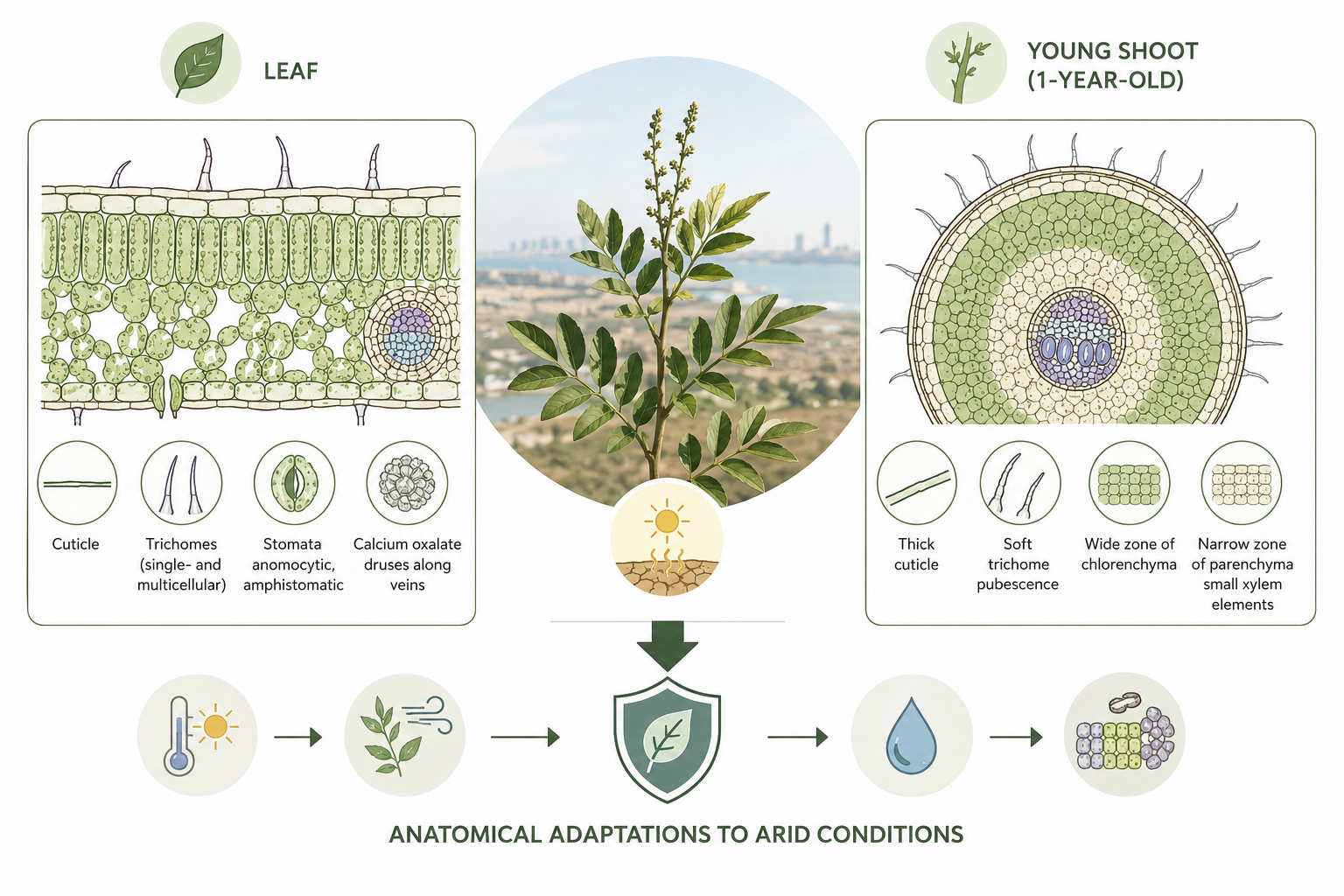
Anatomical structure of the leaves and shoots of Sophora japonica grown under cultivation in Aktau (Mangistau Region)
DOI:
https://doi.org/10.31489/2026feb2/208-214Keywords:
Sophora japonica, shoot, leaf, subtropical plant, anatomical study, Hedysarum gmelinii, morphological and anatomical structure, aboveground and underground organs, diagnostic signs, adaptation to arid climateAbstract
Selecting an adaptive plant assortment under conditions of global climate change and increasing aridification is a critical task for modern botanical science. The objective of this study was to evaluate the anatomical structure of young shoots and leaves of Sophora japonica to assess their adaptability to the arid conditions of the city of Aktau. Plant samples grown in the Mangyshlak Experimental Botanical Garden were collected for the study. Leaves and shoots were fixed, examined using a freezing microtome, and subsequently described in terms of their anatomical structure, with measurements taken of individual tissues. The results revealed that the leaf of Sophora japonica is of the light-type, with a clear division of the mesophyll into palisade and spongy tissues, the presence of a cuticle, and single- and multicellular trichomes on the epidermis; the stomata are of the anomocytic type, and based on their arrangement, the leaf is of the amphistomatic type. The mesophyll contains numerous calcium oxalate druses, localized primarily along the leaf veins. One-year-old shoots have a secondary anatomical structure, featuring a wide zone of chlorenchyma and a narrow zone of parenchyma. Xylem elements are small. The shoot epidermis exhibits a significant cuticle layer and soft trichome pubescence. This set of microscopic characteristics confirms the species’ adaptation to the arid conditions of the city of Aktau
References
1 Bellard, C., Bertelsmeier, C., Leadley, P., Thuiller, W., & Courchamp, F. (2012). Impacts of climate change on the future of biodiversity. Ecology Letters, 15, 365–377. DOI: 10.1111/j.1461-0248.2011.01736x DOI: https://doi.org/10.1111/j.1461-0248.2011.01736.x
2 Borisov, A.V., Alekseev, A.O., Demkina, T.S., Eltsov, M.V., Kalinin, P.I., Alekseeva, T.V., & Khomutova, T.E. (2010). Climate Dynamics and the History of Soil Formation in the Steppe Zone of Eastern Europe in the Holocene. Paleontological Journal, 54(8), 862–871. DOI: https://doi.org/10.1134/S0031030120080067
3 Zhong, L., Ma, Y.M., Salama, M.S., & So, Z. (2010). Assessment of vegetation dynamics and their response to variations in precipitation and temperature in the Tibetan Plateau. Climatic Change, 103, 3–4, 519–535. DOI: https://doi.org/10.1007/s10584-009-9787-8
4 (2019). Intergovernmental Science-Policy Platform on Biodiversity and Ecosystem Services (IPBES). Global Assessment Report on Biodiversity and Ecosystem Services. Retrieved from https://files.ipbes.net/ipbes-web-prod-public files/americas_assessment_en.pdf
5 (2022). World Wide Fund for Nature (WWF). Living Planet Report. Retrieved from https://wwfint.awsassets.panda.org/downloads/embargo_13_10_2022_lpr_2022_full_report_single_page_1.pdf
6 (2026). Climate Change in Asian Regions. www.unep.org. Retrieved from https://www.unep.org/ru/novosti-i-istorii/pressreliz/izmenenie-klimata-privodit-k-povysheniyu-temperatury-i-silnoy-zasukhe
7 Mishra, S., & Krska, B. (2009). Temperature as a basic factor influencing phenological stages in Zizyphus jujuba Mill. Acta Univ. Agric. Silvicult. Mendeliane Brunensins, 57(1), 89–95. DOI: https://doi.org/10.11118/actaun200957010089
8 Quero, J.L., Villar, R., Marañón, T., & Zamora, R. (2006). Interactions of drought and shade effects on seedlings of four Quercus species: physiological and structural leaf responses. New Phytologist, 170(4), 19–34. DOI: 10.1111/J.1469-8137.2006.01713 DOI: https://doi.org/10.1111/j.1469-8137.2006.01713.x
9 (1998). Botanical Microtechnique: a Handbook of Methods of Preparation, Staining, and of Microscopical Investigation of Vegetable Structures. Nature, 57; 340. DOI: 10.1038/057340c0 DOI: https://doi.org/10.1038/057340c0
10 Land, W.J.G. (2016). Botanical Microtechnique. Botanical Gazette, 61(5), 448. DOI: https://doi.org/10.1086/331813
11 Crang, R., Lyons-Sobaski, S., & Wise, R. (2018). Plant Anatomy: A Concept-Based Approach to the Structure of Seed Plants. Textbook. Springer. DOI: https://doi.org/10.1007/978-3-319-77315-5
12 Cutler, D.F., Botha, T., & Stevenson, D.W. (2008). Plant Anatomy: An Applied Approach. Wiley-Blackwell.