Invasive plant species in the flora of the Karaganda region
DOI:
https://doi.org/10.31489/2026feb2/178-184Keywords:
invasive species, Karaganda region, dispersal method, degree of distribution, time of dispersal, degree of naturalizationAbstract
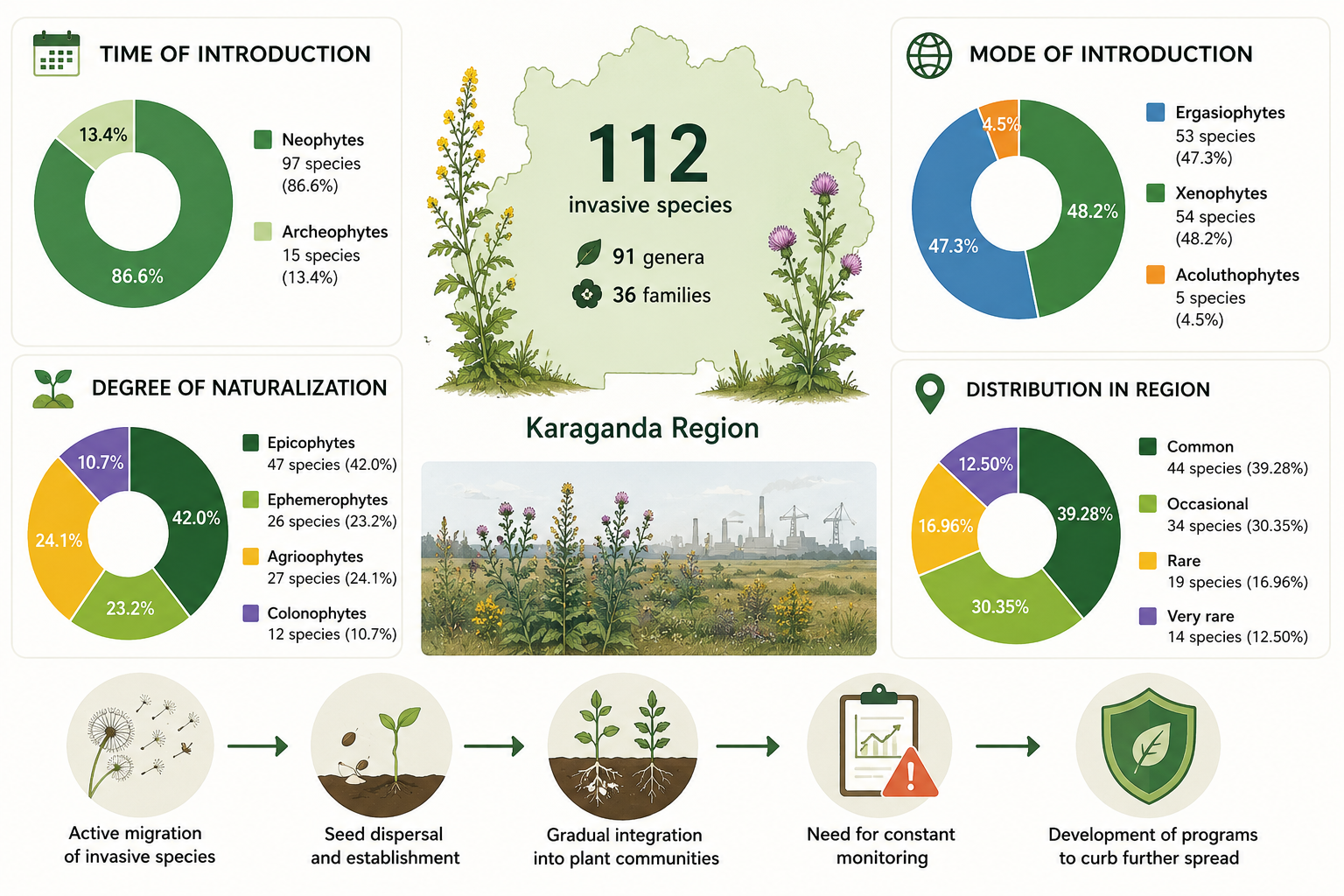
Studying the invasive flora of regions is an important task for preserving biological diversity and monitoring the possible further spread of these taxa. The aim of this study was to compile a list of invasive vascular plant species in the Karaganda region and to characterize them according to their distribution, degree and mode of introduction, and degree of naturalization in this region. The results of the study showed that 112 invasive species from 91 genera and 36 families were identified in the region. In terms of the time of introduction, neophytes predominate in the Karaganda Region—97 species, or 86.6%. Archeophytes account for a smaller share—15 taxa (13.4%). By mode of introduction, the following were identified: ergasiophytes (53 species, or 47.3%), xenophytes (54 species, or 48.2%), and acoluthophytes (5 species, or 4.5%). Based on naturalization mode, the following were identified: epicophytes (47 species or 42.0%), ephemerophytes (26 species or 23.2%), agrioophytes (27 species or 24.1%), and colonophytes (12 species or 10.7%). In terms of distribution, invasive species were classified as follows: occasional – 34 taxa (30.35%); common – 44 taxa (39.28%); very rare – 14 taxa (12.50%); rare – 19 taxa (16.96%). The data obtained reflect active migration processes involving the dispersal of seeds of invasive species and their gradual integration into local plant communities. The active naturalization and prevalence of many taxa require constant monitoring and the development of programs to curb their further spread in the Karaganda region.
References
1 Bradley, B. A., Blumenthal, D. M., Wilcove, D. S., & Ziska, L. H. (2010). Predicting plant invasions in an era of global change. Trends in Ecology and Evolution, 25, 310–318., https://doi.org/10.1016/j.tree.2009.12.003 DOI: https://doi.org/10.1016/j.tree.2009.12.003
2 Crowl, T. A., Crist, T. O., Parmenter, R. R., Belovsky, G., & Lugo, A. E. (2008). The spread of invasive species and infectious disease as drivers of ecosystem change. Frontiers in Ecology and the Environment., 6; 238–246. https://doi.org/10.1890/070151 DOI: https://doi.org/10.1890/070151
3 Callaway, R.M. & Ridenour, W.M. (2004). Novel weapons: invasive success and the evolution of increased competitive ability. Frontiers in Ecology, 2(8); 436–443. https://doi.org/10.1890/1540-9295(2004)002[0436:NWISAT]2.0.CO;2
4 Chytrý, M., Schaminée, J.H.J., & Schwabe, A. (2011). Vegetation survey: a new focus for Applied Vegetation Science. Applied Vegetation Science, 14(4); 435–439. https://doi.org/10.1111/j.1654-109X.2011.01154.x DOI: https://doi.org/10.1111/j.1654-109X.2011.01154.x
5 (2026). Plants of the World Online (POWO). Online resource. Available at: https://powo.science.kew.org/
6 Gnatyuk, E.P. & Kryshen, A.M. (2005). Methods for investigating coenofloras (example of plant communities in harvested forest areas in Karelia). Petrozavodsk: Karelian Research Centre of the Russian Academy of Sciences.
7 Dai, Z.C., Wan, L.Y., Qi, S.S. et al. (2020). Synergy among hypotheses in the invasion process of alien plants: a road map within a timeline. Perspectives in Plant Ecology, Evolution and Systematics, 10; 125575. https://doi.org/10.1016/j.ppees.2020.125575 DOI: https://doi.org/10.1016/j.ppees.2020.125575
8 Dufrene, M. & Legendre, P. (1997). Species assemblages and indicator species: the need for a flexible asymmetrical approach. Ecological Monographs, 67(3); 345–366. DOI: https://doi.org/10.1890/0012-9615(1997)067[0345:SAAIST]2.0.CO;2
9 Gaertner, M., Biggs, R., Te Beest, M., Hui, C., Molofsky, J. & Richardson, D. M. (2014). Invasive plants as drivers of regime shifts: identifying high priority invaders that alter feedback relationships. Diversity and Distributions, 20; 733–744. https://doi.org/10.1111/ddi.12182 DOI: https://doi.org/10.1111/ddi.12182