Cryopreservation of Filipendula ulmaria Seed Material
DOI:
https://doi.org/10.31489/2026feb2/185-191Keywords:
Filipendula ulmaria, seed material, cryopreservation, seed germination, germination energy, freezing-thawing regimenAbstract
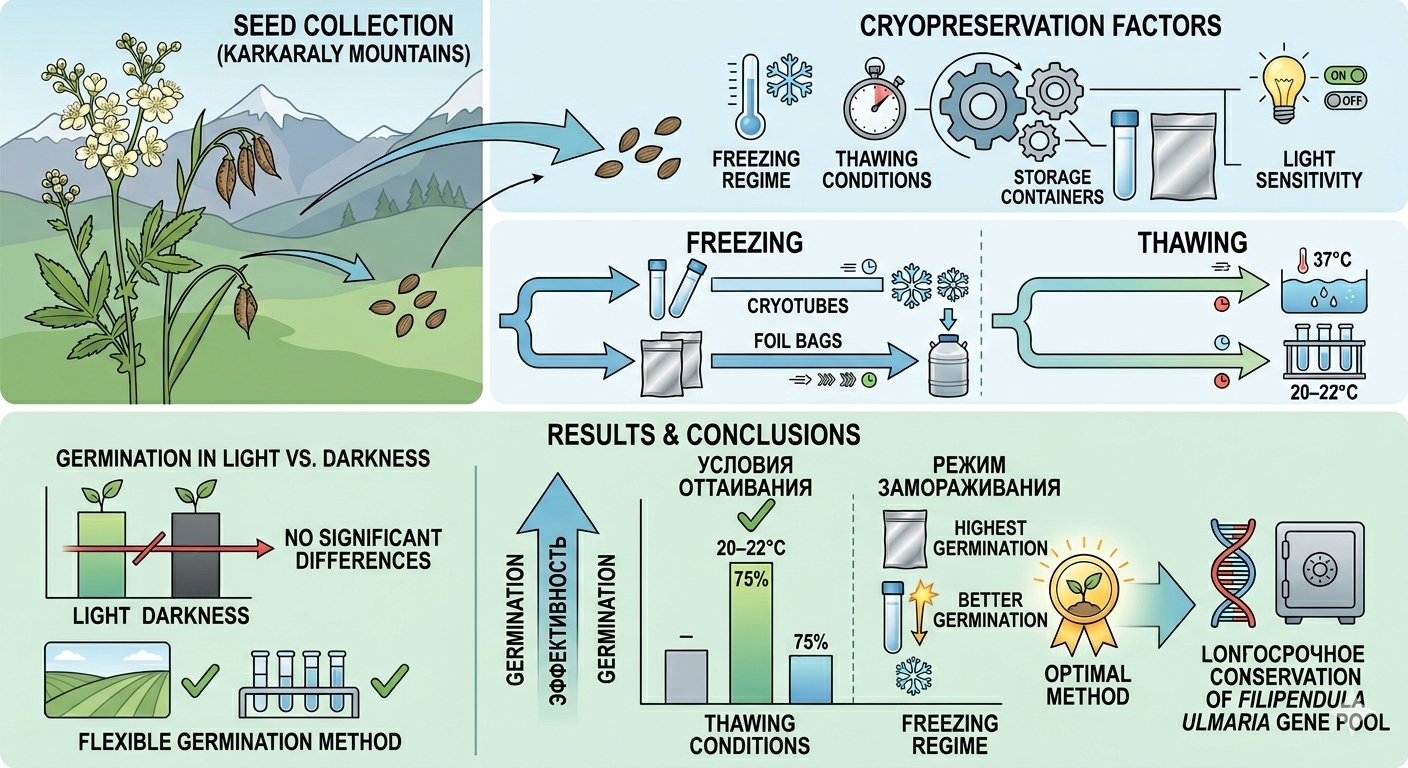
Cryopreservation of plant seeds is of great practical importance for the conservation of biodiversity and practical application. The aim of this study was to evaluate the factors determining the success of cryopreservation of Filipendula ulmaria seeds, including the freezing method, thawing conditions, storage containers, and light sensitivity. Seed material was collected in the wild in the Karkaraly Mountains. Seeds were cryopreserved in cryotubes and aluminum foil bags; seeds stored using traditional methods in a refrigerator served as controls. The results showed no significant differences between germination in light and in darkness, which does not dictate the method of germination in open ground or laboratory conditions. A comparison of thawing regimes revealed the advantage of slow thawing at room temperature (20–22°C), during which germination reached 75%, which was significantly higher than the control values. Analysis of freezing regimes allowed us to establish the highest germination rates with rapid freezing in foil bags. The proposed approach can be used for long-term cryopreservation of the Filipendula ulmaria gene pool.
References
1 Nakum, P., Singh, B., & Solanki, H. (2025). The significance of seed banks: A review of techniques and technologies. World Journal of Advanced Research and Reviews, 25(02), 2401–2407. https://doi.org/10.30574/wjarr.2025.25.2.0573 DOI: https://doi.org/10.30574/wjarr.2025.25.2.0573
2 Wambugu, P.W., Nyamongo, D.O., & Kirwa, E.C. (2023). Role of Seed Banks in Supporting Ecosystem and Biodiversity Conservation and Restoration. Diversity, 15(8), 896. https://doi.org/10.3390/d15080896 DOI: https://doi.org/10.3390/d15080896
3 Zeng, L., Sun, Z., Fu, L., Gu, Y., Li, R., He, M., & Wei, J. (2024). Cryopreservation of Medicinal Plant Seeds: Strategies for Genetic Diversity Conservation and Sustainability. Plants, 13(18), 2577. https://doi.org/10.3390/plants13182577 DOI: https://doi.org/10.3390/plants13182577
4 Pavlov, A.V., Porokhovinova, E.A., Pavlov, A.V., Kiseleva, I.V., & Brutch, N.B. (2026). The Influence of Cryopreservation and Low-Temperature Seed Storage on the Morphological and Agronomical Characteristics of Fiber Flax. Plants, 15(4), 602. https://doi.org/10.3390/plants15040602 DOI: https://doi.org/10.3390/plants15040602
5 Ishmuratova, M., Tleukenova, S., Ramazanov, A., Gavrilkova, E., & Ageev, D. (2021). Study of cryopreservation conditions
for seed materials of Chartolepis intermedia Boiss. Bio Web of Conferences — Northern Asia Plant Diversity, 38, 00046. https://doi.org/10.1051/bioconf/20213800046 DOI: https://doi.org/10.1051/bioconf/20213800046
6 Ren, R., Zhe, J., Guo, J., & Yang, X. (2023). Cryopreservation of herbaceous Asteraceae seeds: effects of seed reserves on seed germination and seedling regrowth. Cryobiology, 112, 104562. https://doi.org/10.1016/j.cryobiol.2023.104562 DOI: https://doi.org/10.1016/j.cryobiol.2023.104562
7 Kholina, A.B., & Voronkova, N.M. (2012). Seed cryopreservation of some medicinal legumes. Journal of Botany, 2012(1), 186891. https://doi.org/10.1155/2012/186891 DOI: https://doi.org/10.1155/2012/186891
8 Ghaffarzadeh-Namazi1, L., Babaeian, N., Ghamari-zare, A., & Nematzadeh, G.H. (2015). Cryopreservation of the seeds of the medicinal plant Satureja bachtiarica Bunge. Int J Biosci., 6(2), 24–29. https://dx.doi.org/10.12692/ijb/6.2.24-29 DOI: https://doi.org/10.12692/ijb/6.2.24-29
9 Farzaneh, A., Hadjiakhoondi, A., Khanavi, M., Manayi, A., Bahram Soltani, R., & Kalkhorani, M. (2021). Filipendula ulmaria (L.) Maxim. (meadowsweet): a review of traditional uses, phytochemistry and pharmacology. Research J Pharmacognosy, 9(3), 85–106. https://doi.org/10.22127/rjp.2021.302028.1781
10 Andonova, T., Muhovski, Y., Apostolova, E., Naimov, S., Mladenova, S., Slavov, I., Dincheva, I., Georgiev, V., Pavlov, A., & Dimitrova-Dyulgerova, I. (2024). DNA-Protective, Antioxidant, and Anti-Carcinogenic Potential of Meadowsweet (Filipendula ulmaria) Dry Tincture. Antioxidants, 13(10), 1200. https://doi.org/10.3390/antiox13101200 DOI: https://doi.org/10.3390/antiox13101200
11 Samardzic, S., Arsenijevic, J., Bozic, D., Milenkovic, M., Tesevic, V., & Maksimovic, Z. (2017). Antioxidant, antiinflammatory, and gastroprotective activity of Filipendula ulmaria (L.) Maxim. and Filipendula vulgaris Moench. Journal of Ethnopharm., 213, 132–137. https://doi.org/10.1026/j.jep.2017.11.013 DOI: https://doi.org/10.1016/j.jep.2017.11.013
12 Sharma, M., Kumar, P., & Dwivedi, P. (2023). Artificial seed production and cryopreservation technology for conservation of plant germplasm with special reference to medicinal plants. Medicinal Plants: Biodiversity, Biotechnology and Conservation, 33, 581–593. Springer. DOI: https://doi.org/10.1007/978-981-19-9936-9_21
13 Reed B.M. (2008). Plant cryopreservation: a practical guide. Springer Science and Business Media, USA. DOI: https://doi.org/10.1007/978-0-387-72276-4
14 Shri, K.K., Pavithra A., Pazhamalai, V., Meenambiga, S.S., & Romauld, S.I. (2025). Plant genetic resources conservation by cryopreservation. In Biotechnology in Plant Conservation. Springer.
15 Hegde, R.B., Kudva, V., & Nayak, S. (2025). Advanced techniques for seed quality assessment and germination monitoring. Discov Appl Sci., 690 (2025). https://doi.org/10.1007/s42452-025-07284-8 DOI: https://doi.org/10.1007/s42452-025-07284-8
16 Prasad, S.R. (2023). Testing seed for quality. In the book Seed Science and Technology, 2023, 299–334. https://doi.org/10.1007/978-981-19-5888-5_13 DOI: https://doi.org/10.1007/978-981-19-5888-5_13