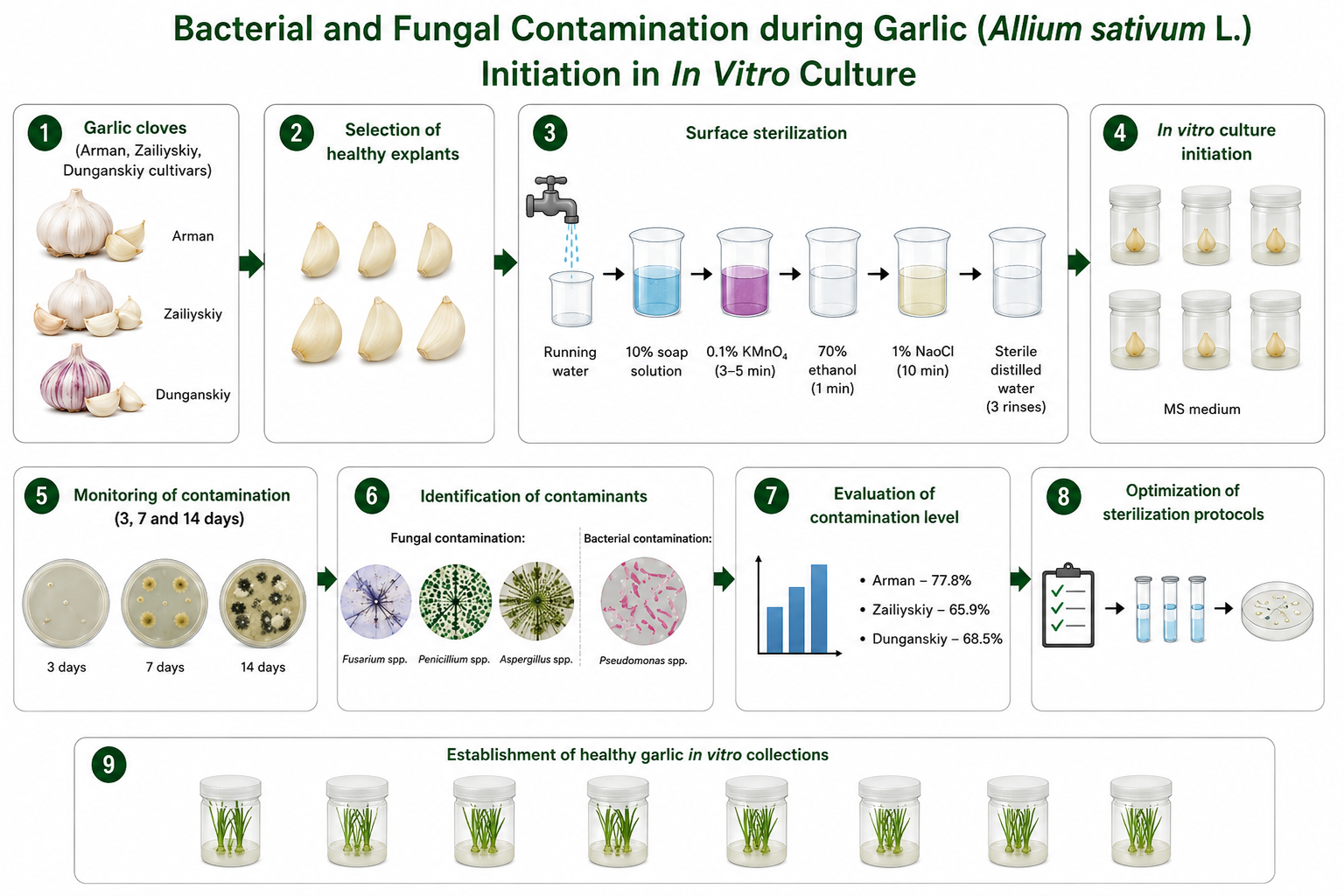
Bacterial and Fungal Contamination during Garlic (Allium sativum L.) Initiation in In Vitro Culture
Problems of bacterial and fungal contamination during the introduction of garlic (Allium sativum l.) Into in vitroculture
DOI:
https://doi.org/10.31489/2026feb3/94-102Keywords:
garlic, Allium sativum L., in vitro, microbial contamination, explants, Fusarium, PenicilliumAbstract
The present study investigated bacterial and fungal contamination occurring during the establishment of garlic (Allium sativum L.) in vitro cultures. The aim of the study was to assess the level of contamination in explants and evaluate the effectiveness of standard surface sterilization protocols. The scientific novelty of the study lies in the first comprehensive assessment in Kazakhstan of bacterial and fungal contamination occurring during the establishment of garlic in vitro cultures. The experiments demonstrated that conventional sterilization methods, including ethanol and disinfectant treatments, did not ensure complete decontamination of the plant material. Consequently, microbial contamination was observed at the early stages of cultivation, resulting in partial or complete necrosis of explants and reduced efficiency of micropropagation. The degree of contamination varied among garlic cultivars, suggesting an influence of genotype and the physiological condition of the donor plants. Microscopic analysis indicated the predominance of fungal morphotypes consistent with genera such as Fusarium, Penicillium, and Aspergillus, as well as the presence of diverse bacterial microflora. However, accurate taxonomic identification of the contaminants requires further molecular genetic analysis. The results demonstrate that microbial contamination remains a critical limiting factor for the successful establishment of garlic in vitro cultures. Therefore, improved pre-treatment of plant material, optimization of sterilization protocols, and refinement of culture conditions are required. The practical significance of the study lies in the development of more effective approaches to reducing contamination, thereby increasing the success rate of micropropagation and facilitating the establishment of healthy in vitro collections.
References
1 Середин Т.М. Распространение и вредоносность микозов на культуре чеснока озимого в условиях Московской области / Т.М. Середин, Л.И. Герасимова, Е.Г. Козарь, И.А. Енгалычева, Е.В. Баранова // Овощи России. — 2018. — № 6. — С. 84–90. DOI: 10.18619/2072-9146-2018-6-84-90.
2 Шестакова К.С. Селекционно-иммунологическая характеристика устойчивости чеснока озимого (Allium sativum L.) к фузариозным гнилям: автореф. дис. канд. с. -х. наук / К.С. Шестокова. — М., 2009. — 23 с.
3 Cremer J. Detection and distribution of viruses infecting garlic crops in Australia / J. Cremer, P. Campbell, V. Steele, D. Persley, J. Thomas, S. Harper, C. Gambley // Plants. — 2021. — Vol. 10(5). — P. 1013. doi:10.3390/plants10051013
4 Moharam M.H.A. Pathogenic fungi in garlic cloves and first report of clove rot of stored bulbs caused by Fusarium prolifera-tum in Upper Egypt / M.H.A. Moharam, E.S. Farrag, M.D.A. Mohamed // Journal of Plant Pathology. — 2013. — Vol. 95. — P. 2096–2103. doi:10.1080/03235408.2013.785122.
5 Степанова М.Ю. Указатель возбудителей болезней сельскохозяйственных растений / М.Ю. Степанова. — Л., 1978. — 500 с.
6 Тимина Л.Т. Комплекс патогенов на овощных культурах в условиях центрального региона РФ / Л.Т. Тимина, И.А. Енгалычева // Овощи России. — 2015. — № 3-4. — С. 123–129. DOI: 10.18619/2072-9146-2015-3-4-123-129.
7 Хмельницкая И.И. Распространение грибов Aspergillus в почвах различных регионов России / И.И. Хмельницкая //
1 съезд микологов. Современная микология в России. — M., 2002. — С. 53-54.
8 Саттон Д. Определитель патогенных и условно-патогенных грибов / Д. Саттон, А. Фоторгилл, M. Ринальди. — М.: Мир, 2001. — 464 с.
9 Поляков А.В. Регенерация растений чеснока озимого (Allium sativum L.) in vitro из воздушных луковичек / А.В. Поляков, М.А. Азопкова, Н.Н. Лебедева, И.В. Муравьёва // Овощи России. — 2018. — № 4. — С. 20–25. DOI: 10.18619/2072-9146-2018-4-20-25.
10 Поляков А.В. In vitro регенерация растений чеснока озимого (Allium sativum L.) из воздушных луковичек / А.В. Поляков, М.А. Азопкова, Н.Н. Лебедева, И.В. Муравьёва // Вестник МГОУ. Естественные науки. — 2018. — № 4. — С. 115–124. DOI: 10.18384/2310-7189-2018-4-115-124.
11 Shim S.T. Natural microflora of pre-processed garlic and their resistance to garlic antimicrobial activity / S.T. Shim, K.H. Kyung // Food Microbiology. — 1999. — Vol. 16(2). — P. 165–172.
12 Ounis S. Co-Occurrence of Stromatinia cepivora and Fusarium proliferatum Fungi on Garlic: In Vitro Investigation of Patho-gen–Pathogen Interactions and In Planta Screening for Resistance of Garlic Cultivars / S. Ounis, G. Turóczi, J. Kiss // Plants. — 2025. — Vol. 14(3). — Article ID 440. DOI: 10.3390/plants14030440
13 Abachi H. Garlic Bulb Decay and Soft Rot Caused by the Cross-Kingdom Pathogen Burkholderia gladioli / H. Abachi, M. Moallem, S.M. Taghavi // Plant Disease. — 2024. — Vol. 108(3). — P. 684–693. DOI: 10.1094/PDIS-08-23-1603-RE
14 Anum H. Different Preharvest Diseases in Garlic and Their Eco-Friendly Management / H. Anum et al. // Plants. — 2024. — Vol. 13(2). — Article ID 267. DOI:10.3390/plants13020267
15 Mohy S. Biological control of garlic white and basal rot pathogens in vitro and under field conditions / S. Mohy, T.M. Elameen, R. Khalaphallah, N.M.S. Hassan // SVU-International Journal of Agricultural Sciences. — 2024. — Vol. 6(4). —
P. 12–23. DOI: 10.21608/svuijas.2024.319563.1393
16 Gasser K. Fusarium dry rot in garlic: hidden infection of planting material leading to high infestation rates during storage of the resulting harvest / K. Gasser, S. Steinkellner, K. Hage-Ahmed // Journal of Crop Health. — 2025. — Vol. 77. — Article ID 132. DOI: 10.1007/s10343-025-01202-z
17 Dedecan O. First report of Stemphylium eturmiunum from garlic (Allium sativum L.) growing areas of Türkiye / O. Dedecan, N. Güneş et al. // Crop Protection. — 2025. — Vol. 25(1). DOI: 10.1016/j.cropro.2025.107253
18 Sharma S. In vitro and field efficacy of fungicide treatments against Fusarium bulb rot of garlic / S. Sharma, S. Mandal, C.S. Cramer // Horticulturae. — 2024. — Vol. 148(2). — P. 321–328. DOI: 10.3390/horticulturae10050527