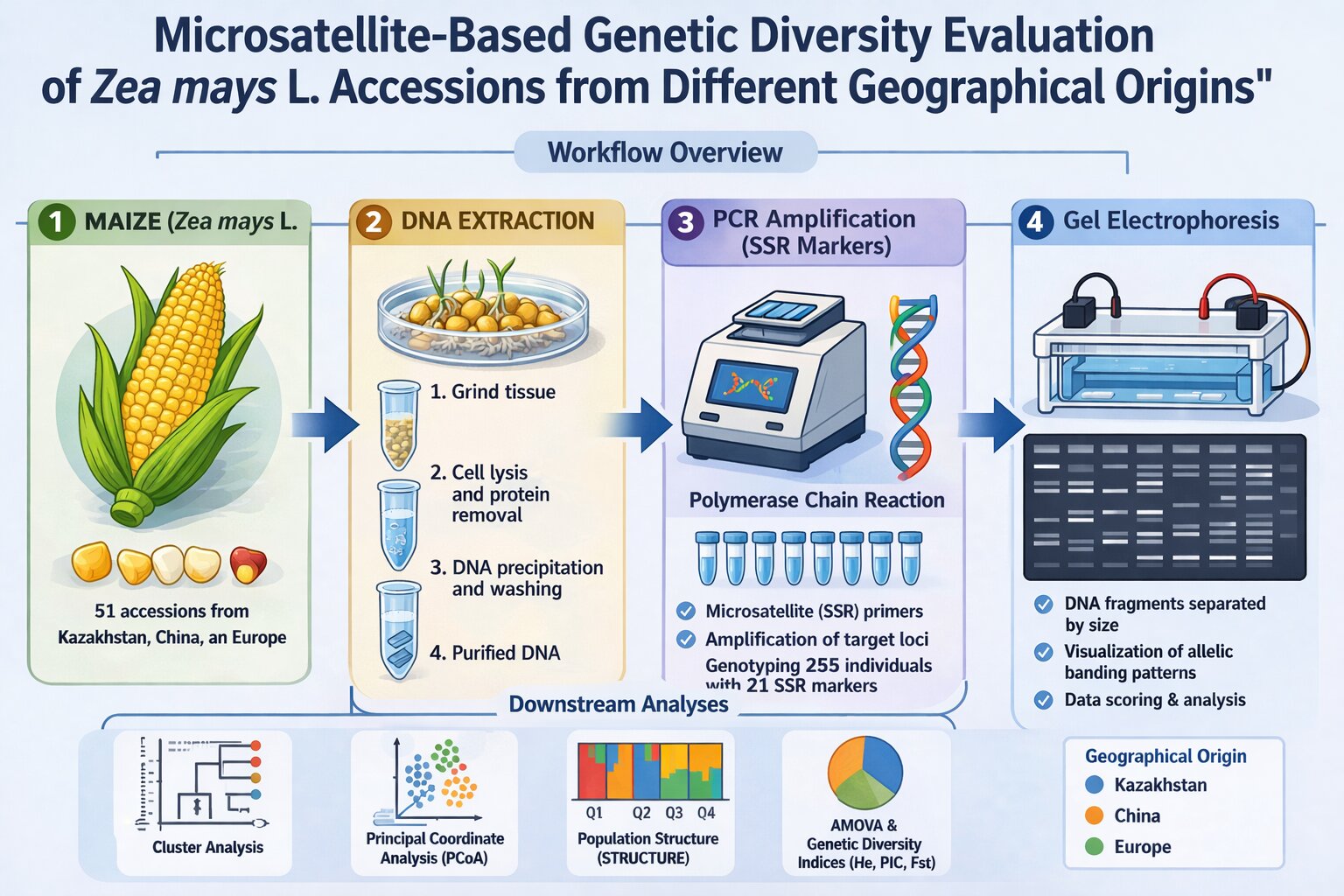
Microsatellite-based genetic diversity evaluation of Zea mays L. accessions from different geographical origins
DOI:
https://doi.org/10.31489/2026feb3/66-85Keywords:
Zea mays, Kazakhstan, molecular marker, SSR, genetic diversity, polymorphism, genetic structure,, genotypingAbstract
The purpose of this study was to investigate genetic diversity and the structure of 51 maize (Zea mays L.) accessions originating from Kazakhstan, China, and Europe using simple sequence repeat (SSR) markers. A total of 21 highly polymorphic SSR markers were applied to genotype 255 individuals, enabling a comprehensive assessment of allelic variation and genetic relationships. The number of alleles per locus ranged from 1.0 to 2.7, with a mean of 1.517, while expected heterozygosity (uHe) averaged 0.192, indicating moderate genetic diversity across accessions. Genetic diversity analysis by geographic origin revealed that European accessions exhibited the highest allelic richness (Na = 5.9) and genetic diversity, followed by the Chinese and Kazakhstani groups. Despite these differences, all groups showed 100% polymorphism, confirming the high informativeness of the selected SSR markers. Polymorphic information content (PIC) values ranged from 0.446 to 0.884, with an average of 0.712, indicating that markers such as phi047, bnlg1520, and umc2189 are highly informative. Analysis of molecular variance (AMOVA) demonstrated that 70% of the total genetic variation was attributable to differences among accessions, indicating strong genetic differentiation (Fst = 0.702) and limited gene flow (Nm = 0.212). Cluster analysis, principal coordinate analysis, and STRUCTURE results consistently revealed clear genetic separation of Chinese accessions, while European and Kazakhstani accessions showed closer genetic relationships and partial admixture. Overall, the findings highlight substantial genetic diversity and distinct population structure among maize accessions, providing valuable insights for germplasm conservation and for selecting genetically diverse parental lines in breeding programs.
References
1 Fischer, R. A., & Edmeades, G. O. (2010). Breeding and cereal yield progress. Crop science, 50, S-85. https://doi.org/10.2135/cropsci2009.10.0564.
2 Tanumihardjo, S. A., McCulley, L., Roh, R., Lopez-Ridaura, S., Palacios-Rojas, N., & Gunaratna, N. S. (2020). Maize agro-food systems to ensure food and nutrition security in reference to the Sustainable Development Goals. Global Food Security, 25, 100327. https://doi.org/10.1016/j.gfs.2019.100327.
3 Leff, B., Ramankutty, N., & Foley, J. A. (2004). Geographic distribution of major crops across the world. Global biogeochemi-cal cycles, 18(1). https://doi.org/10.1029/2003GB002108.
4 Iltis, H. H., & Doebley, J. F. (1980). Taxonomy of Zea (Gramineae). II. Subspecific categories in the Zea mays complex and a generic synopsis. American Journal of Botany, 67(6), 994–1004. https://doi.org/10.1002/j.1537-2197.1980.tb07731.x.
5 (2026). Plants of the World Online. Facilitated by the Royal Botanic Gardens, Kew. Published on the Internet. powo.science.kew.org. Retrieved from https://powo.science.kew.org/ Retrieved 27 March 2026.
6 Matsuoka, Y., Vigouroux, Y., Goodman, M. M., Sanchez G, J., Buckler, E., & Doebley, J. (2002). A single domestication for maize shown by multilocus microsatellite genotyping. Proceedings of the National Academy of Sciences, 99(9), 6080–6084. https://doi.org/10.1073/pnas.052125199.
7 Adhikari, S., Joshi, A., Kumar, A., & Singh, N. K. (2021). Diversification of maize (Zea mays L.) through teosinte (Zea mays subsp. parviglumis Iltis & Doebley) allelic. Genetic Resources and Crop Evolution, 68(7), 2983–2995. https://doi.org/10.1007/s10722-021-01170-z.
8 Wang, R. L., Stec, A., Hey, J., Lukens, L., & Doebley, J. (1999). The limits of selection during maize domestication. Nature, 398(6724), 236–239. https://doi.org/10.1038/18435.
9 Kuleshov, N. N. (1933). World's diversity of phenotypes of maize. Journal of the American Society of Agronomy, 25, 688–700.
10 Scott, P., Pratt, R. C., Hoffman, N., & Montgomery, R. (2019). Specialty corns. Corn (pp. 289–303). AACC International Press.
11 Santillán-Fernández, A., Salinas-Moreno, Y., Valdez-Lazalde, J. R., Bautista-Ortega, J., & Pereira-Lorenzo, S. (2021). Spatial delimitation of genetic diversity of native maize and its relationship with ethnic groups in Mexico. Agronomy, 11(4), 672. https://doi.org/10.3390/agronomy11040672.
12 Wang, M., Wu, M., & Huo, H. (2007). Life-cycle energy and greenhouse gas emission impacts of different corn ethanol plant types. Environmental Research Letters, 2(2), 024001. https://doi.org/10.1088/1748-9326/2/2/024001.
13 Klimek-Kopyra, A., Szmigiel, A., Zajac, T., & Kidacka, A. (2012). Some aspects of cultivation and utilization of waxy maize (Zea mays L. ssp. ceratina). Acta Agrobotanica, 65(3). https://doi.org/10.5586/aa.2012.001.
14 Buckler, E. S., Gaut, B. S., & McMullen, M. D. (2006). Molecular and functional diversity of maize. Current opinion in plant biology, 9(2), 172–176. https://doi.org/10.1016/j.pbi.2006.01.013.
15 Whitt, S. R., Wilson, L. M., Tenaillon, M. I., Gaut, B. S. & Buckler IV, E. S. (2002). Genetic diversity and selection in the maize starch pathway. Proceedings of the National Academy of Sciences, 99(20), 12959–12962. https://doi.org/10.1073/pnas.202476999.
16 Chňapek, M., Balážová, Ž., Špaleková, A., Gálová, Z., Hromadová, Z., Číšecká, L., & Vivodík, M. (2024). Genetic diversity of maize resources revealed by different molecular markers. Genetic Resources and Crop Evolution, 71(8), 4685–4703. https://doi.org/10.1007/s10722-024-01908-5.
17 Sagar, T., Kapoor, N., & Mahajan, R. (2023). Microsatellites as potential molecular markers for genetic diversity analysis in plants. Molecular marker techniques: A potential approach of crop improvement (pp. 81–101). Singapore: Springer Nature Singapore. https://doi.org/10.1007/978-981-99-1612-2_5.
18 Powell, W., Machray, G. C., & Provan, J. (1996). Polymorphism revealed by simple sequence repeats. Trends in plant science, 1(7), 215–222. https://doi.org/10.1016/1360-1385(96)86898-1.
19 Kalia, R. K., Rai, M. K., Kalia, S., Singh, R. & Dhawan, A. K. (2011). Microsatellite markers: an overview of the recent pro-gress in plants. Euphytica, 177(3), 309–334. https://doi.org/10.1007/s10681-010-0286-9.
20 Shete, G. S., Nikam, S. D., Surbhaiyya, S. D., Jadhav, M. P., & Thakare, T. N. (2023). Analysis of genetic diversity in maize (Zea mays L.) variety using SSR markers. International Journal of Plant & Soil Science, 35(15), 205–212. https://doi.org/10.9734/ijpss/2023/v35i153098.
21 Belalia, N., Lupini, A., Djemel, A., Morsli, A., Mauceri, A., Lotti, C., ... & Sunseri, F. (2019). Analysis of genetic diversity and population structure in Saharan maize (Zea mays L.) populations using phenotypic traits and SSR markers. Genetic Resources and Crop Evolution, 66(1), 243–257. https://doi.org/10.1007/s10722-018-0709-3.
22 Vathana, Y., Sa, K. J., Lim, S. E., & Lee, J. K. (2019). Genetic diversity and association analyses of Chinese maize inbred lines using SSR markers. Plant breeding and biotechnology, 7(3), 186–199. https://doi.org/10.9787/PBB.2019.7.3.186.
23 Aci, M. M., Revilla Temiño, P., Morsli, A., Djemel, A., Belalia, N., Kadri, Y., ... & Khelifi, L. (2013). Genetic diversity in Al-gerian maize (Zea mays L) landraces using SSR markers.
24 Suhasini, B., Ravikesavan, R., & Yuvaraja, A. (2023). Microsatellite marker based genetic diversity study in sweet corn in breds (Zea mays L. saccharata). Plant Archives (09725210), 23(2). DOI: 10.51470/PLANTARCHIVES.2023.v23.no2.058.
25 Patel, R., Memon, J., Kumar, S., Patel, D. A., Sakure, A. A., Patel, M. B., ... & Roychowdhury, R. (2024). Genetic diversity and population structure of maize (Zea mays L.) inbred lines in association with phenotypic and grain qualitative traits using SSR geno-typing. Plants, 13(6), 823. https://doi.org/10.3390/plants13060823.
26 Bocianowski, J., Nowosad, K., Wróbel, B., & Szulc, P. (2021). Identification of associations between SSR markers and quanti-tative traits of maize (Zea mays L.). Agronomy, 11(1), 182. https://doi.org/10.3390/agronomy11010182.
27 Sherakhane, M., Lohithaswa, H. C., Sinchana Kashyap, G. S., Gowda, B., Siddaraju, R., & Keshavareddy, G. (2025). Genetic Purity Assessment of Maize Hybrid (Zea mays L.) and Its Parental Lines Employing SSR Markers. Journal of Advances in Biology & Biotechnology, 28(2), 779–785. https://doi.org/10.9734/jabb/2025/v28i22038.
28 Sembayeva, A. S., Ospanbayev, Z., Zhapayev, R. K., Kenenbaуev, S. B., Pejic, B., Kunypiyaeva, G. T., ... & Bekbauov, M. (2025). Corn hybrids assessment for grain yield under the soil tillage regimes and drip irrigation in Southeast Kazakhstan. SABRAO Journal of Breeding and Genetics, 57(1). http://doi.org/10.54910/sabrao2025.57.1.5.
29 Tynykulov, M. (2022). Corn productivity in Northern Kazakhstan. Izdenister Natigeler, 3 (95), 54–62. https://doi.org/10.37884/3-2022/06.
30 Kudaibergenova, I., Kalashnikov, A., Balgabaev, N., Zharkov, V., & Angold, E. (2023). Effect of drip irrigation with foliar dressing of mineral fertilizer Kristalon and their impact on maize grain yield in Southern Kazakhstan. SABRAO Journal of Breeding and Genetics, 55(5), 1855–1864. http://doi.org/10.54910/sabrao2023.55.5.36.
31 Malitskaya, N. V., Kusnetzova, M. A., Ashirbekov, M. Z., Ostretzova, I. B., Nurmukhametova, N. N., Zhumabayeva, S. E.,... & Shoykin, O. D. (2025). Evaluation of early maturing maize hybrids for yield-related traits in Akmola Region, Kazakhstan. SABRAO Journal of Breeding & Genetics, 57(5). http://doi.org/10.54910/sabrao2025.57.5.20.
32 Yermagambetova, M. M., Ibraimov, A. M., Ortaev, A. K., Makhmadzhanov, S. P., & Turuspekov, Y. K. (2025). Genetic di-versity analysis of Zea mays L. accessions based on microsatellite markers. Eurasian Journal of Applied Biotechnology, (3), 24–34. https://doi.org/10.11134/btp.3.2025.3.
33 Dellaporta, S. L., Wood, J., & Hicks, J. B. (1983). A plant DNA minipreparation: version II. Plant molecular biology reporter, 1(4), 19–21. https://doi.org/10.1007/BF02712670.
34 Woodhouse, M. R., Cannon, E. K., Portwood, J. L., Gardiner, J. M., Hayford, R. K., Haley, O., & Andorf, C. M. (2025). Tools and resources at the maize genetics and genomics database (MaizeGDB). Cold Spring Harbor Protocols, 2025(1), pdb-over108430. DOI: 10.1101/pdb.over108430.
35 Peakall, R. O. D., & Smouse, P. E. (2012). GenAlEx 6.5: genetic analysis in Excel. Population genetic software for teaching and research—an update. Bioinformatics, 28(19), 2537–2539. https://doi.org/10.1093/bioinformatics/bts460.
36 Botstein, D., White, R. L., Skolnick, M., & Davis, R. W. (1980). Construction of a genetic linkage map in man using restriction fragment length polymorphisms. American journal of human genetics, 32(3), 314. PMID: 6247908.
37 (2020). RStudio: Integrated Development for R. RStudio, PBC, Boston, MA. www.rstudio.com. Retrieved from http://www.rstudio.com/
38 Hammer, Ø., Harper, D. A., & Ryan, P. D. (2001). PAST: Paleontological statistics software package for education and data analysis. Palaeontologia electronica, 4(1), 9.
39 Xie, J., Chen, Y., Cai, G., Cai, R., Hu, Z., & Wang, H. (2023). Tree Visualization By One Table (tvBOT): a web application for visualizing, modifying and annotating phylogenetic trees. Nucleic acids research, 51(W1), W587–W592. https://doi.org/10.1093/nar/gkad359.
40 Pritchard, J. K., Stephens, M., & Donnelly, P. (2000). Inference of population structure using multilocus genotype data. Genetics, 155(2), 945–959. https://doi.org/10.1093/genetics/155.2.945.
41 Evanno, G., Regnaut, S., & Goudet, J. (2005). Detecting the number of clusters of individuals using the software STRUCTURE: a simulation study. Molecular ecology, 14(8), 2611–2620. https://doi.org/10.1111/ j.1365-294X.2005.02553.x.
42 Kopelman, N. M., Mayzel, J., Jakobsson, M., Rosenberg, N. A., & Mayrose, I. (2015). Clumpak: a program for identifying clustering modes and packaging population structure inferences across K. Molecular ecology resources, 15(5), 1179–1191. https://doi.org/10.1111/1755 0998.12387.
43 Hao, D., Zhang, Z., Cheng, Y., Chen, G., Lu, H., Mao, Y., ... & Xue, L. (2015). Identification of genetic differentiation be-tween waxy and common maize by SNP genotyping. PLoS One, 10(11), e0142585. https://doi.org/10.1371/journal.pone.0142585.
44 Zheng, H., Wang, H., Yang, H., Wu, J., Shi, B., Cai, R., ... & Luo, L. (2013). Genetic diversity and molecular evolution of Chinese waxy maize germplasm. Plos one, 8(6), e66606. https://doi.org/10.1371/journal.pone.0066606.
45 Wu, X., Li, Y., Li, X., Li, C., Shi, Y., Song, Y., ... & Wang, T. (2015). Analysis of genetic differentiation and genomic varia-tion to reveal potential regions of importance during maize improvement. BMC plant biology, 15(1), 256. https://doi.org/10.1186/s12870-015-0646-7
46 Nashath, M. N. F., Mubarak, A. N. M., & Kumara, A. D. N. T. (2023). Exploring genetic diversity of maize (Zea mays L.) ac-cessions in Sri Lanka by employing SSR markers on photosynthetic, canopy architectural and grain yield traits.
47 Wallace, J. G., Bradbury, P. J., Zhang, N., Gibon, Y., Stitt, M., & Buckler, E. S. (2014). Association mapping across numerous traits reveals patterns of functional variation in maize. PLoS genetics, 10(12), e1004845. https://doi.org/10.1371/journal.pgen.1004845.
48 Mishra, S. J., Gopinath, I., Muthusamy, V., Zunjare, R. U., Chand, G., Venkatesh, A. K., ... & Hossain, F. (2025). Unraveling the interactive effect of opaque2 and waxy1 genes on kernel nutritional qualities and physical properties in maize (Zea mays L.). Scientific Reports, 15(1), 3425. https://doi.org/10.1038/s41598-025-87666-5.
49 Li, H., He, X., Lv, H., Zhang, H., Peng, F., Song, J., ... & Zhang, J. (2025). Epibrassinolide regulates Lhcb5 expression though the transcription factor of MYBR17 in maize. Biomolecules, 15(1), 94. https://doi.org/10.3390/biom15010094.
50 Slatkin, M. (1985). Gene flow in natural populations. Annual review of ecology and systematics, 393–430.
51 Kairova, G., Taskuzhina, A., Yanin, K., Ismagulova, E., Oleichenko, S., Sarshayeva, M., ... & Gritsenko, D. (2025). First eval-uation of genetic diversity and population structure of wild and cultivated Juglans regia in Kazakhstan. Genetic Resources and Crop Evolution, 72(7), 8281–8292. https://doi.org/10.1007/s10722-025-02443-7.
52 Urrestarazu, J., Denancé, C., Ravon, E., Guyader, A., Guisnel, R., Feugey, L., ... & Durel, C. E. (2016). Analysis of the genetic diversity and structure across a wide range of germplasm reveals prominent gene flow in apple at the European level. BMC plant biology, 16(1), 130. https://doi.org/10.1186/s12870-016-0818-0.
53 Zatybekov, A., Genievskaya, Y., Fang, C., Abugalieva, S., & Turuspekov, Y. (2025). Uncovering the genetic landscape of soybean accessions from Kazakhstan in comparison with global germplasm using whole genome resequencing. BMC genomics, 26(1), 802. https://doi.org/10.1186/s12864-025-12024-8.