Flora of anthropogenically disturbed territories of the Ridder Metallurgical Complex
DOI:
https://doi.org/10.31489/2026feb3/56-65Abstract
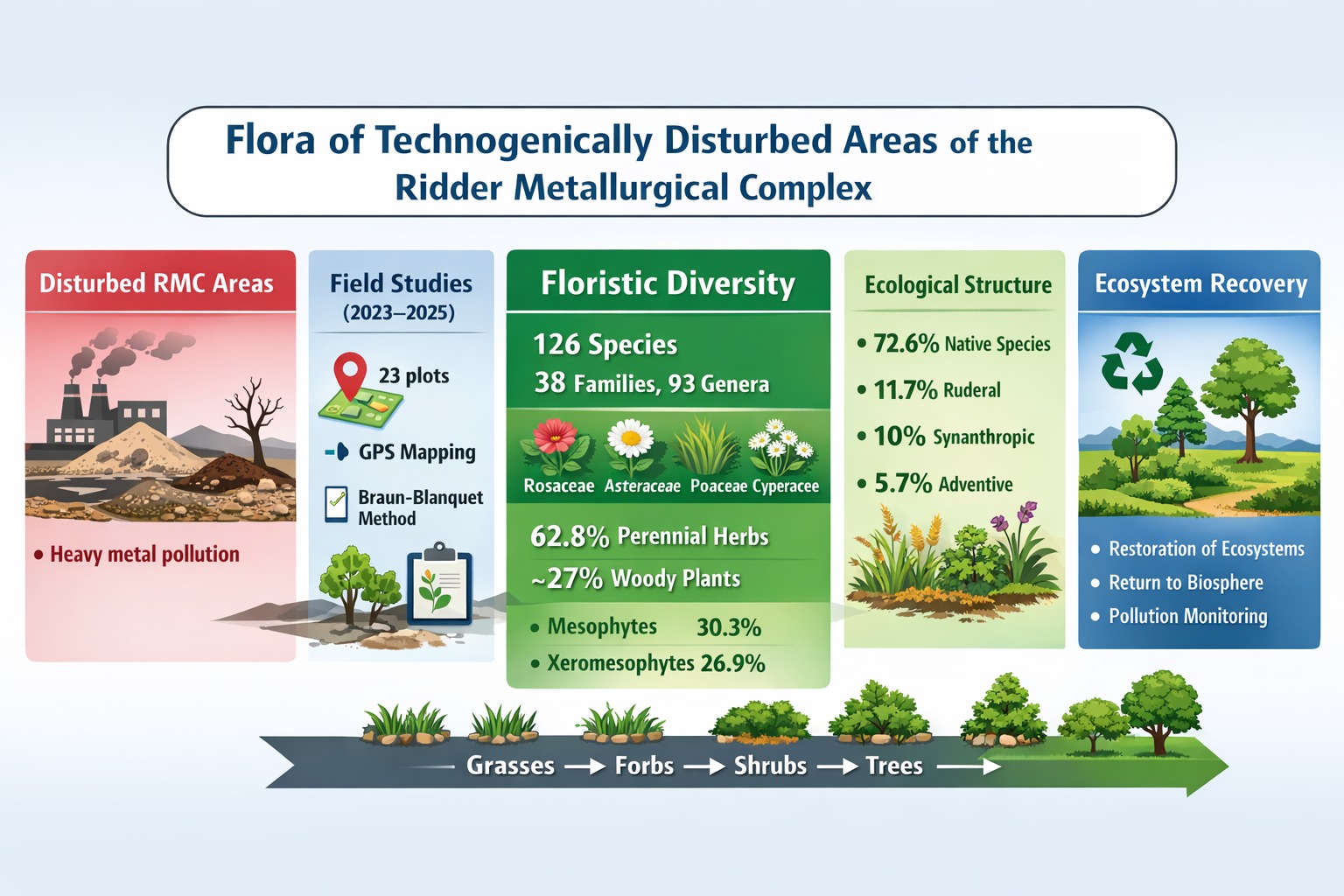
The aim of this study is to provide a comprehensive ecological assessment of the vegetation cover of technogenically disturbed territories of the Ridder Metallurgical Complex based on an analysis of floristic composition, life forms, and ecological plant groups, in order to determine succession pathways and substantiate biological reclamation measures. As part of the study, a comprehensive research program was implemented jointly with the IBBR “Institute of Plant Biology and Biotechnology” to investigate the phytocenoses of technogenic landscapes and the composition of their soils. The studied territory is characterized by a high degree of anthropogen-ic disturbance. The floristic composition was analyzed, comprising 126 species belonging to 38 families and 93 genera. The families Rosaceae (11 genera), Cyperaceae and Asteraceae (9 genera each), and Poaceae (7 genera) were the most prominent in the taxonomic spectrum. The spatial distribution, abundance, life forms, and condition of the plants were determined. A bioecological characterization of the species and their life forms (eco-morphs) was provided, and ecological groups of plants with respect to moisture requirements were identified. The results made it possible to assess the degree of disturbance of the territory and predict the direction of vegetation succession. The vegetation cover is predominantly composed of native, ecologically stable species, reflecting their adaptation to anthropogenic habitats. The findings contribute to the restoration of technogenically disturbed lands and their rehabilitation for integration into the biosphere.
References
1 Hajiyeva, G. N., & Ibrahimova, L. P. (2024). Ecological problems of technogenically disturbed lands on the Absheron Peninsu-la. Journal of Geology, Geography and Geoecology, 33(1), 70–76. https://doi.org/10.15421/112408
2 Stepanova, L. P., Pisareva, A. V., Bolmat, T. N., & Yelisarov, N. A. (2022). Ecological assessment of disturbances in the land-scape structure of alluvial soils of floodplains under technogenesis influences. IOP Conference Series: Earth and Environmental Sci-ence, 988(4), Article 042024. https://doi.org/10.1088/1755-1315/988/4/042024
3 Kopach, P. I., Yakubenko, L. V., Mormul, T. M., Danko, T. T., Gorobets, N. V., & Halchenko, Z. S. (2022). Assessment of natural resource potential of territories disturbed by mining works in the context of effective use of post-technogenic landscape. Geo-Technical Mechanics, 162, 38–47. https://doi.org/10.15407/geotm2022.162.038
4 Osintseva, M. (2023). Assessment of soil properties in technogenically disturbed lands of Kemerovo Oblast — Kuzbass. Qubahan Academic Journal, 3(4), 77–92. https://doi.org/10.48161/qaj.v3n4a164
5 Ivakina, E. V. (2022). Habitat formation in technogenic landscapes. IOP Conference Series: Earth and Environmental Science, 1045(1), Article 012133. https://doi.org/10.1088/1755-1315/1045/1/012133
6 Shergina, O. V., Mironova, A. S., Mikhailova, T. A., & Badryanova, V. V. (2022). Assessment of effects of anthropogenic disturbance on plant communities and soils in urbanized territories. IOP Conference Series: Earth and Environmental Science, 979(1), Article 012162. https://doi.org/10.1088/1755-1315/979/1/012162
7 Ivanova, S., Vesnina, A., Fotina, N., & Prosekov, A. (2024). Technogenically disturbed lands of coal mines: Restoration meth-ods. Nature Environment and Pollution Technology, 23(4), 2447–2452. https://doi.org/10.46488/NEPT.2024.v23i04.050
8 Dudnikova, T., Sushkova, S., Minkina, T., Barbashev, A., Ferreira, C. S. S., Antonenko, E., Shuvaev, E., & Bakoeva, G. (2023). Main factors in polycyclic aromatic hydrocarbons accumulations in the long-term technogenic contaminated soil. Eurasian Journal of Soil Science, 12(3), 282–289. https://doi.org/10.18393/ejss.1291033
9 Chaplygina, A. B., Filatova, O. V., Litvin, L. M., & Nykyforov, V. V. (2023). The main factors and prospects for the restora-tion of biodiversity in technogenic territories: On the example of the Poltava Mining and Processing Plant. Biosystems Diversity, 31(1), 100–112. https://doi.org/10.15421/012311
10 (2024). Royal Botanic Gardens, Kew. www.plantsoftheworldonline.org. Retrieved from http://www.plantsoftheworldonline.org/
11 Raunkiaer, C. (1905). Types biologiques pour la géographie botanique. Oversigt over Det Kongelige Danske Videnskabernes Selskabs Forhandlinger, 347–437.
12 Litvinskaya, S. A. (2023). Transformation and features of plant successions of the Taman Peninsula in case of technogenic im-pact. Russian Journal of Earth Sciences, 23(5), 1–6. https://doi.org/10.2205/2023ES02SI18
13 Watkinson, A. D., Juckers, M., D’Andrea, L., Beckett, P., & Spiers, G. (2022). Ecosystem recovery of the Sudbury technogen-ic barrens 30 years post-restoration. Eurasian Soil Science, 55(5), 663–672. https://doi.org/10.1134/S106422932205012X
14 Faleyev, D., Ivanov, A., Petrov, S., & Smirnov, V. (2024). Changes in vegetation cover as a result of anthropogenic and tech-nogenic impact on arid ecosystems of the Ashchykol depression (Betpak-Dala): Problems and prospects for the recultivation of uranium mines. BIO Web of Conferences, 128, Article 00006. https://doi.org/10.1051/bioconf/202412800006