Assessment of the cytotoxic activity of humates produced by “Shubarkol Komir” JSC
DOI:
https://doi.org/10.31489/2026feb1/114-122Keywords:
humic preparations, potassium humate, sodium humate, cytotoxic activity, concentration, safetyAbstract
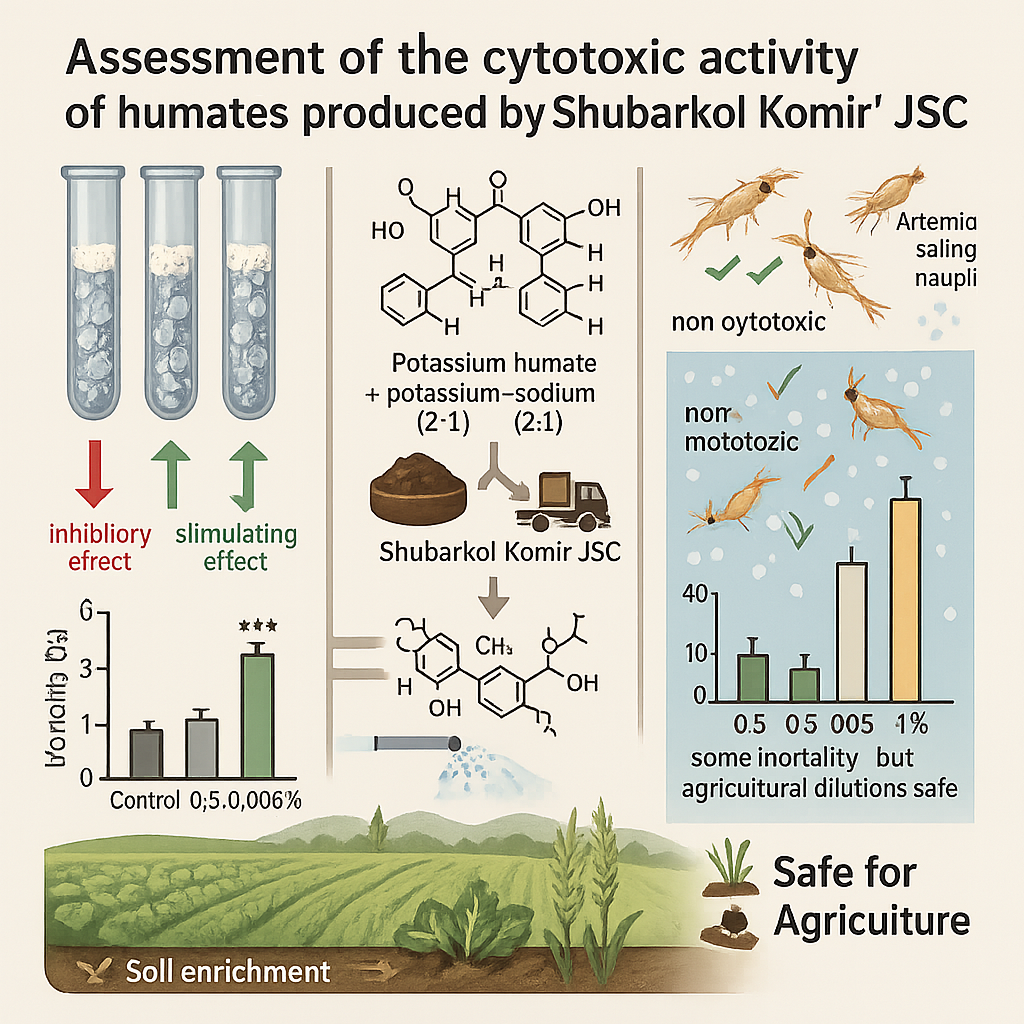
The development of new humic preparations from locally available raw materials is important for advancing the domestic industry of the Republic of Kazakhstan. In Central Kazakhstan, humic preparations such as potassium humate and sodium humate have been developed by “Shubarkol Komir” JSC based on weathered coal. To confirm their applicability, studies assessing their biological activity and safety are required. The purpose of this study is to evaluate the cytotoxic activity of potassium humate and a mixture of potassium humate and humate in different dilutions. The study materials included humates produced by “Shubarkol Komir” JSC, which were compared with a commercial preparation, ECO humate, using tests on Saccharomyces cerevisiae cells and Artemia salina nauplii. The test results showed that high concentrations of humic preparations (4 %) had an inhibitory effect on the foaming ability of yeast, which was lower than that of the comparison drug nystatin. Concentrations from 0.5 to 0.005 % did not inhibit Saccharomyces cerevisiae and activated the foaming ability. The results of the second experimental series demonstrated that both the humates produced by “Shubarkol Komir” JSC and the reference preparation were non-cytotoxic to Artemia salina larvae at all tested concentrations (0.5–0.005%), indicating their safety. Thus, the obtained data confirm the safety of using potassium humate and a mixture of potassium humate and sodium humate produced by “Shubarkol Komir” JSC in agriculture.
References
1 Lobartini J. C. The geochemical nature and agricultural importance of commercial humic matter / J. C. Lobartini, K. H. Tan, J. A. Rema, A. R. Gingle, C. Pape, D. S. Himmelsbach // Science of the total environment. — 1992. — Vol. 113 (1-2). — P. 1–15. https://doi.org/10.1016/0048-9697(92)90013-1 DOI: https://doi.org/10.1016/0048-9697(92)90013-I
2 Wang R. Production of artificial humic acid from rice straw for fertilizer production and soil improvement / R. Wang, D. Li, F. Deng, Zh. Cao, G. Zheng // Science of total environment. — 2024. — Vol. 906(1). — P. 167548. https://doi.org/10.1016/j.scitotenv.2023.167548 DOI: https://doi.org/10.1016/j.scitotenv.2023.167548
3 Rose M. T. A meta-analysis and review of plant-growth response to humic substances / M. T. Rosa, A. F. Patti, K. R. Little, A. L. Brown, W. R. Jackson, T. R. Cavagnaro // In Advances in Agronomy. — Amsterdam: Elsevier, 2014. — P. 37–89. https://doi.org/10.1016/B978-0-12-800138-7.00002-4 DOI: https://doi.org/10.1016/B978-0-12-800138-7.00002-4
4 Li Y. Humic acid fertilizer improves soil properties and soil microbial diversity of continuous cropping peanut: a three-year experiment / Y. Li, F. Fang, J. Wei, X. Wu, R. Cui, G. Li, F. Zheng, D. Tan // Scientific Report. — 2019. — Vol. 9. — P. 1–9. https://doi.org/10.1038/s41598-019-48620-46 DOI: https://doi.org/10.1038/s41598-019-48620-4
5 Arif M. Humic acids as a feed addictive in poultry diets: a review / M. Arif, M. Alagawany, M. E. Abd El-Hack, M. Saeed, M. A. Arain, S. S. Elnesr // Iran J Vet Res. — 2019. — Vol. 20(3). — P. 167–172.
6 Savelyeva A. V. Detoxication of oil-contaminated soils by using humic acids / A. V. Savelyeva, E. V. Linkevich, N. V. Yudina, N. Nebogina // IOP Conference. Series Materials Science and Engineering. — 2019. — Vol. 597(1). — P. 012020. https://doi.org/10.1088/1757-899X/597/1/012020 DOI: https://doi.org/10.1088/1757-899X/597/1/012020
7 Tang W. W. Impact of humic/fulvic acid on the removal of heave metals from aqueous solutions using nanomaterials: a review / W. W. Tang, G.-M. Zeng, J. -L. Gong, J. Liang, P. Xu, Ch. Zhang, B.-B. Huang // Sci Total Inviron. — 2014. — Vol. 15(468-469). — P. 1014–1027. https://doi.org/10.1016/j.scitotenv.2013.09.044 DOI: https://doi.org/10.1016/j.scitotenv.2013.09.044
8 Clapp C. E. Plant growth promoting activity of HS // Understanding and Managing Organic Matter in Soils, Sediments, and Waters / C. E. Clapp, Y. Chen, M. H. B. Hayes, H. H. Cheng. — Madison: IHSS, 2001. — P. 243–255.
9 Kovalevski D. V. A new approach to description of structure of HS and its application to estimating a quantitative structure — property relationship / D. V. Kovalevski, I. V. Perminova, A. V. Kudryavtsev, V. S. Petrosyan // The role of humic substance in the ecosystem and in environmental protection: Trans. 8th Meeting of IHSS. — Wroclav (Poland), 1996. — P. 99.
10 Riede U. N. Humate induced activation of human granulocytes / U. N. Riede, G. Zeck-Kapp, N. Freudenberg et al. // Virchows Arch. B. Cell Pathol. Incl. Mol. Pathol. — 1991. — Vol. 60. — No. 1. — Р. 27–34. DOI: https://doi.org/10.1007/BF02899524
11 Горовая А. И. Гуминовые вещества: Строение, функции, механизм действия, протектор, свойства, экологическая роль / А. И. Горовая, Д. С. Орлов, О. В. Щербенко // Нац. акад. Наук Украины, Ин-т проблем природопользования и экологии. — Киев: Наукова думка, 1995. — 303 с.
12 Имбаева Д. С. Влияние биопрепарата на основе гумата калия, обогащенного микроэлементами, на организм лабораторных животных / Д. С. Имбаева, Е. В. Кухар // Материалы Международной научно-теоретической конференции «Сейфуллинские чтения — 16: Молодежная наука новой формации — будущее Казахстана». — 2020. — Т. 1. — Ч.3 — С. 243–245.
13 Карпухин А. И. Функциональная роль комплексных соединений в генезисе почв и питании растений // В сб.: Гуминовые вещества в биосфере / А. И. Карпухин. — М.: Наука, 1993. — С. 117–126.
14 Пироговская Г. В. Использование гуминовых препаратов в получении минеральных удобрений / Г. В. Пироговская, И. А. Богомаз, Е. И. Шагиева, М. Ф. Коваленок, С. И. Кулешова, Г. В. Наумова, Г. И. Райцина // В сб.: Гуминовые вещества в биосфере. — М.: Наука, 1993. — С. 166–174.
15 Abutova R. J. Humic preparation and plant activity / R. J. Abutova, M. K. Kozhakhmetov // Journal of water and land development. — 2022. — Vol. 55. — P. 104–108. https://doi.org/10.24452/jwld.2022.142311 DOI: https://doi.org/10.24425/jwld.2022.142311
16 Жданова Г. О. Использование Saccharomyces cerevisiae для оценки биологической активности лекарственных препаратов / Г. О. Жданова, О. Ф. Вятчина, В. А. Быбин, Д. И. Стом, Г. М. Федосеева // Сибирский медицинский журнал. — 2013. —№ 4. — С. 104–106.
17 Meyer B. N. Brine shrimp: A convenient general bioassay for active plant constituents / B. N. Meyer, N. R. Ferrighi, J. E. Putnam, L. B. Jacobsen, D. E. Nichols, J. L. McLaughlin // Planta Medica. — 1982. — Vol. 45. — P. 31–34. DOI: https://doi.org/10.1055/s-2007-971236