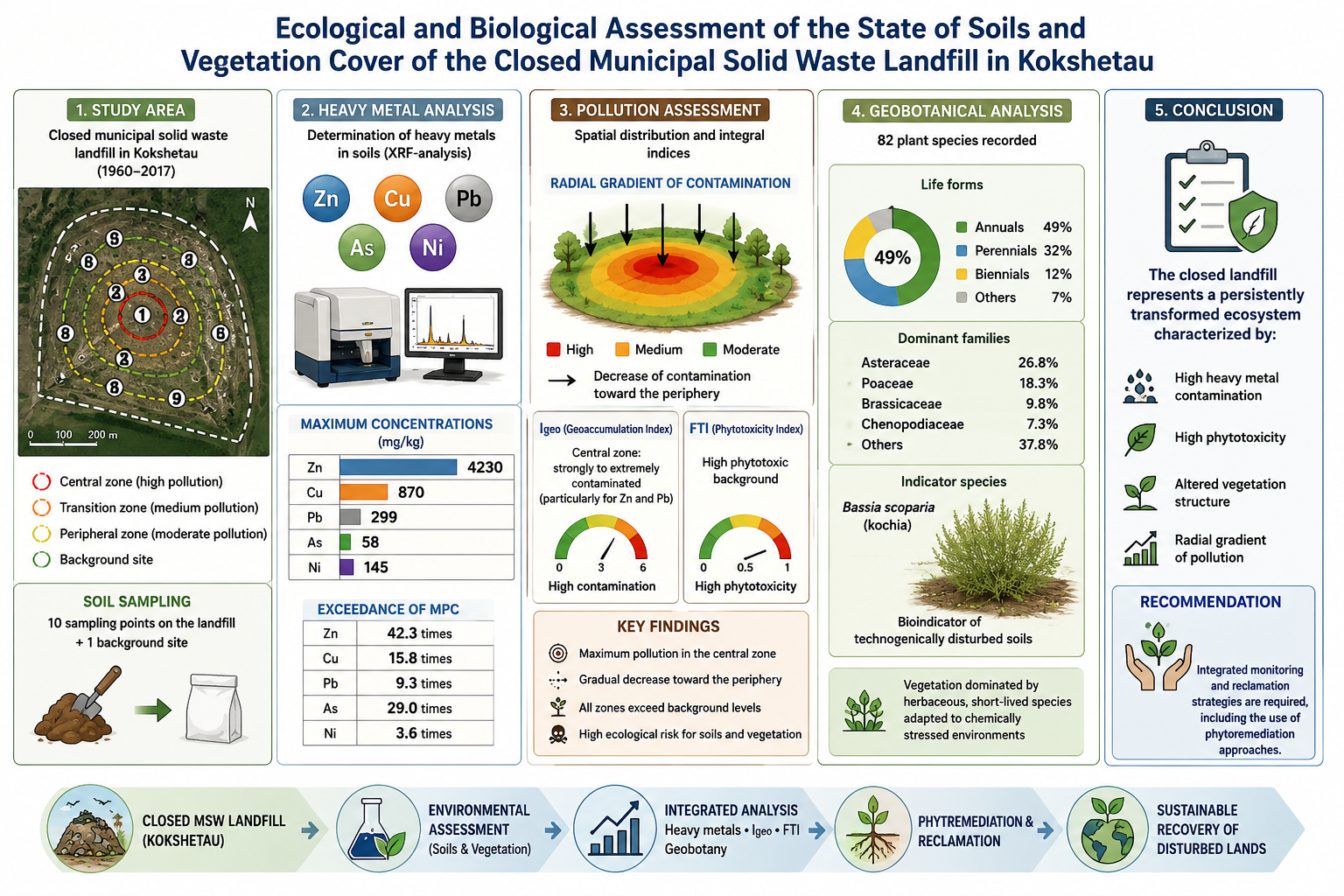
Ecological and biological assessment of the state of soils and vegetation cover of the closed municipal solid waste landfill in Kokshetau
DOI:
https://doi.org/10.31489/2026feb3/43-55Keywords:
landfill of solid household waste, phytotoxicity, anthropogenic impact, heavy metals, ecosystem disturbance, soil contaminationAbstract
The ecological state of a closed municipal solid waste (MSW) landfill in Kokshetau, operated from 1960 to 2017 and lacking engineered protective systems, was assessed with a focus on heavy metal contamination and its effects on vegetation. Soil analysis revealed substantial exceedances of maximum permissible concentrations (MPCs) and background concentrations. Maximum concentrations reached 4230 mg/kg for Zn, 870 mg/kg for Cu, 299 mg/kg for Pb, 58 mg/kg for As, and 145 mg/kg for Ni, exceeding MPCs by 42.3, 15.8, 9.3, 29.0, and 3.6 times, respectively. Compared with background concentrations, these values were 48.1, 8.5, 19.9, 4.1, and 3.2 times higher, respectively. A pronounced radial contamination gradient was identified, with maximum concentrations in the central zone and a gradual decrease toward the periphery. However, even peripheral areas showed elevated concentrations relative to background levels, indicating persistent anthropogenic impact despite landfill closure. The geo-accumulation index (Igeo) classified the central soils as strongly to extremely contaminated, particularly with respect to Zn and Pb, while the phytotoxicity index (FTI) indicated a high level of phytotoxicity. Geobotanical analysis revealed substantial transformation of the vegetation, which was dominated by herbaceous and short-lived species, with annual species accounting for 49% of the recorded flora. The preva-lence of Asteraceae, Poaceae, Brassicaceae, and Chenopodiaceae is consistent with adaptation to chemically stressed environments. The dominance of Bassia scoparia suggests its potential as a bioindicator of technogenically disturbed soils. Overall, the landfill represents a long-term anthropogenically transformed ecosystem requiring integrated environmental monitoring and reclamation measures.
References
1 Štrbac S. Heavy metal concentrations in soil near illegal landfills: Ecological implications and ANN hazard prediction / S. Štrbac, L. Mandić, B. Škrbić, M. Marković // Journal of Soils and Sediments. — 2024. — Vol. 24(1). — P. 1–17. https://doi.org/10.1007/s11368-023-03637-1
2 Агаркова С.В. Проблемы утилизации твердых бытовых отходов / С.В. Агаркова // Вестник науки. — 2020. —
Т. 2, № 3 (24). — С. 71–74.
3 Glazyrin S.A. Analysis of the efficiency and environmental impact of municipal solid waste incineration as a tool for sustaina-bility development in Kazakhstan / S.A. Glazyrin, E.E. Kopishev, M.G. Zhumagulov, Z.A. Bimurzina, Y.K. Aibuldinov // Sustainabil-ity. — 2025. — Vol. 17(19). — Article ID 8696. https://doi.org/10.3390/su17198696
4 Kurmanbayeva A. Waste accumulation and geoecological assessment of the territories around the landfills in Kokshetau / A. Kurmanbayeva, Z. Bayazitova, A. Talal, A. Kakabayev, S. Zhaparova // International Journal of GEOMATE. — 2022. —
Vol. 23, Iss. 96. — P. 179–185. https://doi.org/10.21660/2022.96. j2384
5 Inglezakis V.J. Municipal solid waste management in Kazakhstan: Astana and Almaty case studies / V.J. Inglezakis, K. Moustakas, G. Khamitovac, D. Tokmurzin, R. Rakhmatulina, B. Serik, Y. Abikak // Chemical Engineering Transactions. — 2017. — Vol. 56. — P. 565–570. https://doi.org/10.3303/CET1756095
6 Aibuldinov Y. K. Analysis of the composition and properties of municipal solid waste in various cities of Kazakhstan / Y.K. Aibuldinov, S.A. Glazyrin, E.E. Kopishev, M.G. Zhumagulov, Z.A. Bimurzina // Energies. — 2024. — Vol. 17(24). — Article ID 6426. https://doi.org/10.3390/en17246426
7 Kaliaskarova Z.K. Soil pollution with heavy metals on the land of the Karasai landfill of municipal solid waste in Almaty city / Z.K. Kaliaskarova, Zh.N. Aliyeva, A.S. Ikanova, E.S.M. Negim // News of the National Academy of Sciences of the Republic of Ka-zakhstan. Series of Geology and Technical Sciences. — 2019. — Vol. 6(438). — P. 256–267. https://doi.org/10.32014/2019.2518-170X.177.
8 Bayazitova Z.E. Assessment of ecological danger of seepage water solid waste landfill of Kokshetau / Z.E. Bayazitova, A.S. Kurmanbayeva, A.A. Kakabayev, S.B. Zhaparova, G.S. Baituk, A. Zandybay, G.E. Baikenova // Bulletin of Kazakh National Uni-versitety. Ecological series. — 2022. — Vol. 70(1). — P. 46–55. https://doi.org/10.26577/EJE.2022.v70.i1.05
9 Курманбаева А.С. Биорекультивация полигонов твёрдых бытовых отходов / А.С. Курманбаева, З.Е. Баязитова, Н.М. Сафронова // Eurasian Journal of Applied Biotechnology. — 2024. — № 3S.
10 Akter S. Heavy metal contamination of surface soils: concentrations, sources, and ecological risks / S. Akter, A. Huq, M. Uddin // Environmental Geochemistry & Health. — 2025. — Vol. 198. — Article ID 165. https://doi.org/10.1080/03067319.2023.2280180
11 Qi J. Heavy metal contamination in soil and ecological risk assessment near waste disposal sites / J. Qi, Y. Zhang, X. Chen // PeerJ. — 2024. — Vol. 12. — e18510. https://doi.org/10.7717/peerj.18510
12 Гигиенические нормативы ПДК химических веществ в почве. — [Электронный ресурс]. — Режим доступа: https://adilet.zan.kz/rus/docs/V2100022595?utm_source=chatgpt.com
13 Broadley M. R. Zinc in plants / M. R. Broadley, P.J. White, J.P. Hammond, I. Zelko, A. Lux // New Phytologist. — 2007. — Vol. 173(4). — P. 677–702. https://doi.org/10.1111/j.1469-8137.2007.01996.x
14 Finnegan P. M. Arsenic toxicity: the effects on plant metabolism / P.M. Finnegan, W. Chen // Frontiers in Physiology. — 2012. — Vol. 3. — Article ID 182. https://doi.org/10.3389/fphys.2012.00182
15 Cai S. Assessment of metal pollution and effects of physicochemical factors on soil microbial communities around a landfill / S. Cai, S. Zhou, Q. Wang, J. Cheng, B. Zeng // Ecotoxicology and Environmental Safety. — 2024. — Vol. 271. — Article ID 115968. https://doi.org/10.1016/j.ecoenv.2024.115968
16 Khan S. Global soil pollution by toxic elements: Current status and future perspectives / S. Khan, M. Naushad, E.C. Lima, et al. // Science of the Total Environment. — 2021. — Vol. 778. — P. 146–171. https://doi.org/10.1016/j.scitotenv.2021.146171
17 Nagajyoti P. C. Heavy metals, occurrence and toxicity for plants / P.C. Nagajyoti, K.D. Lee, T.V.M. Sreekanth // Environmental Chemistry Letters. — 2010. — Vol. 8. — P. 199–216. https://doi.org/10.1007/s10311-010-0297-8
18 Prach K. Four opportunities for studies of ecological succession / K. Prach, L. R. Walker // Trends in Ecology & Evolution. — 2011. — No. 26. — Р. 119–123. https://doi.org/10.1016/j.tree.2010.12.007