Evidence for asymmetric DNA strand inheritance in vertebrate mitochondria
DOI:
https://doi.org/10.31489/2026feb3/30-42Keywords:
mitochondrial DNA, DNA strand equivalence, patterns of mutation, Chargaff’s second parity rule, DNA replicationAbstract
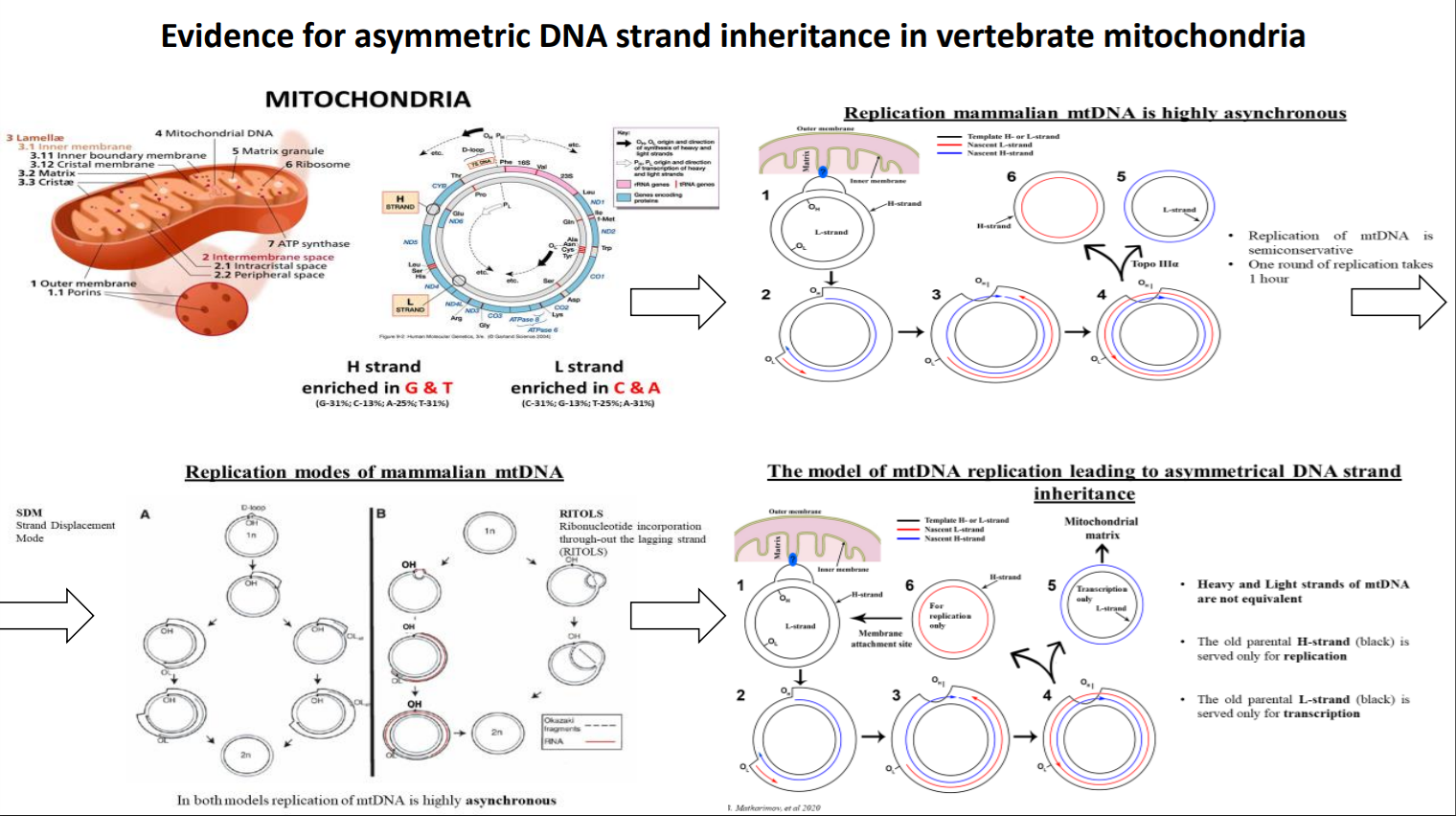
A classical experiment proposed in 1958 by Meselson and Stahl confirmed the semi-conservative mechanism of DNA replication in cellular organisms, according to which, after cell division, each daughter cell inherits a chromosome consisting of one parental chain (W or C) and one newly synthesized complementary chain (C' or W'). Since each DNA strand is replicated the same number of times after each cell division, it can be assumed that the W and C chains are equivalent as a result of a combination of cell division and a semi-conservative DNA replication mechanism. However, some non-cellular organisms, including single-stranded DNA and RNA viruses, do not conform to the concept of strand equivalence. A key feature of vertebrate mitochondrial genomes is the notable asymmetry in nucleotide composition between their two chains. This allows them to be separated during ultracentrifugation in an alkaline cesium chloride gradient into a heavy (H) chain that is rich in guanine and thymine, and a light (L) strand enriched in cytosine and adenine nucleotides. Despite extensive research, the exact mechanism of human mitochondrial DNA replication and its possible connection to this asymmetric composition remain unclear. In this paper, we propose a conceptual model for asymmetric inheritance of mitochondrial DNA strands to account for the strand-specific mutation asymmetry characteristic of vertebrate mtDNA.
References
1 Gomes-dos-Santos, A., Vilas-Arrondo, N., Machado, A. M., Román-Palacios, C., & Rocha, E. P. C. (2023). Mitochondrial replication’s role in vertebrate mtDNA strand asymmetry. Open Biology, 13(12), 230181. https://doi.org/10.1098/rsob.230181
2 Boore, J. L. (1999). Animal mitochondrial genomes. Nucleic Acids Research, 27(8), 1767–1780.
3 Kolesnikov, A. A., & Gerasimov, E. S. (2012). Diversity of mitochondrial genome organization. Biochemistry (Moscow), 77(13), 1424–1435.
4 Lee, W. -J., Conroy, J., Howell, W. H., & Kocher, T. D. (1995). Structure and evolution of teleost mitochondrial control re-gions. Journal of Molecular Evolution, 41(1), 54–66.
5 Berk, A. J., & Clayton, D. A. (1974). Mechanism of mitochondrial DNA replication in mouse L-cells: asynchronous replication of strands, segregation of circular daughter molecules, aspects of topology and turnover of an initiation sequence. Journal of Molecular Biology, 86(4), 801–824.
6 Picard, M., Wallace, D. C., & Burelle, Y. (2016). The rise of mitochondria in medicine. Mitochondrion, 30, 105–116. https://doi.org/10.1016/j.mito.2016.07.003
7 Gibson, A., Gowri-Shankar, V, Higgs, P. G., & Rattray, M. (2005). A comprehensive analysis of mammalian mitochondrial genome base composition and improved phylogenetic methods. Molecular Biology and Evolution, 22(2), 251–264.
8 Noack, K., Zardoya, R., & Meyer, A. (1996). The complete mitochondrial DNA sequence of the bichir (Polypterusornatipin-nis), a basal ray-finned fish: ancient establishment of the consensus vertebrate gene order. Genetics, 144(3), 1165–1180.
9 Clayton, D. A. (1982). Replication of animal mitochondrial DNA. Cell, 28(4), 693–705.
10 Gustafsson, C. M., Falkenberg, M., & Larsson, N. -G. (2016). Maintenance and expression of mammalian mitochondrial DNA. Annual Review of Biochemistry, 85, 133–160. https://doi.org/10.1146/annurev-biochem-060815-014402
11 Gyllensten, U., Wharton, D., Josefsson, A., & Wilson, A. C. (1991). Paternal inheritance of mitochondrial DNA in mice. Na-ture, 352, 255–257.
12 Wolff, J. N., & Gemmell, N. J. (2008). Lost in the zygote: the dilution of paternal mtDNA upon fertilization. Heredity, 101, 429–434.
13 Nishimura, Y., Yoshinari, T., Naruse, K., et al. (2006). Active digestion of sperm mitochondrial DNA in single living sperm revealed by optical tweezers. Proceedings of the National Academy of Sciences of the USA, 103, 1382–1387.
14 DeLuca, S. Z., & O’Farrell, P. H. (2012). Barriers to male transmission of mitochondrial DNA in sperm development. Devel-opmental Cell, 22, 660–668.
15 Lee, W., et al. (2023). Molecular basis for maternal inheritance of human mitochondrial DNA. Nature Genetics, 55, 1632–1639.
16 Shoubridge, E. A., & Wai, T. (2007). Mitochondrial DNA and the mammalian oocyte. Current Topics in Developmental Biolo-gy, 77, 87–111. https://doi.org/10.1016/S0070-2153(06)77004-1
17 Larsson, N. G. (2010). Somatic mitochondrial DNA mutations in mammalian aging. Annual Review of Biochemistry, 79(1), 683–706.
18 Taylor, R. W., & Turnbull, D. M. (2005). Mitochondrial DNA mutations in human disease. Nature Reviews Genetics, 6(5), 389–402. https://doi.org/10.1038/nrg1606
19 Stewart, J. B., Freyer, C., Elson, J. L., & Larsson, N. G. (2008). Strong purifying selection in transmission of mammalian mito-chondrial DNA. PLoS Biology, 6(1), e10. https://doi.org/10.1371/journal.pbio.0060010
20 Lima, A., et al. (2021). Cell competition acts as a purifying selection to eliminate cells with mitochondrial defects during early mouse development. Nature Metabolism, 3(8), 1091–1108.
21 Yang, L., et al. (2020). Mitochondrial DNA mutation exacerbates female reproductive aging via impairment of the NADH/NAD+ redox. Aging Cell, 19(9), e13206. https://doi.org/10.1111/acel.13206
22 Roger, A. J., Muñoz-Gómez, S. A., & Kamikawa, R. (2017). The origin and diversification of mitochondria. Current Biology, 27(21), R1177–R1192.
23 Ricchetti, M., Tekaia, F., & Dujon, B. (2004). Continued colonization of the human genome by mitochondrial DNA. PLoS Bi-ology, 2(9), e273.
24 Park, C. B., & Larsson, N. G. (2011). Mitochondrial DNA mutations in disease and aging. The Journal of Cell Biology, 193(5), 809–818. https://doi.org/10.1083/jcb.201010024
25 Wallace, D. C., et al. (1988). Mitochondrial DNA mutation associated with Leber’s hereditary optic neuropathy. Science, 242(4884), 1427–1430.
26 Xu, B., & Clayton, D. A. (1995). A persistent RNA–DNA hybrid is formed during transcription at a phylogenetically con-served mitochondrial DNA sequence. Molecular and Cellular Biology, 15, 580–589.
27 Fusté, J. M., et al. (2010). Mitochondrial RNA polymerase is needed for activation of the origin of light-strand DNA replica-tion. Molecular Cell, 37, 67–78.
28 Cerritelli, S. M., et al. (2003). Failure to produce mitochondrial DNA results in embryonic lethality in Rnaseh1 null mice. Mo-lecular Cell, 11, 807–815.
29 Falkenberg, M. (2018). Mitochondrial DNA replication in mammalian cells: overview of the pathway. Essays in Biochemistry, 62(3), 287–296. https://doi.org/10.1042/EBC20170100
30 Falkenberg, M., & Gustafsson, C. M. (2020). Mammalian mitochondrial DNA replication and mechanisms of deletion for-mation. Critical Reviews in Biochemistry and Molecular Biology, 55(6), 509–524. https://doi.org/10.1080/10409238.2020.1818684
31 Wanrooij, S., Fusté, J. M., & Farge, G., et al. (2008). Human mitochondrial RNA polymerase primes lagging-strand DNA syn-thesis in vitro. Proceedings of the National Academy of Sciences of the USA, 105(32), 11122–11127.
32 Park, J., Baruch-Torres, N., & Yin, Y. W. (2023). Structural and molecular basis for mitochondrial DNA replication and tran-scription in health and antiviral drug toxicity. Molecules (Basel, Switzerland), 28(4), 1796. https://doi.org/10.3390/molecules28041796
33 Oláhová, M., et al. (2021). POLRMT mutations impair mitochondrial transcription causing neurological disease. Nature Com-munications, 12(1), 1135.
34 Jiang, M., et al. (2021). The mitochondrial single-stranded DNA binding protein is essential for initiation of mtDNA replication. Science Advances, 7(27), eabf8631.
35 Shi, Y., Posse, V., & Zhu, X., et al. (2016). Mitochondrial transcription termination factor 1 directs polar replication fork paus-ing. Nucleic Acids Research, 44(12), 5732–5742.
36 Akbari, M., Nilsen, H. L., & Montaldo, N. P. (2022). Dynamic features of human mitochondrial DNA maintenance and tran-scription. Frontiers in Cell and Developmental Biology, 10, 984245.
37 Wanrooij, S., & Falkenberg, M. (2010). The human mitochondrial replication fork in health and disease. Biochimica et Biophys-ica Acta (BBA) — Bioenergetics, 1797(8), 1378–1388.
38 Nicholls, T. J., et al. (2014). Linear mtDNA fragments and unusual mtDNA rearrangements associated with pathological defi-ciency of MGME1 exonuclease. Human Molecular Genetics, 23(23), 6147–6162.
39 Matic, S., et al. (2018). Mice lacking the mitochondrial exonuclease MGME1 accumulate mtDNA deletions without developing progeria. Nature Communications, 9(1), 1202.
40 Yasukawa, T., & Kang, D. (2018). An overview of mammalian mitochondrial DNA replication mechanisms. Journal of Bio-chemistry, 164(3), 183–193. https://doi.org/10.1093/jb/mvy058
41 MirallesFusté, J., et al. (2014). In vivo occupancy of mitochondrial single-stranded DNA binding protein supports the strand displacement mode of DNA replication. PLoS Genetics, 10(12), e1004832.
42 Pohjoismäki, J. L., et al. (2010). Mammalian mitochondrial DNA replication intermediates are essentially duplex but contain ex-tensive tracts of RNA/DNA hybrid. Journal of Molecular Biology, 397(5), 1144–1155.
43 Reyes, A., Kazak, L., Wood, S. R., et al. (2013). Mitochondrial DNA replication proceeds via a “bootlace” mechanism involv-ing the incorporation of processed transcripts. Nucleic Acids Research, 41(11), 5837–5850. https://doi.org/10.1093/nar/gkt196
44 Yasukawa, T., et al. (2006). Replication of vertebrate mitochondrial DNA entails transient ribonucleotide incorporation throughout the lagging strand. The EMBO Journal, 25(22), 5358–5371. https://doi.org/10.1038/sj.emboj.7601392
45 Hsieh, C. L. (2019). Novel lines of evidence for the asymmetric strand displacement model of mitochondrial DNA replication. Molecular and Cellular Biology, 39(2), e00406-18. https://doi.org/10.1128/MCB.00406-18
46 Kosar, M., Piccini, D., Foiani, M., & Giannattasio, M. (2021). A rapid method to visualize human mitochondrial DNA replica-tion through rotary shadowing and transmission electron microscopy. Nucleic Acids Research, 49(21), e121. https://doi.org/10.1093/nar/gkab770
47 Brown, T. A., et al. (2005). Replication of mitochondrial DNA occurs by strand displacement with alternative light-strand ori-gins, not via a strand-coupled mechanism. Genes & Development, 19(20), 2466–2476.
48 McKinney, E. A., & Oliveira, M. T. (2013). Replicating animal mitochondrial DNA. Genetics and Molecular Biology, 36, 308–315.
49 Wanrooij, S., et al. (2008). Human mitochondrial RNA polymerase primes lagging-strand DNA synthesis in vitro. Proceedings of the National Academy of Sciences of the USA, 105(32), 11122–11127. https://doi.org/10.1073/pnas.0805399105
50 Holt, I. J., Lorimer, H. E., & Jacobs, H. T. (2000). Coupled leading- and lagging-strand synthesis of mammalian mitochondrial DNA. Cell, 100(5), 515–524.
51 Taanman, J. -W. (1999). The mitochondrial genome: structure, transcription, translation and replication. Biochimica et Biophysi-ca Acta (BBA) — Bioenergetics, 1410(2), 103–123.
52 Xia, X. (2019). Is there a mutation gradient along vertebrate mitochondrial genome mediated by genome replication? Mitochon-drion, 46, 30–40. https://doi.org/10.1016/j.mito.2018.06.004
53 Berk, A. J., & Clayton, D. A. (1974). Mechanism of mitochondrial DNA replication in mouse L-cells: asynchronous replication of strands, segregation of circular daughter molecules, aspects of topology and turnover of an initiation sequence. Journal of Molecular Biology, 86(4), 801–824.
54 Alexeyev, M., Shokolenko, I., Wilson, G., & LeDoux, S. (2013). The maintenance of mitochondrial DNA integrity — critical analysis and update. Cold Spring Harbor Perspectives in Biology, 5(5), a012641.
55 Sies, H., et al. (2022). Defining roles of specific reactive oxygen species (ROS) in cell biology and physiology. Nature Reviews Molecular Cell Biology, 23(7), 499–515. https://doi.org/10.1038/s41580-022-00456-z
56 Stewart, J. B., & Larsson, N. G. (2014). Keeping mtDNA in shape between generations. PLoS Genetics, 10(10), e1004670.
57 Ross, J. M., et al. (2013). Germline mitochondrial DNA mutations aggravate ageing and can impair brain development. Nature, 501(7467), 412–415.
58 Burger, G., Gray, M. W., & Lang, B. F. (2003). Mitochondrial genomes: anything goes. Trends in Genetics, 19, 709–716. https://doi.org/10.1016/j.tig.2003.10.012
59 Sanchez-Contreras, M., et al. (2023). The multi-tissue landscape of somatic mtDNA mutations indicates tissue-specific accumu-lation and removal in aging. eLife, 12, e83395. https://doi.org/10.7554/eLife.83395
60 Pohjoismäki, J. L., Forslund, J. M., Goffart, S., et al. (2018). Known unknowns of mammalian mitochondrial DNA mainte-nance. BioEssays, 40(9), 1800102.
61 Kirschner, R. H., Wolstenholme, D. R., & Gross, N. J. (1968). Replicating molecules of circular mitochondrial DNA. Proceed-ings of the National Academy of Sciences of the USA, 60(4), 1466–1472.
62 Ciesielski, L., Oliveira, M. T., & Kaguni, L. S. (2016). Animal mitochondrial DNA replication. The Enzymes, 39, 255–292.
63 Holt, I. J., & Jacobs, H. T. (2014). Unique features of DNA replication in mitochondria: a functional and evolutionary perspec-tive. BioEssays, 36(11), 1024–1031.
64 Kennedy, S. R., Salk, J. J., Schmitt, M. W., & Loeb, L. A. (2013). Ultra-sensitive sequencing reveals an age-related increase in somatic mitochondrial mutations that are inconsistent with oxidative damage. PLoS Genetics, 9(9), e1003794. https://doi.org/10.1371/journal.pgen.1003794
65 Albrecht-Buehler, G. (2006). Asymptotically increasing compliance of genomes with Chargaff's second parity rules through in-versions and inverted transpositions. Proceedings of the National Academy of Sciences of the USA, 103(47), 17828–17833. https://doi.org/10.1073/pnas.0605553103
66 MirallesFusté, J., et al. (2014). In vivo occupancy of mitochondrial single-stranded DNA binding protein supports the strand displacement mode of DNA replication. PLoS Genetics, 10(12), e1004832. https://doi.org/10.1371/journal.pgen.1004832
67 Williams, S. L., Mash, D. C., Züchner, S., & Moraes, C. T. (2013). Somatic mtDNA mutation spectra in the aging human pu-tamen. PLoS Genetics, 9(12), e1003990. https://doi.org/10.1371/journal.pgen.1003990
68 Coskun, P. E., Beal, M. F., & Wallace, D. C. (2004). Alzheimer’s brains harbor somatic mtDNA control-region mutations that suppress mitochondrial transcription and replication. Proceedings of the National Academy of Sciences of the USA, 101(29), 10726–10731. https://doi.org/10.1073/pnas.0403649101
69 Filograna, R., et al. (2021). Mitochondrial DNA copy number in human disease: the more the better? FEBS Letters, 595(8), 976–1002.
70 Ju, Y. S., et al. (2014). Origins and functional consequences of somatic mitochondrial DNA mutations in human cancer. eLife, 3, e02935.
71 Matkarimov, B. T., & Saparbaev, M. K. (2020). DNA repair and mutagenesis in vertebrate mitochondria: evidence for asym-metric DNA strand inheritance. In Mechanisms of Genome Protection and Repair, 77–10.
72 Fonseca, M. M., Harris, D. J., & Posada, D. (2014). The inversion of the control region in three mitogenomes provides further evidence for an asymmetric model of vertebrate mtDNA replication. PLoS ONE, 9(9), e106654. https://doi.org/10.1371/journal.pone.0106654
73 Holt, I. J., & Reyes, A. (2012). Human mitochondrial DNA replication. Cold Spring Harbor Perspectives in Biology, 4(12), a012971. https://doi.org/10.1101/cshperspect.a012971
74 Pohjoismäki, J. L. O., Forslund, J. M. E., Goffart, S., Torregrosa-Muñumer, R., & Wanrooij, S. (2018). Known unknowns of mammalian mitochondrial DNA maintenance. BioEssays, 40(9), 1800102. https://doi.org/10.1002/bies.201800102
75 Laurie, B., Katritch, V., Sogo, J., Koller, T., Dubochet, J., & Stasiak, A. (1998). Geometry and physics of catenanes applied to the study of DNA replication. Biophysical Journal, 74, 2815–2822. https://doi.org/10.1016/S0006-3495(98)77988-3
76 Nicholls, T. J., Nadalutti, C. A., Motori, E., Sommerville, E. W., Gorman, G. S., Basu, S., … Gustafsson, C. M. (2018). Topoisomerase 3α is required for decatenation and segregation of human mtDNA. Molecular Cell, 69(1), 9–23.e6. https://doi.org/10.1016/j.molcel.2017.11.033
77 Lynch, A. S., & Wang, J. C. (1993). Anchoring of DNA to the bacterial cytoplasmic membrane through cotranscriptional syn-thesis of polypeptides encoding membrane proteins or proteins for export: a mechanism of plasmid hypernegative supercoiling in mu-tants deficient in DNA topoisomerase I. Journal of Bacteriology, 175, 1645–1655.
78 Shutt, T. E., & Gray, M. W. (2006). Bacteriophage origins of mitochondrial replication and transcription proteins. Trends in Genetics, 22(2), 90–95. https://doi.org/10.1016/j.tig.2005.11.007
79 Hanawalt, P. C., & Spivak, G. (2008). Transcription-coupled DNA repair: two decades of progress and surprises. Nature Re-views Molecular Cell Biology, 9(12), 958–970. https://doi.org/10.1038/nrm2549
80 Touchon, M., Arneodo, A., d'Aubenton-Carafa, Y., & Thermes, C. (2004). Transcription-coupled and splicing-coupled strand asymmetries in eukaryotic genomes. Nucleic Acids Research, 32(17), 4969–4978. https://doi.org/10.1093/nar/gkh823
81 Shi, Y., Posse, V., Zhu, X., Hyvärinen, A. K., Jacobs, H. T., Falkenberg, M., & Gustafsson, C. M. (2016). Mitochondrial tran-scription termination factor 1 directs polar replication fork pausing. Nucleic Acids Research, 44(12), 5732–5742. https://doi.org/10.1093/nar/gkw302
82 Cluett, T. J., Akman, G., Reyes, A., Kazak, L., Mitchell, A., Wood, S. R., et al. (2018). Transcript availability dictates the bal-ance between strand-asynchronous and strand-coupled mitochondrial DNA replication. Nucleic Acids Research, 46(20), 10771–10781. https://doi.org/10.1093/nar/gky852
83 Cadet, J., Douki, T., & Ravanat, J. L. (2010). Oxidatively generated base damage to cellular DNA. Free Radical Biology and Medicine, 49(1), 9–21. https://doi.org/10.1016/j.freeradbiomed.2010.03.025
84 Balaban, R. S., Nemoto, S., & Finkel, T. (2005). Mitochondria, oxidants, and aging. Cell, 120(4), 483–495.
85 Degtyareva, N. P., Saini, N., Sterling, J. F., Placentra, V. C., Klimczak, L. J., Gordenin, D. A., & Doetsch, P. W. (2019). Muta-tional signatures of redox stress in yeast single-strand DNA and of aging in human mitochondrial DNA share a common feature. PLoS Biology, 17(5), e3000263. https://doi.org/10.1371/journal.pbio.3000263
86 Saccone, C., Attimonelli, M., & Sbisà, E. (1987). Structural elements highly preserved during the evolution of the D-loop-containing region in vertebrate mitochondrial DNA. Journal of Molecular Biology, 192(3), 503–511. https://doi.org/10.1016/0022-2836(86)90272-X
87 Brown, G. G., Gadaleta, G., Pepe, G., Saccone, C., & Sbisà, E. (1986). Structural conservation and variation in the D-loop-containing region of vertebrate mitochondrial DNA. Journal of Molecular Biology, 192(3), 503–511. https://doi.org/10.1016/0022-2836(86)90272-X
88 Ji, X., Guo, W., Gu, X., Guo, S., Zhou, K., & Su, L., et al. (2022). Mutational profiling of mtDNA control region reveals tu-mor-specific evolutionary selection involved in mitochondrial dysfunction. eBioMedicine, 80, 104058. https://doi.org/10.1016/j.ebiom.2022.104058