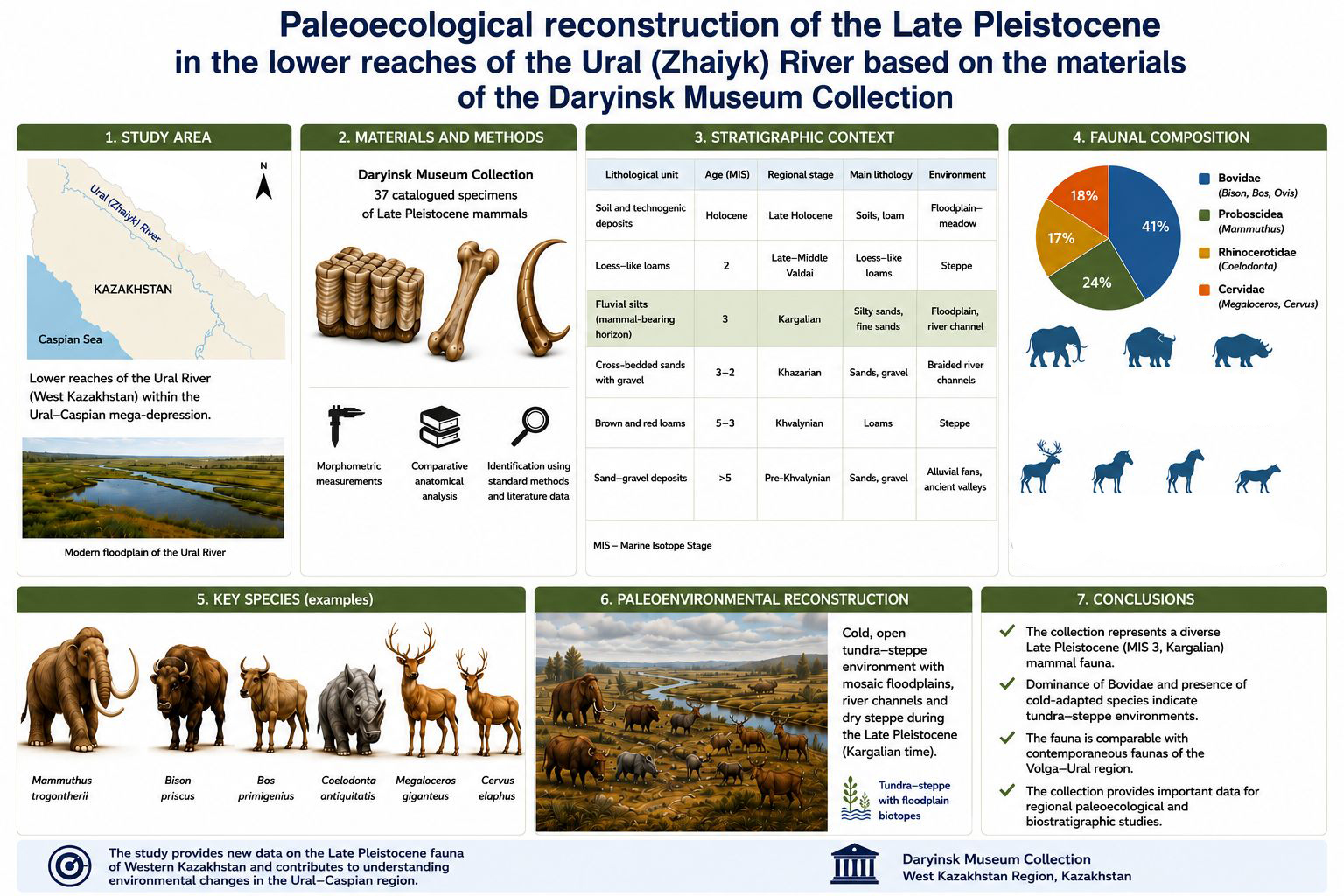
Paleoecological reconstruction of the Late Pleistocene in the lower reaches of the Ural (Zhaiyk) River based on the materials of the Daryinsk Museum Collection
DOI:
https://doi.org/10.31489/2026feb3/86-93Keywords:
Late Pleistocene, Western Kazakhstan, Ural (Zhaiyk) River, megafauna, paleoecological reconstruction,, museum collection, large mammals, QuaternaryAbstract
This article presents the results of a comprehensive study of a collection of Pleistocene mammal remains from the M.A. Sholokhov Memorial Museum (Daryinsk settlement, Baiterek District, West Kazakhstan Region). The material was collected from Late Pleistocene alluvial deposits in the lower reaches of the Ural (Zhaiyk) River and remained unidentified for a long time. Morphometric analyses allowed the collection to be documented and introduced into the scientific record for the first time, and enabled clarification of the taxonomic attribution of the large mammal remains. The collection includes skulls of Bos primigenius and Bison priscus, numerous postcranial elements and teeth of Mammuthus primigenius, a tooth of the transitional form Mammuthus trogontherii chosaricus, a femur of Coelodonta antiquitatis (Blumenbach, 1799), as well as antler beams of Megaloceros giganteus and Cervus elaphus. Comparative analyses following von den Driesch, Garutt, Dubrovo, and Foronova, together with comparisons with published series from the Ural–Volga–Caspian region, confirm the typical composition of the Pleistocene megafauna of Western Kazakhstan and indicate a broad spectrum of ecosystems, ranging from cold tundra–steppe environments to floodplain meadows. The results are significant for re-constructing Late Pleistocene palaeoecological conditions in the Ural–Caspian Lowland and for assessing environmental dynamics associated with climatic fluctuations.
References
1 Driesch A. A guide to the measurement of animal bones from archaeological sites / A. Driesch // Peabody Museum Bulletin. — 1976. — № 1. — 136 p.
2 Дуброво И.А. Систематическое положение слона Хазарского фаунистического комплекса / И.А. Дубово // Бюллетень комиссии по изучению четвертичного периода. — 1966. — № 32. — С. 63–74
3 Гарутт В.Е. Исследования зубов вымерших слонов: методические рекомендации / В.Е. Гарутт, И.В. Форонова. — Новосибирск: Наука, 1976. — 35 с.
4 Шер А.В. О методике определения генерации коренных зубов вымерших слонов / А.В. Шер, В.Е. Гарутт // Труды Зоологического института АН СССР. — 1985. — Т. 131. — С. 93–103.
5 Громова В.И. Первобытный бык или тур (Bos primigenius Boj.) в СССР / В.И. Громова // Ежегодник Зоологического музея АН СССР. — 1931. — Т. 32. — С. 293–364.
6 Русанов Б.С. Ископаемые бизоны Якутии / Б.С. Рувсанов. — Якутск: Якутское книжное издательство, 1975. — 143 с.
7 Хромов А.А. Эволюция рода Bison и морфологические адаптации первобытных бизонов Bison priscus Bojanus из неоплейстоцена Поволжья / А.А. Хромов // Труды университета «Дубна». Экология и науки о Земле. — 2004. — Вып. 1. — С. 195–208
8 Вислобокова И.А. Ископаемые олени Евразии / И.А. Вислобокова // Труды ПИН АН СССР. — 1990. — Т. 240. — 208 с.
9 Боескоров Г.Г. К систематике и распространению баранов рода Ovis (Artiodactyla, Bovidae) в плейстоцене и голоцене Сибири и Дальнего Востока / Г.Г. Боескоров // Зоологический журнал. — 2001. — Т. 80, № 2. — С. 243–256.
10 Titov V. Data on elephants from Middle–Upper Pleistocene sediments of Astrakhan Volga area (Astrakhan Region, Russia) / V. Titov, M. Golovachev // VI International Conference on Mammoths and their Relatives. — Thessaloniki, 2014. — P. 200.
11 Larramendi A. Shoulder height, body mass and shape of proboscideans / A. Larramendi // Acta Palaeontologica Polonica. — 2016. — Vol. 61, No. 3. — P. 537–574.
12 Obada T. Mammuthus cf. chosaricus (Dubrovo, 1966) from Duruitoarea Veche, Republic of Moldova / Т. Obada, А. David // Structura și funcționarea ecosistemelor în zona de interferență biogeografică. — Chișinău, 2008. — P. 209–211.
13 Яхимович В.Л. Плейстоцен нижнего течения р. Урал / В.Л. Яхимович и др. — Уфа, 1986. — 135 с.
14 Шкатова В.К. Значение нижнеуральского опорного разреза для стратиграфии и палеогеографии плейстоцена Западного Казахстана / В.К. Шкатович // Бюллетень комиссии по изучению четвертичного периода. — 1976. — № 45. — С. 73–82.
15 Якупова Д.Б. История изучения ископаемых позвоночных кайнозоя и мезозоя Западного Казахстана / Д.Б. Якупова, М.Т. Берлигужин, К.М. Ахмеденов // Материалы Международной научно-практической конференции «Биоразнообразие животного мира Казахстана». — Алматы, 2021. — С. 138.
16 Местонахождения ископаемых позвоночных фанерозоя Казахстана: справочник для палеонтологов, геологов и биологов / отв. ред. П.А. Тлеубердина. — Алматы, 2017. — 300 с.
17 Кожамкулова Б.С. Вымершие животные Казахстана (палеогеография позднего кайнозоя) / Б.С. Кожамкулова, Н.Н. Костенко. — Алма-Ата: Наука, 1984. — 104 с.
18 Labe B. Réhabilitation de Mammuthus intermedius (Jourdan, 1861), un mammouth (Mammalia, Elephantidae) du Pléistocène moyen récent d’Europe / B. Labe, C. Guérin // Comptes Rendus Palevol. — 2005. — Vol. 4. — P. 235–242.
19 Kahlke R.D. The origin of Eurasian Mammoth Faunas (Mammuthus-Coelodonta Faunal Complex) / R.D. Kahlke R.D. // Qua-ternary Science Reviews. — 2014. — Vol. 96. — P. 32–49.