Wild-Growing Species of the Genus Ribes L. in Central Kazakhstan: Bioecological Characteristics
DOI:
https://doi.org/10.31489/2026feb2/137-151Keywords:
Ribes L., Central Kazakhstan, bioecology, phytochemical composition, currants, medicinal plants, wild-growing speciesAbstract
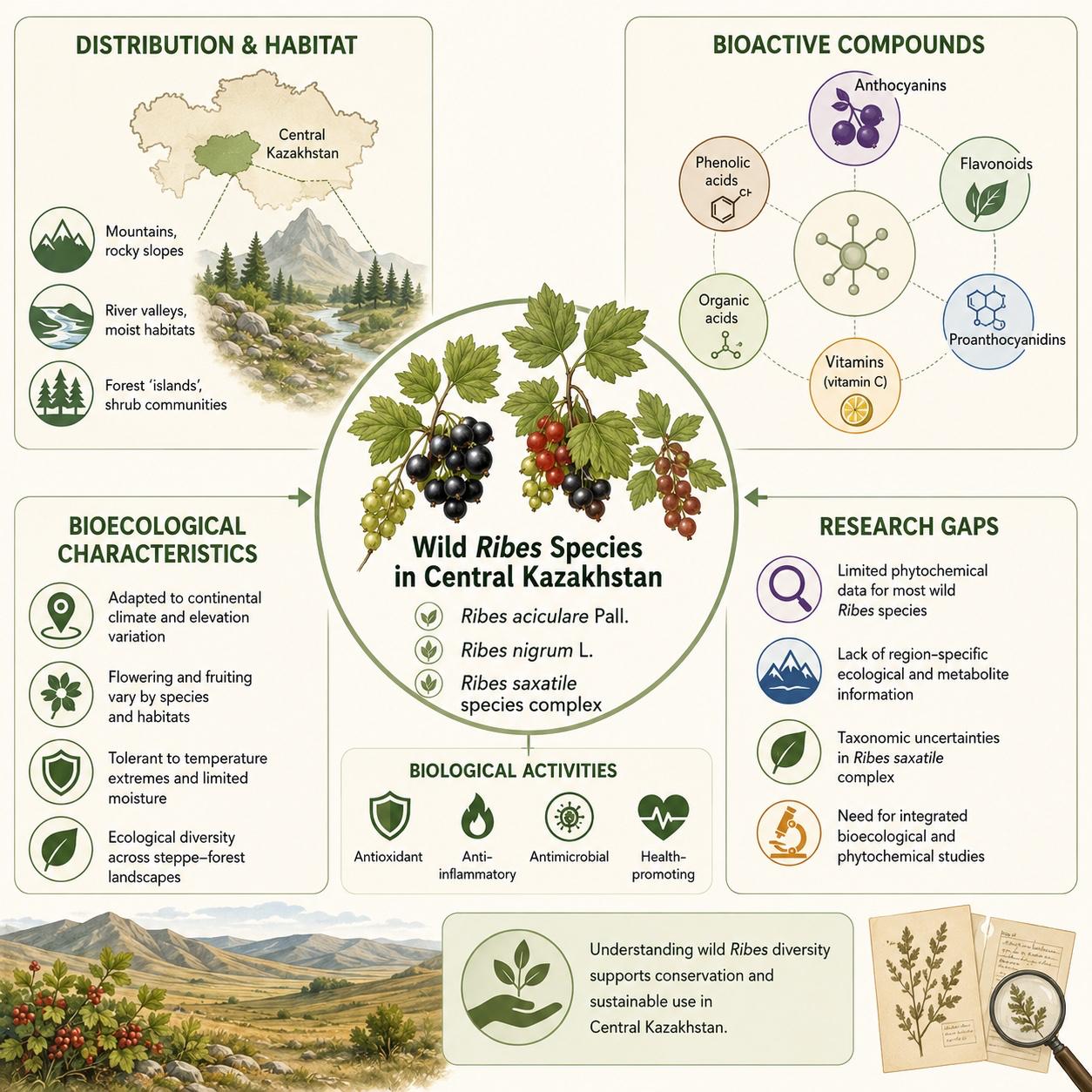
The genus Ribes L.(Grossulariaceae) comprises numerous species of ecological, nutritional, and medicinal importance that are widely distributed across temperate regions of the Northern Hemisphere. Central Kazakhstan represents a biogeographically complex area characterized by diverse landscapes and heterogeneous environmental conditions; however, information on wild-growing Ribes species in this region remains fragmented and insufficiently systematized. This review aims to synthesize and critically evaluate the available literature on the bioecological characteristics, phytochemical composition, and research prospects of wild Ribes species occurring in Central Kazakhstan, with particular focus on Ribes aciculare Pall., Ribes nigrum L., and representatives of the Ribes saxatile species complex. The review is based on an analysis of regional floristic sources, ecological studies, and phytochemical investigations published in international and regional scientific journals. Data on species distribution, habitat preferences, phenology, and ecological adaptations are summarized, together with information on major groups of bioactive compounds, including anthocyanins, flavonoids, proanthocyanidins, organic acids, and vitamins. Most phytochemical studies of the genus Ribes have focused on Ribes nigrum, which remains the best-studied species. In contrast, information on other wild Ribes taxa remains limited and scattered across different publications, making comprehensive evaluation difficult. Taxonomic uncertainties within the Ribes saxatile species complex further complicate regional research and highlight the importance of accurate species identification. The existing literature also reveals several important gaps, particularly regarding region-specific phytochemical characteristics, ecological variation among natural populations, and the influence of environmental factors on secondary metabolite accumulation. Further research integrating bioecological and phytochemical approaches is necessary to better understand wild Ribes diversity and support the sustainable use of these species in Central Kazakhstan.
References
1. 1 Bai, H., Zhao, X., Deng, R., Liu, Y., Du, Y., & Zheng, B. (2025). Species diversity and distribution patterns of wild Ribes in China. Bulletin of Botanical Research, 45(6), 975–983. https://doi.org/10.7525/j.issn.1673-5102.2025.06.014
2. 2 Boda, F., Ștefănescu, R., Sebestyen, M., Râștei, I., Laczkó-Zöld, E., &Farczádi, L. (2025). Pharmacognostic evaluation and antioxidant profiling of five varieties of Ribes nigrum grown in Romania. Plants, 14(11), 1604. https://doi.org/10.3390/plants14111604 DOI: https://doi.org/10.3390/plants14111604
3. 3 Brennan, R. M. (2008). Currants and gooseberries. In J. F. Hancock (Ed.). Temperate fruit crop breeding (pp. 177–196). Springer. DOI: https://doi.org/10.1007/978-1-4020-6907-9_6
4. 4 Brennan, R. M., & Graham, J. (2009). Improving fruit quality in Ribes species. Plant Breeding Reviews, 31, 203–243.
5. 5 Charters, Y. M., Wilkinson, M. J., & Kingsnorth, C. S. (2002). Molecular analysis of Ribes species and cultivars. Theoretical and Applied Genetics, 104(5), 879–888.
6. 6 Ciesarová, Z., Murkovic, M., Cejpek, K., Kreps, F., Tobolková, B., Koplík, R., Belajová, E., Kukurová, K., &Daško, Ľ. (2020). Why is Ribes nigrum a good source of antioxidants. Journal of Food Composition and Analysis, 85, 103309.
7. 7 Clifford, M. N. (2000). Anthocyanins — nature, occurrence and dietary burden. Journal of the Science of Food and Agriculture, 80(7), 1063–1072. DOI: https://doi.org/10.1002/(SICI)1097-0010(20000515)80:7<1063::AID-JSFA605>3.0.CO;2-Q
8. 8 Dobson, G., Shepherd, T., Verrall, S. R., Conner, S., Mc Dougall, G. J., Stewart, D., & Davies, H. V. (2012). Phyto chemical diversityin Ribes. Phyto chemistry, 76, 45–56.
9. 9 Flora of Kazakhstan Editorial Board. (1961–1975). Flora of Kazakhstan (Vols. 1–9). Academy of Sciences of the Kazakh SSR.
10. 10 Graham, J., Brennan, R., & McNicol, J. W. (1996). Genetic diversity in Ribes. Theoretical and Applied Genetics, 92(2), 164170.
11. 11 Hummer, K. E., & Barney, D. L. (2002). Currants. In J. Janick & A. Whipkey (Eds.). Trends in new crops and new uses (pp. 494–500). ASHS Press. DOI: https://doi.org/10.21273/HORTTECH.12.3.377
12. 12 Izteleuova, E. Y., Zhumashova, G. T., Bekezhanova, T. S., Allambergenova, Z. B., Zhaparkulova, K. A., Karaubayeva, A. A., Kaldybayeva, A. K., Sakipova, Z. B., Ibragimova, L. N., & Korona-Glowniak, I. (2025). The current state of knowledge on Ribes spp. plants. Plants, 14(20), 3196. https://doi.org/10.3390/plants14203196 DOI: https://doi.org/10.3390/plants14203196
13. 13 Kalendar, R., Tanskanen, J., Immonen, S., Nevo, E., & Schulman, A. H. (2000). Genomee volution of wild Ribes. Genome, 43(6), 1021–1029.
14. 14 Karakaya, S., & El, S. N. (1999). Phenolic composition of Ribes fruits. Food Chemistry, 67(1), 27–31. DOI: https://doi.org/10.1016/S0308-8146(99)00103-X
15. 15 Kaur, C., & Kapoor, H. C. (2001). Antioxidants in fruits and vegetables – the millennium’s health. International Journal of Food Science & Technology, 36(7), 703–725. DOI: https://doi.org/10.1111/j.1365-2621.2001.00513.x
16. 16 Klongsiriwet, C., Purintrapibal, W., Paphochanang, P., Prammanon, A., Huipaod, N., &Hiranyachattada, S. (2025). Effect of condensed tannins from black currant (Ribes nigrum) on acetylcholine-induced intestinal contractility. Science Asia, 51(5), 1–11. DOI: https://doi.org/10.2306/scienceasia1513-1874.2025.090
17. 17 Koponen, J. M., Happonen, A. M., Mattila, P. H., & Törrönen, A. R. (2007). Contents of anthocyanins in Ribes. Journal of Agricultural and Food Chemistry, 55(16), 6907–6913. DOI: https://doi.org/10.1021/jf062897a
18. 18 Krüger, E., & Dietrich, H. (2018). Black currant (Ribes nigrum): chemistry and functionality. Journal of Berry Research, 8(1), 1–12.
19. 19 Lee, J., Durst, R. W., &Wrolstad, R. E. (2005). Determination of total monomeric anthocyanin pigment content. Journal of AOAC International, 88(5), 1269–1278. DOI: https://doi.org/10.1093/jaoac/88.5.1269
20. 20 Minasyan, A., Pires, V., Gondcaille, C., Ginovyan, M., Mróz, M., Savary, S., Cherkaoui-Malki, M., Kusznierewicz, B., Bartoszek, A., Andreoletti, P., & Sahakyan, N. (2025). Ribes nigrum leaf extract regulates redox balance in microglial cells. BMC Complementary Medicine and Therapies, 25, 49. https://doi.org/10.1186/s12906-025-04780-7 DOI: https://doi.org/10.1186/s12906-025-04780-7
21. 21 Mamyrova, G., Moldaliev, Z., Kaarova, M., Kolomiiets, Y., & Kalinichenko, A. (2025). Biotechnological aspects of sawflies control in blackcurrant plantations. Scientific Horizons, 28(6), 65–76. DOI: https://doi.org/10.48077/scihor6.2025.65
22. 22 Pikunova, A., Goryunova, S., Goryunov, D., Golyaeva, O., Dolzhikova, M., & Pavlenko, A. (2022). Genetic diversity and pedigree analysis of red currant germplasm. Plants, 11(13), 1623. https://doi.org/10.3390/plants11131623 DOI: https://doi.org/10.3390/plants11131623
23. 23 Prior, R. L., Wu, X., & Schaich, K. (2005). Standardized methods for antioxidant capacity. Journal of Agricultural and Food Chemistry, 53(10), 4290–4302. DOI: https://doi.org/10.1021/jf0502698
24. 24 Rehder, A. (1940). Manual of cultivated trees and shrubs. Macmillan.
25. 25 Rice-Evans, C. A., Miller, N. J., & Paganga, G. (1997). Antioxidant properties of phenolic compounds. Trendsin Plant Science, 2(4), 152–159. DOI: https://doi.org/10.1016/S1360-1385(97)01018-2
26. 26 Sagdullaev, S. S., & Ishmuratova, M. Y. (2016). Flora of the Ulytau Mountains (Central Kazakhstan). Karaganda State University Press.
27. 27 Scalzo, J., Politi, A., Pellegrini, N., Mezzetti, B., & Battino, M. (2005). Plant genotype affects antioxidant capacity. Journal of Agricultural and Food Chemistry, 53(23), 108–110.
28. 28 Stintzing, F. C., & Carle, R. (2004). Functional properties of anthocyanins. Trends in Food Science & Technology, 15(1), 19–38. DOI: https://doi.org/10.1016/j.tifs.2003.07.004
29. 29 Tattini, M., Landi, M., Brunetti, C., Giordano, C., Remorini, D., & Gould, K. S. (2014). Flavonoids as antioxidants. Environmental and Experimental Botany, 114, 3–14.
30. 30 Wang, S. Y., & Lin, H. S. (2000). Antioxidant activity in fruits. Journal of Agricultural and Food Chemistry, 48(2), 140–146. DOI: https://doi.org/10.1021/jf9908345
31. 31 Zhao, X., Zhao, D., Ge, X., Zhang, Y., Du, Y., Liu, J., Liu, Y., Wang, H., & Zheng, B. (2025). Research on the species diversity and distribution patterns of wild Ribes in Northeast Asia. Plants, 14(12), 1780. https://doi.org/10.3390/plants14121780 DOI: https://doi.org/10.3390/plants14121780
32. 32 Sagdullaev, S. S., & Ishmuratova, M. Y. (2016). Flora of the Ulytau Mountains (Central Kazakhstan). Karaganda State University Press.
33. 33 Seeram, N. P. (2008). Berry fruits for cancer prevention. Journal of Agricultural and Food Chemistry, 56(3), 630–635. DOI: https://doi.org/10.1021/jf072504n
34. 34 Tattini, M., Landi, M., Brunetti, C., Giordano, C., Remorini, D., & Gould, K. S. (2014). Flavonoids as antioxidants. Environmental and Experimental Botany, 114, 3–14.
35. 35 Xu, J., Li, T., Liu, X., Shi, W., Zhang, D., & Chang, Y. (2025). Reference genes for expression normalization in Ribes odoratum. Scientific Reports, 15, 29214. https://doi.org/10.1038/s41598-025-12051-1 DOI: https://doi.org/10.1038/s41598-025-12051-1