Study of the genus Rosehip (Rosa) using molecular biological methods
DOI:
https://doi.org/10.31489/2026feb3/192-200Keywords:
rosehip, Rosa majalis, DNA barcoding, PCR, sequencing, phylogenetic analysisAbstract
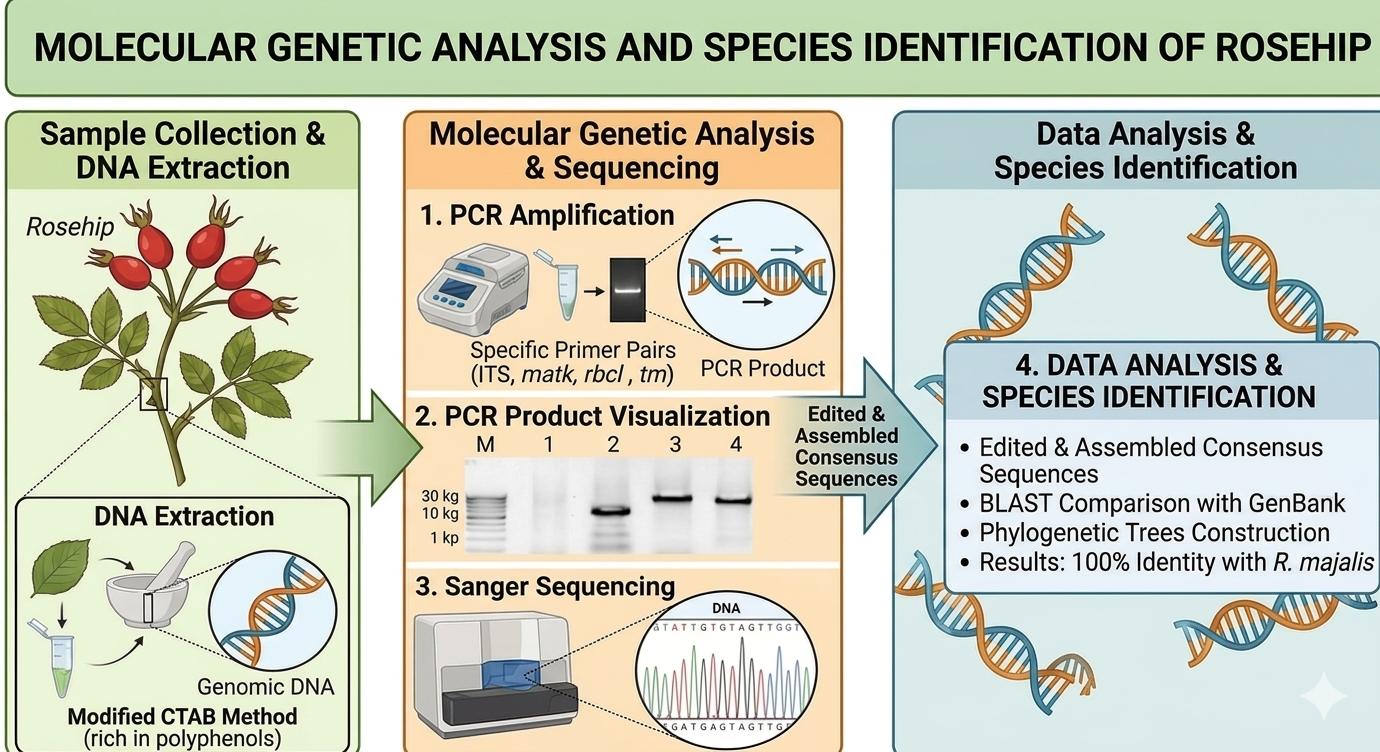
This study presents a molecular genetic analysis of a rosehip sample using DNA barcoding and phylogenetic approaches. The aim of the research was species identification based on comparative analysis of nucleotide sequences of nuclear and chloroplast marker genes ITS, matK, rbcL, and trn. Genomic DNA was extracted from rosehip leaves using a modified CTAB method optimized for plant material rich in polyphenolic compounds. Target DNA fragments were amplified by polymerase chain reaction using specific primer pairs. PCR products were visualized by agarose gel electrophoresis, purified, and sequenced using the Sanger method on an automated genetic analyzer. The obtained nucleotide sequences were edited, assembled into consensus sequences, and analyzed using SeqScape and MEGA software packages. Species identification was performed through sequence comparison with the GenBank database using the BLAST algorithm and by constructing phylogenetic trees. The results demonstrated 100% sequence identity of all studied genetic markers with reference sequences of Rosa majalis. Phylogenetic analysis confirmed that the investigated sample clustered with other representatives of this species within the genus Rosa. The findings indicate high diagnostic value of the selected DNA markers for reliable molecular identification of rosehip species. The integrated approach combining PCR amplification, sequencing, and phylogenetic analysis proved to be effective for taxonomic verification. The results may be applied in plant systematics, pharmacognosy, biodiversity studies, and quality control of medicinal plant raw materials.
References
1 Иващенко А.А. Растительный мир Казахстана. Научно-популярное издание / А.А. Иващенко. –– Алматы: Алматы кітап баспасы, 2009. — 176 с.
2 Павлов Н.В. Флора Казахстана / Н.В. Павлов. — Алма-Ата: Изд. Наука, 1961. — 639 с.
3 Муранец А.П. Изучение биоразнообразия дикоросов рода Rosa L. в Казахстане и их молекулярно-генетическая идентификация / А.П. Муранец, А.К. Есимсеитова, Д.А. Дюсембекова, А.С. Нуртаза, К.Р. Калыбаев, К.З. Кожанов, А.А. Какимжанова // Вестник Евразийского национального университета имени Л.Н. Гумилева. Серия Биологические науки. — 2022. — Т. 139, № 2. — С. 44–60. DOI: 10.32523/2616-7034-2022-139-2-44-60.
4 Аметов А.А. Характеристика растительных сообществ с участием Lonicera iliensis Pojark. в условиях среднего течения реки Или / А.А. Аметов, Н.М. Мухитдинов, К.Т. Абидкулова, Л.Н. Карашолакова, А. Ыдырыс // Вестник КазНУ. Серия биологическая. — 2016. — Т.4, № 69. — С. 12–21.
5 Семенютина А.В. Обоснование ассортимента шиповников для обогащения лесомелиоративных комплексов в засушливых условиях / А.В. Семенютина, А.С. Соломенцева // Известия Нижневолжского агроуниверситетского комплекса: наука и высшее профессиональное образование. — 2013. — № 3 (31). — С. 74–79.
6 Healey A. Protocol: a simple method for extracting next-generation sequencing quality genomic DNA from recalcitrant plant species / A. Healey, A. Furtado, T. Cooper et al. // Plant Methods. — 2014. — Vol. 10, No. 21. DOI: https://doi.org/10.1186/1746-4811-10-21.
7 Kim C.S. A simple and rapid method for isolation of high quality genomic DNA from fruit trees and conifers using PVP / C.S. Kim, C.H. Lee, J.S. Shin, Y.S. Chung, N.I. Hyung // Nucleic Acids Res. — 1997. — Vol. 25. — P. 1085-1086. 10.1093/nar/25.5.1085.
8 Johnsen K. Phenotypic and genotypic characterization of phenanthrene-degrading fluorescent Pseudomonas biotypes / K. Johnsen, S. Andersen, C.S. Jacobsen // Appl. Environ. Microbiol. — 1996. — Vol. 62, No. 10. — P. 3818–3825.
9 Scarpellini M. Development of PCR assay to identify Pseudomonas fluorescens and its biotype / M. Scarpellini, L. Franzetti, A. Galli // FEMS Microbiol. Lett. — 2004. — Vol. 236 (2). — P. 257–260. DOI: 10.1016/j.femsle.2004.05.043.
10 Ramesh R. Polymerase chain reaction / R. Ramesh, A. Munshi, S.K. Panda // Natl Med J India. — 1992. — Vol. 5, No. 3. — Р. 115–119.
11 Lee P.Y. Agarose gel electrophoresis for the separation of DNA fragments / P.Y. Lee, J. Costumbrado, C.Y. Hsu, Y.H. Kim // J. Vis. Exp. — 2012. — No. 62. — Article e3923. DOI: 10.3791/3923.
12 Eren K. DNA sequencing methods: from past to present / K. Eren, N. Taktakoğlu, I. Pirim // Eurasian J. Med. — 2022. — Vol. 54. — P. 47–56. DOI: 10.5152/eurasianjmed.2022.22280.
13 Chen Y. Magnetic particles for integrated nucleic acid purification, amplification and detection without pipetting / Y. Chen, Y. Liu, Y. Shi, J. Ping, J. Wu, H. Chen // Trends Analyt Chem. — 2020. — No. 127. — P. 115912. DOI: 10.1016/j.trac.2020.115912.
14 Liu G-Q. The molecular phylogeny of land plants: progress and future prospects / G-Q. Liu, L. Lian, W. Wang // Diversity. — 2022. — Vol. 14, No. 10. — P. 782. DOI: https://doi.org/10.3390/d14100782.
15 Edwards S.V. Natural selection and phylogenetic analysis / S.V. Edwards // Proc. Natl. Acad. Sci. U.S.A. — 2009. —
Vol. 106. — No. 22. — Р. 8799–8800. DOI: https://doi.org/10.1073/pnas.0904103106.
16 Bakiyev S.S. Isolation, identification, and characterization of pathogenic Aeromonas hydrophila from critically endangered Acipenser baerii / S.S. Bakiyev, I. Smekenov, I. Zharkova, S. Kobegenova, N. Sergaliyev, G. Absatirov, A. Bissenbaev // Aquaculture Reports, 26, 101293. — 2022. — Р. 1–11.