Surveillance of West Nile Fever in the Republic of Kazakhstan, 2023–2025
DOI:
https://doi.org/10.31489/2026feb2/164-177Keywords:
monitoring, PCR, West Nile Virus, flaviviruses, wild birds, mosquitoes, ticks, bats, epizootiological monitoringAbstract
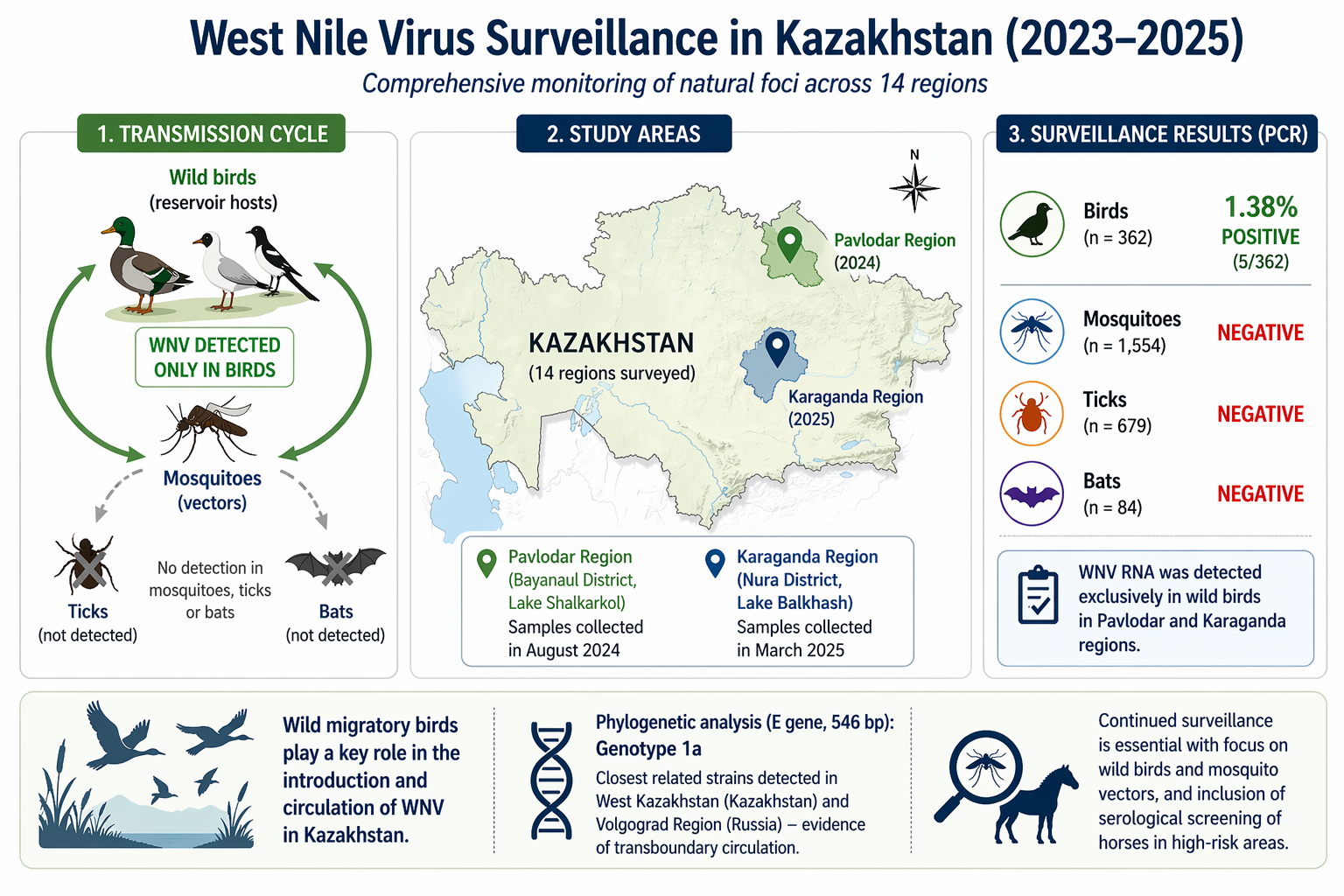
In 2023–2025, comprehensive monitoring of West Nile fever (WNF) was conducted across 14 regions of the Republic of Kazakhstan to assess virus circulation in natural foci. The study included the main potential reservoirs and vectors of the pathogen, namely wild migratory birds, mosquitoes, ixodid ticks, and bats. A total of 362 biological samples from wild birds, 84 samples from bats, 679 ticks, and 1,554 mosquitoes were examined. Laboratory diagnostics were performed using polymerase chain reaction (PCR) with primers specific to West Nile virus. According to the results, West Nile virus RNA was detected exclusively in wild birds—in 5 of 362 samples, corresponding to a prevalence of 1.38 % (95 % CI: 0.45–3.19 %). No West Nile virus RNA was detected in samples obtained from mosquitoes, ticks, or bats. Positive samples were detected in wild birds from the Pavlodar and Karaganda regions. The obtained data confirm the leading role of migratory birds in the introduction of West Nile virus into the territory of Kazakhstan and indicate the need for continued systematic epizootiological and molecular monitoring to assess the risk of the formation and maintenance of natural infection foci.
References
1 Nash, D., Mostashari, F., Fine, A., et al. (2001). The outbreak of West Nile virus infection in the New York City area in 1999. New England Journal of Medicine, 344(24), 1807–1814. DOI: https://doi.org/10.1056/NEJM200106143442401
2 Chancey, C., Grinev, A., Volkova, E., & Rios, M. (2015). The global ecology and epidemiology of West Nile virus. BioMed Research International, 2015, Art. ID 376230. https://doi.org/10.1155/2015/376230 DOI: https://doi.org/10.1155/2015/376230
3 Balanca, G., Gaidet, N., Savini, G., et al. (2009). Low West Nile virus circulation in wild birds in an area of recurring outbreaks in Southern France. Vector-Borne and Zoonotic Diseases, 9(6), 737–741. https://doi.org/10.1089/vbz.2008.0147 DOI: https://doi.org/10.1089/vbz.2008.0147
4 Bernkopf, H., Levine, S., & Nerson, R. (1953). Isolation of West Nile virus in Israel. Journal of Infectious Diseases, 93(3), 207–218. DOI: https://doi.org/10.1093/infdis/93.3.207
5 Jupp, P.G. (2001). The ecology of West Nile virus in South Africa and the occurrence of outbreaks in humans. Annals of the New York Academy of Sciences, 951, 143–152. DOI: https://doi.org/10.1111/j.1749-6632.2001.tb02692.x
6 Murgue, B., Murri, S., Triki, H., Deubel, V., & Zeller, H.G. (2001). West Nile virus in the Mediterranean basin: 1950–2000. Annals of the New York Academy of Sciences, 951, 117–126. DOI: https://doi.org/10.1111/j.1749-6632.2001.tb02690.x
7 Hayes, E.B., Komar, N., Nasci, R.S., Montgomery, S.P., O’Leary, D.R., & Campbell, G.L. (2005). Epidemiology and trans-mission dynamics of West Nile virus disease. Emerging Infectious Diseases, 11(8), 1167–1173. DOI: https://doi.org/10.3201/eid1108.050289a
8 Swetnam, D., Widen, S.G., Wood, T.G., et al. (2018). Terrestrial bird migration and West Nile virus circulation, United States. Emerging Infectious Diseases, 24(12), 2184–2194. DOI: https://doi.org/10.3201/eid2412.180382
9 Campbell, G.L., Marfin, A.A., Lanciotti, R.S., & Gubler, D.J. (2002). West Nile virus. The Lancet Infectious Diseases, 2(9), 519–529. DOI: https://doi.org/10.1016/S1473-3099(02)00368-7
10 Petersen, L.R., Brault, A.C., & Nasci, R.S. (2013). West Nile virus: Review of the literature. JAMA, 310(3), 308–315. DOI: https://doi.org/10.1001/jama.2013.8042
11 World Health Organization. (2017). West Nile virus: Fact sheet. www.who.int. https://www.who.int/news-room/fact-sheets/detail/west-nile-virus
12 Ostapchuk, Y.O., Zhigailov, A.V., Perfilyeva, Y.V., Shumilina, A.G., Yeraliyeva, L.T., Nizkorodova, A.S., Kuznetsova, T.V., Iskakova, F.A., Berdygulova, Z.A., Neupokoeva, A.S., & Mamadaliyev, S.M. (2020). Two case reports of neuroinvasive West Nile virus infection in the Almaty region, Kazakhstan. IDCases, Art. e00872. https://doi.org/10.1016/j.idcr.2020.e00872 DOI: https://doi.org/10.1016/j.idcr.2020.e00872
13 Egemberdieva, R.A., Shapieva, Zh.Zh., Dmitrovskii, A.M., Maikanov, N.S., Musralina, L.Z., & Ergalieva, A.A. (2019). Lik-horadka Zapadnogo Nila: kliniko-epidemiologicheskie proiavleniia [West Nile fever: Clinical and epidemiological manifestations]. Vestnik Kazakhskogo Natsionalnogo Meditsinskogo Universiteta — Bulletin of the National Medical University, 2, 17–20 [in Russian].
14 Kerimbayev, A.A., Musaeva, G.K., Omarova, Z.D., Rystaeva, R.A., Kopeev, S.K., Rametov, N.M., & Orynbaev, M.B. (2015). Monitoring likhoradki Zapadnogo Nila sredi dikikh ptits na territorii RK [Monitoring of West Nile fever among wild birds in Kazakhstan]. Vestnik Gosudarstvennogo universiteta imeni Shakarima goroda Semei — Bulletin of the Shakarim State University of Semey, 4(72), 150–162 [in Russian].
15 Alibekova, D.A., Smith, G.J., Argimbayeva, T.U., Omarova, Z.D., Rystaeva, R.A., Yermekbay, T.T., Tulendibayev, A.B., Aubakir, N.A., & Orynbaev, M.B. (2023). Likhoradka Zapadnogo Nila sredi dikikh ptits v yuzhnykh regionakh Kazakhstana [West Nile fever among wild birds in southern Kazakhstan]. Biotehnologiia i biologicheskaia bezopasnost: dostizheniia i perspektivy razvitiia. Materialy Mezhdunarodnoi nauchno-prakticheskoi konferentsii, posviashchennoi 65-letiiu Nauchno-issledovatelskogo instituta problem biologicheskoi bezopasnosti Ministerstvo Zdravookhraneniia Respubliki Kazakhstan — Biotech-nology and Biological Safety: Achievements and Development Prospects Proceedings of the International Scientific and Practical Conference dedicated to the 65th anniversary of the Research Institute for Biological Safety Problems of the Ministry of Health of the Republic of Kazakhstan (pp. 170-171) [in Russian].
16 World Organisation for Animal Health (WOAH). (2024). Manual of diagnostic tests and vaccines for terrestrial animals (13th ed., Chapter 2.1.24: West Nile fever). Paris: WOAH.
17 Tamura, K., Stecher, G., Peterson, D., Filipski, A., & Kumar, S. (2013). MEGA6: Molecular evolutionary genetics analysis version 6.0. Molecular Biology and Evolution, 30(12), 2725–2729. https://doi.org/10.1093/molbev/mst197 DOI: https://doi.org/10.1093/molbev/mst197
18 Palmieri, C., Franca, M., Uzal, F., Anderson, M., Barr, B., Woods, L., Moore, J., Woolcock, P., & Shivaprasad, H. L. (2011). Pathology and immunohistochemical findings of West Nile virus infection in Psittaciformes. Veterinary Pathology, 48, 975–984. DOI: https://doi.org/10.1177/0300985810391112
19 Sultankulova, K.T., Melisbek, A.M., Kozhabergenov, N.S., Burashev, Y.D., Mukhami, N.N., Zakarya, K.D., & Orynbaev, M.B. (2021). Detection of West Nile fever among wild birds in Kazakhstan. Eurasian Journal of Ecology, 68(3), 64–71. https://doi.org/10.26577/EJE.2021.v68.i3.07 DOI: https://doi.org/10.26577/EJE.2021.v68.i3.07
20 Hook, S.A., Nelson, C.A., & Mead, P.S. (2021). West Nile virus: Biology, transmission, and human infection. Clinical Microbiology Reviews, 35(1), e00103-21. https://doi.org/10.1128/CMR.00103-21
21 Anderson, J.F., Andreadis, T.G., Vossbrinck, C.R., Tirrell, S., Wakem, E.M., French, R.A., & Garmendia, A.E. (1999). Isola-tion of West Nile virus from mosquitoes, crows, and a Cooper’s hawk in Connecticut. Science, 286, 2331–2333. https://doi.org/10.1126/science.286.5448.233 DOI: https://doi.org/10.1126/science.286.5448.2331
22 Grazhdanov, A.K., Ayazbayev, T.Z., Toporkov, A.V., Bidashko, F.G., Zakharov, A.V., Belonozhkina, L.B., Pak, M.V., & Andryushchenko, A.V. (2014). O vyiavlenii novykh prirodnykh ochagov aktualnykh infektsionnykh boleznei na zapade Kazakhstana [Identification of new natural foci of infectious diseases in western Kazakhstan]. Problemy osobo opasnykh infektsii — Problems of especially dangerous infections, 3, 20–24 [in Russian]. DOI: https://doi.org/10.21055/0370-1069-2014-3-20-24
23 Alibekova, D.A., Barakbayev, K.B., Omarova, Z.D., Rystaeva, R.A., Sultankulova, K.T., Burashev, Y.D., Argimbayeva, T.U., Tulendibayev, A.B., Aubakir, N.A., Yermekbay, T.T., Abeuov, K.B., Kerimbayev, A.A., & Orynbaev, M.B. (2025). Serological investigations on West Nile virus in horses in Kazakhstan. Microorganisms, 13, Art. 2541. https://doi.org/10.3390/microorganisms13112541 DOI: https://doi.org/10.3390/microorganisms13112541
24 World Organisation for Animal Health (WOAH) (2023). West Nile fever. In Manual of diagnostic tests and vaccines for ter-restrial animals. Paris: WOAH.
25 Metz, M.B.C., Olufemi, O.T., Daly, J.M., & Barba, M. (2021). Systematic review and meta-analysis of seroprevalence studies of West Nile virus in equids in Europe between 2001 and 2018. Transboundary and Emerging Diseases, 68(4), 1814–1823. https://doi.org/10.1111/tbed.13866 DOI: https://doi.org/10.1111/tbed.13866
26 Centers for Disease Control and Prevention. (2022). West Nile virus: Veterinary impact. www.cdc.gov. Retrieved from https://www.cdc.gov/westnile/veterinarians/index.html
27 Platonov, A.E., Fedorova, M.V., Karan, L.S., Shopenskaya, T.A., Platonova, O.V., & Zhuravlev, V. I. (2008). Epidemiology of West Nile infection in Volgograd, Russia, in relation to climate change and mosquito bionomics. Parasitology Research, 103(Suppl. 1), S45–S53. https://doi.org/10.1007/s00436-008-1050-0 DOI: https://doi.org/10.1007/s00436-008-1050-0
28 Platonov, A.E., Shipulin, G.A., Shipulina, O.Y., Tyutyunnik, E.N., Frolochkina, T.I., Lanciotti, R.S., Yazyshina, S.,
Platonova, O.V., Obukhov, I.L., Zhukov, A.N., Vengerov, Y.Y., & Pokrovskii, V.I. (2001). Outbreak of West Nile virus infection, Volgograd Region, Russia, 1999. Emerging Infectious Diseases, 7(1), 128–132. https://doi.org/10.3201/eid0701.010118 DOI: https://doi.org/10.3201/eid0701.010118
29 Nurmakhanov, T., Sansyzbaev, Y., Atshabar, B., Berlin, V., Kobzhasarov, D., Yeskhojayev, O., Vilkova, A., Ayazbayev, T., Andryushchenko, A., Bidashko, F., Hay, J., & Shvetsov, A. (2021). Phylogenetic characteristics of West Nile virus isolated from Culex modestus mosquitoes in West Kazakhstan. Frontiers in Public Health, 8, Art. 575187. https://doi.org/10.3389/fpubh.2020.575187 DOI: https://doi.org/10.3389/fpubh.2020.575187
30 Grazhdanov, A.K., Kozhanova, O.I., Toporkov, A.V., Ayazbayev, T.Z., Matveeva, N.I., Karnaukhov, I.G., Popov, N.V., Razdorskii, A.S., & Arkhipova, G.N. (2013). Sravnitelnyi analiz proiavlenii opasnykh infektsii v Saratovskoi i Zapadno-Kazakhstanskoi oblastiakh v tseliakh sovremennoi otsenki epidemiologicheskikh riskov [Comparative analysis of dangerous infections in Saratov and West Kazakhstan regions]. Problemy osobo opasnykh infektsii — Problems of especially dangerous infections, 4, 38–44 [in Russian].