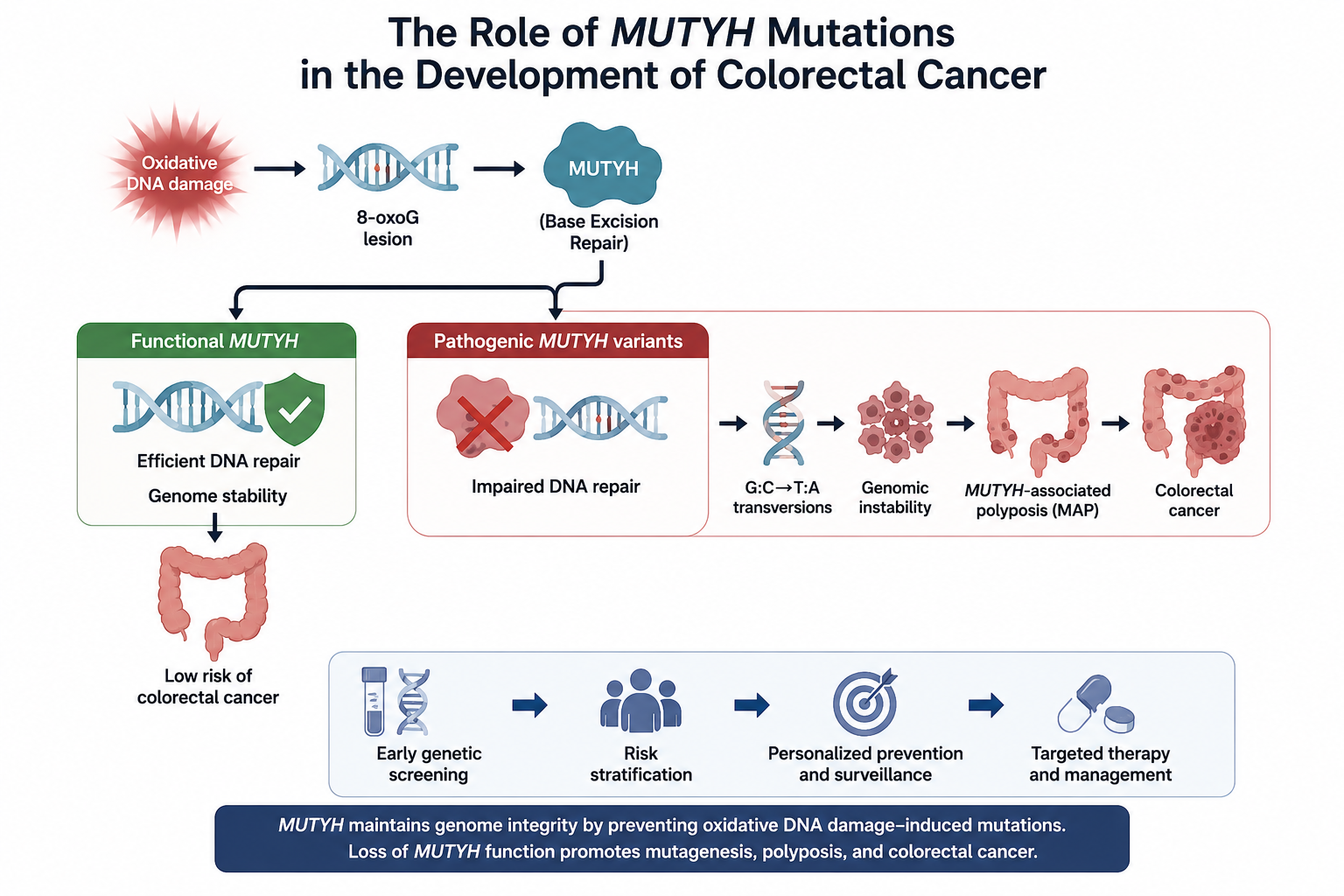
The role of mutations in the MUTYH gene in the development of colorectal cancer
DOI:
https://doi.org/10.31489/2026feb3/103-111Keywords:
base excision repair, adenine DNA glycosylase , DNA repair, MUTYH, colorectal cancerAbstract
Mutations in the MUTYH gene, which encodes a DNA glycosylase, are associated with an increased risk of colorectal cancer (CRC), particularly in individuals with hereditary MUTYH-associated polyposis (MAP). MUTYH is an essential component of the base excision repair (BER) pathway, where it removes adenine resi-dues that are mispaired with 8-oxoguanine (8-oxoG), a major product of oxidative DNA damage. Loss of MUTYH function caused by pathogenic variants promotes the accumulation of oxidative DNA damage-associated mutations, including G:C→T:A transversions, thereby contributing to genomic instability and colo-rectal tumorigenesis. This review examines the pathogenic mechanisms underlying MAP and its characteristic phenotypic features. Structural and functional studies indicate that many pathogenic MUTYH variants result in reduced adenine DNA glycosylase activity, leading to impaired base excision repair. Potential therapeutic strate-gies aimed at restoring or compensating for defective MUTYH function are being investigated, including ap-proaches based on synthetic lethality. Increasing attention is also being paid to molecular genetic testing for bial-lelic pathogenic variants in the MUTYH gene, particularly in individuals with clinical or family histories sug-gestive of hereditary colorectal cancer or polyposis. Identification of such variants may enable more precise risk assessment and facilitate personalized surveillance and preventive management. Overall, advances in under-standing the role of MUTYH in genome maintenance have provided important insights into the pathogenesis of MAP and created opportunities for improving the diagnosis, risk stratification, and management of colorectal cancer.
References
1 Siegel, R. L., Miller, K. D., Fuchs, H. E., & Jemal, A. (2022). Cancer statistics, 2022. CA: A Cancer Journal for Clinicians, 72(1), 7–33. https://doi.org/10.3322/caac.21708
2 Kantor, M., Sobrado, J., Patel, S., Eiseler, S., & Ochner, C. (2017). Hereditary colorectal tumors: A literature review on MUTYH-associated polyposis. Gastroenterology Research and Practice, 2017, Article ID 8693182. https://doi.org/10.1155/2017/8693182
3 Venesio, T., Balsamo, A., D’Agostino, V. G., & Ranzani, G. N. (2012). MUTYH-associated polyposis (MAP), the syndrome implicating base excision repair in inherited predisposition to colorectal tumors. Frontiers in Oncology, 2, Article ID 83. https://doi.org/10.3389/fonc.2012.00083
4 Curia, M. C., Catalano, T., & Aceto, G. M. (2020). MUTYH: Not just polyposis. World Journal of Clinical Oncology, 11(7), 428–449. https://doi.org/10.5306/wjco.v11.i7.428
5 Nakamura, T., Okabe, K., Hirayama, S., Chirifu, M., Ikemizu, S., Morioka, H., Nakabeppu, Y., & Yamagata, Y. (2021). Structure of the mammalian adenine DNA glycosylase MUTYH: Insights into the base excision repair pathway and cancer. Nucleic Acids Research, 49(12), 7154–7163. https://doi.org/10.1093/nar/gkab492
6 Kairupan, C., & Scott, R. J. (2007). Base excision repair and the role of MUTYH. Hereditary Cancer in Clinical Practice, 5, Article ID 199.https://doi.org/10.1186/1897-4287-5-4-199
7 Guarinos, C., Juárez, M., Egoavil, C., Castillejo, A., Barberá, V. M., Pérez-Cabornero, L., Sánchez-Heras, A. B., Castellví-Bel, S., Llor, X., & Castells, A. (2014). Prevalence and characteristics of MUTYH-associated polyposis in patients with multiple adenomatous and serrated polyps. Clinical Cancer Research, 20(5), 1158–1168. https://doi.org/10.1158/1078-0432.CCR-13-1490
8 David, S. S., O’Shea, V. L., & Kundu, S. (2007). Base-excision repair of oxidative DNA damage. Nature, 447, 941–950. https://doi.org/10.1038/nature05978
9 Dizdaroglu, M., Coskun, E., & Jaruga, P. (2017). Repair of oxidatively induced DNA damage by DNA glycosylases: Mechanisms of action, substrate specificities and excision kinetics. Mutation Research/Reviews in Mutation Research, 763, 212–245. https://doi.org/10.1016/j.mrrev.2017.02.001
10 Al-Tassan, N., Chmiel, N., Maynard, J., Fleming, N., Livingston, A. L., Williams, G. T., Hodges, A. K., Davies, D. R., David, S. S., Sampson, J. R., & Cheadle, J. P. (2002). Inherited variants of MYH associated with somatic G: C→T: A mutations in colorectal tumors. Nature Genetics, 30, 227–232. https://doi.org/10.1038/ng828
11 Buisine, M. P., Bonadona, V., Baert-Desurmont, S., Frebourg, T., Olschwang, S., Parc, Y., Taieb, J., Saurin, J. C., & Laurent-Puig, P. (2020). MUTYH-associated polyposis: Review and update of the French recommendations. Bulletin du Cancer, 107(5), 586–600. https://doi.org/10.1016/j.bulcan.2020.02.004
12 Wallace, S. S. (2014). Base excision repair: A critical player in many games. DNA Repair, 19, 14–26. https://doi.org/10.1016/j.dnarep.2014.02.011
13 Majumdar, C., Demir, M., Merrill, S. R., Pande, P., & David, S. S. (2024). FSHing for DNA damage: Key features of MutY detection of 8-oxoguanine: adenine mismatches. Accounts of Chemical Research, 57(7), 1019–1031. https://doi.org/10.1021/acs.accounts.3c00759
14 Talhaoui, I., Matkarimov, B. T., Tchenio, T., Zharkov, D. O., & Saparbaev, M. K. (2017). Aberrant base excision repair pathway of oxidatively damaged DNA. Free Radical Biology and Medicine, 107, 266–277. https://doi.org/10.1016/j.freeradbiomed.2016.11.040
15 Trasviña-Arenas, C. H., Dissanayake, U. C., Tamayo, N., Merrill, S. R., Demir, M., Majumdar, C., & David, S. S. (2025). Structure of human MUTYH and functional profiling of cancer-associated variants. Nature Communications, 16, Article ID 1234. https://doi.org/10.1038/s41467-025-58361-w
16 Nuñez, N., Majumdar, C., Lay, K. T., & David, S. S. (2018). Fe–S clusters and MutY base excision repair glycosylases. Methods in Enzymology, 599, 21–68. https://doi.org/10.1016/bs.mie.2017.11.035
17 McDonnell, K. J., Chemler, J. A., Bartels, P. L., Sloggett, S., Viner, R., Chatterjee, N., Barton, J. K., & David, S. S. (2018). A human MUTYH variant linking colonic polyposis to redox degradation of the [4Fe–4S]²⁺ cluster. Nature Chemistry, 10, 752–759. https://doi.org/10.1038/s41557-018-0068-x
18 Magrin, L., Fanale, D., Brando, C., Corsini, L. R., Calò, V., Bazan, V., & Russo, A. (2022). MUTYH-associated tumor syndrome: The other face of MAP. Oncogene, 41, 2531–2539. https://doi.org/10.1038/s41388-022-02304-y
19 Banda, D. M., Nuñez, N. N., Burnside, M. A., Bradshaw, E. M., & David, S. S. (2017). Repair of 8-oxoG: A mismatches by the MUTYH glycosylase. Free Radical Biology and Medicine, 107, 202–215. https://doi.org/10.1016/j.freeradbiomed.2017.01.008
20 Grasso, F., Di Meo, S., De Luca, G., & Venditti, P. (2015). The MUTYH base excision repair gene protects against inflammation-associated colorectal carcinogenesis. Oncotarget, 6(27), 19671–19684. https://doi.org/10.18632/oncotarget.4284
21 Trasviña-Arenas, C. H., Demir, M., Lin, W. -J., & David, S. S. (2021). Structure, function and evolution of the helix–hairpin–helix DNA glycosylase superfamily. DNA Repair, 108, Article ID 103231. https://doi.org/10.1016/j.dnarep.2021.103231
22 Manlove, A. H., McKibbin, P. L., Doyle, E. L., Majumdar, C., Hamm, M. L., & David, S. S. (2017). Structure–activity relationships reveal key features of 8-oxoguanine: adenine mismatch detection by the MutY glycosylase. ACS Chemical Biology, 12(9), 2335–2344. https://doi.org/10.1021/acschembio.7b00389
23 Limpose, K. L., Corbett, A. H., & Doetsch, P. W. (2017). BERing the burden of damage: Pathway crosstalk and post-translational modification of base excision repair proteins regulate DNA damage management. DNA Repair, 56, 51–64. https://doi.org/10.1016/j.dnarep.2017.06.007
24 Markkanen, E., Dorn, J., & Hübscher, U. (2015). Mutagenic processing of 8-oxoguanine- and 8-oxoadenine-containing DNA by human DNA polymerases η and κ. DNA Repair, 21, 58–67. https://doi.org/10.1016/j.dnarep.2014.06.007
25 Sanchez-Mete, L., Mosciatti, L., Casadio, M., Vittori, L., Martayan, A., & Stigliano, V. (2023). MUTYH-associated polyposis: Is it time to change upper gastrointestinal surveillance? World Journal of Gastrointestinal Oncology, 15(11), 1891–1899. https://doi.org/10.4251/wjgo.v15.i11.1891
26 Curia, G., Catalano, F., & Aceto, S. (2023). The multifaceted role of MUTYH in cancer and beyond: From molecular mechanisms to therapeutic opportunities. Biomedicines, 11(10), Article ID 2700. https://doi.org/10.3390/biomedicines11102700
27 Morcillo, M., Yagüe, M. L., Pérez-Cabornero, M., Infante, E., Lastra, E., & Urioste, M. (2020). Molecular pathogenesis of MUTYH-associated polyposis and implications for clinical management. Cancers, 12(9), Article ID 2680. https://doi.org/10.3390/cancers12092680
28 Weren, R. D. A., Ligtenberg, M. J. L., Kets, C. M., de Voer, R. M., Verwiel, E. T. P., Spruijt, L., van Zelst-Stams, W. A. G., Jongmans, M. C. J., & Hoogerbrugge, N. (2021). Cancer risks associated with monoallelic MUTYH pathogenic variants: A retrospective cohort study. Genetics in Medicine, 23(7), 1340–1346. https://doi.org/10.1038/s41436-021-01234-9
29 Nielsen, M., Joerink-van de Beld, M. C., Jones, N., Vogt, S., Tops, C. M., Vasen, H. F. A., Sampson, J. R., Aretz, S., &
Hes, F. J. (2009). Analysis of MUTYH Genotypes and Colorectal Phenotypes in Patients With MUTYH-Associated Polyposis. Gastroenterology, 136(2), 471–476. https://doi.org/10.1053/j.gastro.2008.10.056
30 Vogt, S., Jones, N., Christian, D., Engel, C., Nielsen, M., Kaufmann, A., Steinke, V., Vasen, H. F. A., & Hes, F. J. (2009). Expanded extracolonic tumor spectrum in MUTYH-associated polyposis. Gastroenterology, 137(6), 1976–1985. e1–10. https://doi.org/10.1053/j.gastro.2009.08.052
31 Win, A. K., Young, J. P., Lindor, N. M., Tucker, K. M., Ahnen, D. J., & Young, G. P. (2012). Colorectal and other cancer risks for carriers and noncarriers from families with a DNA mismatch repair gene mutation: a prospective cohort study. Journal of Clin-ical Oncology, 30(9), 958–964. https://doi.org/10.1200/JCO.2011.39.5590
32 Nieuwenhuis, M. H., and Vasen, H. F. A. (2007). Correlations between genotype and phenotype of familial adenomatous polyposis. Critical Reviews in Oncology/Hematology, 61, 153–161. https://doi.org/10.1016/j.critrevonc.2006.07.004
33 Lubbe, S. J., Di Bernardo, M. C., Chandler, I. P., & Houlston, R. S. (2009). Clinical Implications of the Colorectal Cancer Risk Associated With MUTYH Mutation. Journal of Clinical Oncology, 27(24), 3975–3980. https://doi.org/10.1200/JCO.2008.21.6853
34 Lucci-Cordisco, E., Amenta, S., Panfili, A., Del Valle, J., Capellá, G., & Pineda, M. (2022). Variants of uncertain significance (VUS) in cancer predisposing genes: What are we learning from multigene panels? European Journal of Medical Genetics, 65(1), 104400. https://doi.org/10.1016/j.ejmg.2021.104400
35 Nielsen, M., Morreau, H., Vasen, H. F. A., & Hes, F. J. (2011). MUTYH-associated polyposis (MAP). Critical Reviews in Oncology/Hematology, 79(1), 1–16. https://doi.org/10.1016/j.critrevonc.2010.05.011