Organelle Dynamics during Salinity-Induced Programmed Cell Death in Plants
DOI:
https://doi.org/10.31489/2026feb3/17-29Keywords:
Programmed cell death, salinity stress, reactive oxygen species, nitic oxide, phytohormones, enzymeAbstract
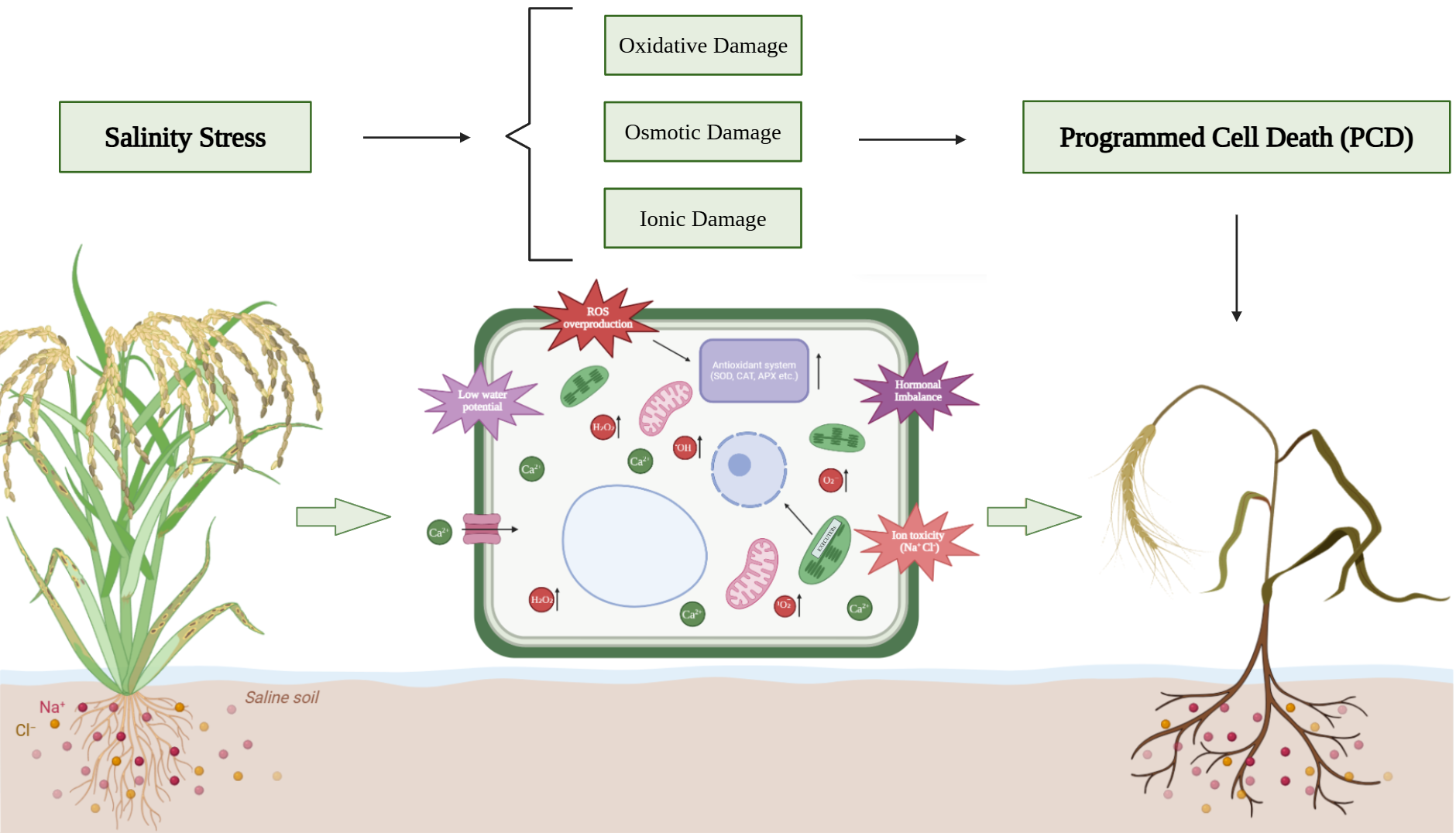
Programmed cell death (PCD) is a complex mechanism induced by environmental stress (ePCD) or developmental processes (dPCD). ePCD can be triggered by various types of unfavorable abiotic conditions, including salinity stress. Exposure to high concentrations of salt not only declines the morphological features of plants but also severely affects biochemical and molecular processes. Furthermore, plant activates numerous defense mechanisms, which take place in different organelles in a plant cell. It includes ionic, osmotic and oxidative damage in the plasma membrane, mitochondria, chloroplasts, vacuole and nucleus. Main disturbance in the plasma membrane is characterized by a decline in the transport system, ROS accumulation and Ca2+ influx. Mitochondrial dysfunction is rightly related to high accumulation of ROS, activation of protective pathways such as AOX, UCPs, GABA shunt, and cytochrome c release. Moreover, photosynthetic rate is highly decreased related to a decline in chlorophyll content. Vacuoles integrate osmotic and ionic signals by sequestering Na+ through NHX antiporters and V-ATPase activity, but when this system collapses and Ca2+ converge on the nucleus. Moreover, overproduction of ROS acts as a signal molecule to EXECUTER proteins in chloroplast-nuclear communication. Salinization activates osmotic, ionic and oxidative signals that result in chromatin degradation. Altogether, those interconnected processes lead to the PCD.
References
1 Daneva, A., Gao, Z., Van Durme, M., & Nowack, M. K. (2016). Functions and Regulation of Programmed Cell Death in Plant Development. Annual Review of Cell and Developmental Biology, 32(1), 441–468. https://doi.org/10.1146/annurev-cellbio-111315-124915
2 Fagundes, D., Bohn, B., Cabreira, C., Leipelt, F., Dias, N., Bodanese-Zanettini, M. H., & Cagliari, A. (2015). Caspases in plants: Metacaspase gene family in plant stress responses. Functional & Integrative Genomics, 15(6), 639–649. https://doi.org/10.1007/s10142-015-0459-7
3 Jiang, C., Wang, J., Leng, H. -N., Wang, X., Liu, Y., Lu, H., Lu, M. -Z., & Zhang, J. (2021). Transcriptional Regulation and Signaling of Developmental Programmed Cell Death in Plants. Frontiers in Plant Science, 12, 702928. https://doi.org/10.3389/fpls.2021.702928
4 Ye, C., Zheng, S., Jiang, D., Lu, J., Huang, Z., Liu, Z., Zhou, H., Zhuang, C., & Li, J. (2021). Initiation and Execution of Pro-grammed Cell Death and Regulation of Reactive Oxygen Species in Plants. International Journal of Molecular Sciences, 22(23), 12942. https://doi.org/10.3390/ijms222312942
5 Shabala, S. (2009). Salinity and programmed cell death: Unravelling mechanisms for ion specific signalling. Journal of Experi-mental Botany, 60(3), 709–712. https://doi.org/10.1093/jxb/erp013
6 Liu, J., Fu, C., Li, G., Khan, M. N., & Wu, H. (2021). ROS Homeostasis and Plant Salt Tolerance: Plant Nanobiotechnology Updates. Sustainability, 13(6), 3552. https://doi.org/10.3390/su13063552
7 Petrov, V., Hille, J., Mueller-Roeber, B., & Gechev, T. S. (2015). ROS-mediated abiotic stress-induced programmed cell death in plants. Frontiers in Plant Science, 6. https://doi.org/10.3389/fpls.2015.00069
8 Zaninotto, F., Camera, S. L., Polverari, A., & Delledonne, M. (2006). Cross Talk between Reactive Nitrogen and Oxygen Spe-cies during the Hypersensitive Disease Resistance Response. Plant Physiology, 141(2), 379–383. https://doi.org/10.1104/pp.106.078857
9 Wang, Y., Loake, G. J., & Chu, C. (2013). Cross-talk of nitric oxide and reactive oxygen species in plant programed cell death. Frontiers in Plant Science, 4. https://doi.org/10.3389/fpls.2013.00314
10 Ren, H., Zhao, X., Li, W., Hussain, J., Qi, G., & Liu, S. (2021). Calcium Signaling in Plant Programmed Cell Death. Cells, 10(5), 1089. https://doi.org/10.3390/cells10051089
11 Barwal, S. K., Shah, S. H., Pawar, A., Siddiqui, M. H., Agnihotri, R. K., Vimala, Y., & Wani, S. H. (2024). Mechanistic in-sights of salicylic acid-mediated salt stress tolerance in Zea mays L. seedlings. Heliyon, 10(14), e34486. https://doi.org/10.1016/j.heliyon.2024.e34486
12 Pan, Y. -J., Liu, L., Lin, Y. -C., Zu, Y. -G., Li, L. -P., & Tang, Z. -H. (2016). Ethylene Antagonizes Salt-Induced Growth Re-tardation and Cell Death Process via Transcriptional Controlling of Ethylene-, BAG- and Senescence-Associated Genes in Arabidopsis. Frontiers in Plant Science, 7. https://doi.org/10.3389/fpls.2016.00696
13 Zhu, Y., Wang, Q., Gao, Z., Wang, Y., Liu, Y., Ma, Z., Chen, Y., Zhang, Y., Yan, F., & Li, J. (2021). Analysis of Phytohor-mone Signal Transduction in Sophora alopecuroides under Salt Stress. International Journal of Molecular Sciences, 22(14), 7313. https://doi.org/10.3390/ijms22147313
14 Schwarze, J., Carolan, J. C., Stewart, G. S., McCabe, P. F., & Kacprzyk, J. (2023). The boundary of life and death: Changes in mitochondrial and cytosolic proteomes associated with programmed cell death of Arabidopsis thaliana suspension culture cells. Fron-tiers in Plant Science, 14, 1194866. https://doi.org/10.3389/fpls.2023.1194866
15 Obara, K., Kuriyama, H., & Fukuda, H. (2001). Direct Evidence of Active and Rapid Nuclear Degradation Triggered by Vacu-ole Rupture during Programmed Cell Death in Zinnia. Plant Physiology, 125(2), 615–626. https://doi.org/10.1104/pp.125.2.615
16 Wertman, J., Lord, C. E., Dauphinee, A. N., & Gunawardena, A. H. (2012). The pathway of cell dismantling during pro-grammed cell death in lace plant (Aponogeton madagascariensis) leaves. BMC Plant Biology, 12(1), 115. https://doi.org/10.1186/1471-2229-12-115
17 Williams, B., & Dickman, M. (2008). Plant programmed cell death: Can’t live with it; can’t live without it. Molecular Plant Pa-thology, 9(4), 531–544. https://doi.org/10.1111/j.1364-3703.2008.00473.x
18 Mustafa, G., Akhtar, M. S., & Abdullah, R. (2019). Global Concern for Salinity on Various Agro-Ecosystems. In M.S. Akhtar (Ed.), Salt Stress, Microbes, and Plant Interactions: Causes and Solution (pp. 1–19). Springer Singapore. https://doi.org/10.1007/978-981-13-8801-9_1
19 Stavi, I., Thevs, N., & Priori, S. (2021). Soil Salinity and Sodicity in Drylands: A Review of Causes, Effects, Monitoring, and Restoration Measures. Frontiers in Environmental Science, 9, 712831. https://doi.org/10.3389/fenvs.2021.712831
20 Ondrasek, G., Rathod, S., Manohara, K. K., Gireesh, C., Anantha, M. S., Sakhare, A. S., Parmar, B., Yadav, B. K., Bandumu-la, N., Raihan, F., Zielińska-Chmielewska, A., Meriño-Gergichevich, C., Reyes-Díaz, M., Khan, A., Panfilova, O., Seguel Fuentealba, A., Romero, S. M., Nabil, B., Wan, C. (Craig), … Horvatinec, J. (2022). Salt Stress in Plants and Mitigation Approaches. Plants, 11(6), 717. https://doi.org/10.3390/plants11060717
21 Conde, A., Chaves, M. M., & Geros, H. (2011). Membrane Transport, Sensing and Signaling in Plant Adaptation to Environ-mental Stress. Plant and Cell Physiology, 52(9), 1583–1602. https://doi.org/10.1093/pcp/pcr107
22 Mansour, M. M. F. (2014). The plasma membrane transport systems and adaptation to salinity. Journal of Plant Physiology, 171(18), 1787–1800. https://doi.org/10.1016/j.jplph.2014.08.016
23 Kingsbury, R. W., & Epstein, E. (1986). Salt Sensitivity in Wheat: A Case for Specific Ion Toxicity. Plant Physiology, 80(3), 651–654. https://doi.org/10.1104/pp.80.3.651
24 Sharma, P., Jha, A. B., Dubey, R. S., & Pessarakli, M. (2012). Reactive Oxygen Species, Oxidative Damage, and Antioxidative Defense Mechanism in Plants under Stressful Conditions. Journal of Botany, 2012, 1–26. https://doi.org/10.1155/2012/217037
25 Gandhi, A., & Oelmüller, R. (2023). Emerging Roles of Receptor-like Protein Kinases in Plant Response to Abiotic Stresses. International Journal of Molecular Sciences, 24(19), 14762. https://doi.org/10.3390/ijms241914762
26 Jiang, Z., Zhou, X., Tao, M., Yuan, F., Liu, L., Wu, F., Wu, X., Xiang, Y., Niu, Y., Liu, F., Li, C., Ye, R., Byeon, B.,
Xue, Y., Zhao, H., Wang, H. -N., Crawford, B. M., Johnson, D. M., Hu, C., … Pei, Z. -M. (2019). Plant cell-surface GIPC sphin-golipids sense salt to trigger Ca2+ influx. Nature, 572(7769), 341–346. https://doi.org/10.1038/s41586-019-1449-z
27 Shi, H., Ishitani, M., Kim, C., & Zhu, J. -K. (2000). The Arabidopsis thaliana salt tolerance gene SOS1 encodes a putative Na+ /H+ antiporter. Proceedings of the National Academy of Sciences, 97(12), 6896–6901. https://doi.org/10.1073/pnas.120170197
28 Shi, H., Quintero, F. J., Pardo, J. M., & Zhu, J. -K. (2002). The Putative Plasma Membrane Na+ /H+ Antiporter SOS1 Controls Long-Distance Na+ Transport in Plants. The Plant Cell, 14(2), 465–477. https://doi.org/10.1105/tpc.010371
29 Phang, T., Shao, G., & Lam, H. (2008). Salt Tolerance in Soybean. Journal of Integrative Plant Biology, 50(10), 1196–1212. https://doi.org/10.1111/j.1744-7909.2008.00760.x
30 Craig Plett, D., & Møller, I. S. (2010). Na+ transport in glycophytic plants: What we know and would like to know. Plant, Cell & Environment, 33(4), 612–626. https://doi.org/10.1111/j.1365-3040.2009.02086.x
31 Eisenach, C., Papanatsiou, M., Hillert, E., & Blatt, M. R. (2014). Clustering of the K+ channel GORK of A rabidopsis parallels its gating by extracellular K+. The Plant Journal, 78(2), 203–214. https://doi.org/10.1111/tpj.12471
32 Qiu, Q. -S., Guo, Y., Quintero, F. J., Pardo, J. M., Schumaker, K. S., & Zhu, J. -K. (2004). Regulation of Vacuolar Na+/H+ Exchange in Arabidopsis thaliana by the Salt-Overly-Sensitive (SOS) Pathway. Journal of Biological Chemistry, 279(1), 207–215. https://doi.org/10.1074/jbc.M307982200
33 Joseph, B., & Jini, D. (2010). Salinity Induced Programmed Cell Death in Plants: Challenges and Opportunities for Salt-tolerant Plants. Journal of Plant Sciences, 5(4), 376–390. https://doi.org/10.3923/jps.2010.376.390
34 Mansour, M. M. F., Salama, K. H. A., & Allam, H. Y. H. (2015). Role of the Plasma Membrane in Saline Conditions: Lipids and Proteins. The Botanical Review, 81(4), 416–451. https://doi.org/10.1007/s12229-015-9156-4
35 Hatsugai, N., Kuroyanagi, M., Yamada, K., Meshi, T., Tsuda, S., Kondo, M., Nishimura, M., & Hara-Nishimura, I. (2004). A Plant Vacuolar Protease, VPE, Mediates Virus-Induced Hypersensitive Cell Death. Science, 305(5685), 855–858. https://doi.org/10.1126/science.1099859
36 Liu, M., Yu, H., Ouyang, B., Shi, C., Demidchik, V., Hao, Z., Yu, M., & Shabala, S. (2020). NADPH oxidases and the evolu-tion of plant salinity tolerance. Plant, Cell & Environment, 43(12), 2957–2968. https://doi.org/10.1111/pce.13907
37 Farvardin, A., González-Hernández, A. I., Llorens, E., García-Agustín, P., Scalschi, L., & Vicedo, B. (2020). The Apoplast: A Key Player in Plant Survival. Antioxidants, 9(7), 604. https://doi.org/10.3390/antiox9070604
38 Hasanuzzaman, M., Raihan, Md. R. H., Masud, A. A. C., Rahman, K., Nowroz, F., Rahman, M., Nahar, K., & Fujita, M. (2021). Regulation of Reactive Oxygen Species and Antioxidant Defense in Plants under Salinity. International Journal of Molecular Sciences, 22(17), 9326. https://doi.org/10.3390/ijms22179326
39 Pottosin, I., Velarde-Buendia, A. M., Bose, J., Zepeda-Jazo, I., Shabala, S., & Dobrovinskaya, O. (2014). Cross-talk between reactive oxygen species and polyamines in regulation of ion transport across the plasma membrane: Implications for plant adaptive re-sponses. Journal of Experimental Botany, 65(5), 1271–1283. https://doi.org/10.1093/jxb/ert423
40 Yan, J., Liu, Y., Yan, J., Liu, Z., Lou, H., & Wu, J. (2023). The salt‐activated CBF1/CBF2/CBF3‐GALS1 module fine‐tunes galactan‐induced salt hypersensitivity in Arabidopsis. Journal of Integrative Plant Biology, 65(8), 1904–1917. https://doi.org/10.1111/jipb.13501
41 Liu, Q., Zhao, N., Yamaguch-Shinozaki, K., & Shinozaki, K. (2000). Regulatory role of DREB transcription factors in plant drought, salt and cold tolerance. Chinese Science Bulletin, 45(11), 970–975. https://doi.org/10.1007/BF02884972
42 Zandkarimi, H., Ebadi, A., Salami, S. A., Alizade, H., & Baisakh, N. (2015). Analyzing the Expression Profile of AREB/ABF and DREB/CBF Genes under Drought and Salinity Stresses in Grape (Vitis vinifera L.). PLOS ONE, 10(7), e0134288. https://doi.org/10.1371/journal.pone.0134288
43 Che‐Othman, M. H., Millar, A. H., & Taylor, N. L. (2017). Connecting salt stress signalling pathways with salinity‐induced changes in mitochondrial metabolic processes in C 3 plants. Plant, Cell & Environment, 40(12), 2875–2905. https://doi.org/10.1111/pce.13034
44 Tang, H., & Zhu, H. (2022). Specific Changes in Morphology and Dynamics of Plant Mitochondria under Abiotic Stress. Hor-ticulturae, 9(1), 11. https://doi.org/10.3390/horticulturae9010011
45 Rozentsvet, O. A., Bogdanova, E. S., Nurminsky, V. N., Nesterov, V. N., & Chernyshov, M. Yu. (2023). Detergent-Resistant Membranes in Chloroplasts and Mitochondria of the Halophyte Salicornia perennans under Salt Stress. Plants, 12(6), 1265. https://doi.org/10.3390/plants12061265
46 Vianello, A., Zancani, M., Peresson, C., Petrussa, E., Casolo, V., Krajňáková, J., Patui, S., Braidot, E., & Macrì, F. (2007). Plant mitochondrial pathway leading to programmed cell death. Physiologia Plantarum, 129(1), 242–252. https://doi.org/10.1111/j.1399-3054.2006.00767.x
47 Eubel, H., Heinemeyer, J., Sunderhaus, S., & Braun, H. -P. (2004). Respiratory chain supercomplexes in plant mitochondria. Plant Physiology and Biochemistry, 42(12), 937–942. https://doi.org/10.1016/j.plaphy.2004.09.010
48 Møller, I. M., Rasmusson, A. G., & Van Aken, O. (2021). Plant mitochondria — past, present and future. The Plant Journal, 108(4), 912–959. https://doi.org/10.1111/tpj.15495
49 Schwarzländer, M., Logan, D. C., Johnston, I. G., Jones, N. S., Meyer, A. J., Fricker, M. D., & Sweetlove, L. J. (2012). Puls-ing of Membrane Potential in Individual Mitochondria: A Stress-Induced Mechanism to Regulate Respiratory Bioenergetics in Ara-bidopsis. The Plant Cell, 24(3), 1188–1201. https://doi.org/10.1105/tpc.112.096438
50 Barreto, P., Koltun, A., Nonato, J., Yassitepe, J., Maia, I. D. G., & Arruda, P. (2022). Metabolism and Signaling of Plant Mito-chondria in Adaptation to Environmental Stresses. International Journal of Molecular Sciences, 23(19), 11176. https://doi.org/10.3390/ijms231911176
51 Van Aken, O. (2021). Mitochondrial redox systems as central hubs in plant metabolism and signaling. Plant Physiology, 186(1), 36–52. https://doi.org/10.1093/plphys/kiab101
52 Barreto, P., Okura, V., Pena, I. A., Maia, R., Maia, I. G., & Arruda, P. (2016). Overexpression of mitochondrial uncoupling protein 1 (UCP1) induces a hypoxic response in Nicotiana tabacum leaves. Journal of Experimental Botany, 67(1), 301–313. https://doi.org/10.1093/jxb/erv460
53 Che‐Othman, M. H., Jacoby, R. P., Millar, A. H., & Taylor, N. L. (2020). Wheat mitochondrial respiration shifts from the tri-carboxylic acid cycle to the GABA shunt under salt stress. New Phytologist, 225(3), 1166–1180. https://doi.org/10.1111/nph.15713
54 Ramos-Ruiz, R., Martinez, F., & Knauf-Beiter, G. (2019). The effects of GABA in plants. Cogent Food & Agriculture, 5(1), 1670553. https://doi.org/10.1080/23311932.2019.1670553
55 Arimura, S. (2018). Fission and Fusion of Plant Mitochondria, and Genome Maintenance. Plant Physiology, 176(1), 152–161. https://doi.org/10.1104/pp.17.01025
56 Ježek, J., Cooper, K. F., & Strich, R. (2021). The Impact of Mitochondrial Fission-Stimulated ROS Production on Pro-Apoptotic Chemotherapy. Biology, 10(1), 33. https://doi.org/10.3390/biology10010033
57 Morciano, G., Naumova, N., Koprowski, P., Valente, S., Sardão, V. A., Potes, Y., Rimessi, A., Wieckowski, M. R., & Oliveira, P. J. (2021). The mitochondrial permeability transition pore: An evolving concept critical for cell life and death. Biological Reviews, 96(6), 2489–2521. https://doi.org/10.1111/brv.12764
58 Vacca, R. A., Valenti, D., Bobba, A., Merafina, R. S., Passarella, S., & Marra, E. (2006). Cytochrome c is released in a Reac-tive Oxygen Species-Dependent Manner and Is Degraded via Caspase-Like Proteases in Tobacco Bright-Yellow 2 Cells en Route to Heat Shock-Induced Cell Death. Plant Physiology, 141(1), 208–219. https://doi.org/10.1104/pp.106.078683
59 İbrahimova, U., Kumari, P., Yadav, S., Rastogi, A., Antala, M., Suleymanova, Z., Zivcak, M., Tahjib-Ul-Arif, Md., Hussain, S., Abdelhamid, M., Hajihashemi, S., Yang, X., & Brestic, M. (2021). Progress in understanding salt stress response in plants using biotechnological tools. Journal of Biotechnology, 329, 180–191. https://doi.org/10.1016/j.jbiotec.2021.02.007
60 Parihar, P., Singh, S., Singh, R., Singh, V. P., & Prasad, S. M. (2015). Effect of salinity stress on plants and its tolerance strat-egies: A review. Environmental Science and Pollution Research, 22(6), 4056–4075. https://doi.org/10.1007/s11356-014-3739-1
61 Munns, R. (1993). Physiological processes limiting plant growth in saline soils: Some dogmas and hypotheses. Plant, Cell & Environment, 16(1), 15–24. https://doi.org/10.1111/j.1365-3040.1993.tb00840.x
62 Balasubramaniam, T., Shen, G., Esmaeili, N., & Zhang, H. (2023). Plants’ Response Mechanisms to Salinity Stress. Plants, 12(12), 2253. https://doi.org/10.3390/plants12122253
63 Gulzar, S., Hussain, T., Gul, B., & Hameed, A. (2020). Photosynthetic Adaptations and Oxidative Stress Tolerance in Halo-phytes from Warm Subtropical Region. In M. -N. Grigore (Ed.), Handbook of Halophytes (pp. 1–31). Springer International Publish-ing. https://doi.org/10.1007/978-3-030-17854-3_52-1
64 Wrzaczek, M., Brosché, M., & Kangasjärvi, J. (2013). ROS signaling loops—Production, perception, regulation. Current Opinion in Plant Biology, 16(5), 575–582. https://doi.org/10.1016/j.pbi.2013.07.002
65 Wiciarz, M., Gubernator, B., Kruk, J., & Niewiadomska, E. (2015). Enhanced chloroplastic generation of H2 O2 in stress‐resistant Thellungiella salsuginea in comparison to Arabidopsis thaliana. Physiologia Plantarum, 153(3), 467–476. https://doi.org/10.1111/ppl.12248
66 Kamal, A. H. M., Cho, K., Kim, D. -E., Uozumi, N., Chung, K. -Y., Lee, S. Y., Choi, J. -S., Cho, S. -W., Shin, C. -S., & Woo, S. H. (2012). Changes in physiology and protein abundance in salt-stressed wheat chloroplasts. Molecular Biology Reports, 39(9), 9059–9074. https://doi.org/10.1007/s11033-012-1777-7
67 Allel, D., Ben-Amar, A., & Abdelly, C. (2018). Leaf photosynthesis, chlorophyll fluorescence and ion content of barley (Hordeum vulgare) in response to salinity. Journal of Plant Nutrition, 41(4), 497–508. https://doi.org/10.1080/01904167.2017.1385811
68 Abdul Qados, A. M. S. (2011). Effect of salt stress on plant growth and metabolism of bean plant Vicia faba (L.). Journal of the Saudi Society of Agricultural Sciences, 10(1), 7–15. https://doi.org/10.1016/j.jssas.2010.06.002
69 Salim Akhter, M., Noreen, S., Mahmood, S., Athar, H. -R., Ashraf, M., Abdullah Alsahli, A., & Ahmad, P. (2021). Influence of salinity stress on PSII in barley (Hordeum vulgare L.) genotypes, probed by chlorophyll-a fluorescence. Journal of King Saud Uni-versity — Science, 33(1), 101239. https://doi.org/10.1016/j.jksus.2020.101239
70 Mu, Y., Lin, J., Mu, C., & Gao, Z. (2015). Effects of NaCl Stress on the Growth and Physiological Changes in Oat (Avena sa-tiva) Seedlings. Notulae Botanicae Horti Agrobotanici Cluj-Napoca, 43(2), 468–472. https://doi.org/10.15835/nbha4329972
71 Hao, S., Wang, Y., Yan, Y., Liu, Y., Wang, J., & Chen, S. (2021). A Review on Plant Responses to Salt Stress and Their Mechanisms of Salt Resistance. Horticulturae, 7(6), 132. https://doi.org/10.3390/horticulturae7060132
72 Mansour, M. M. F. (2023). Role of Vacuolar Membrane Transport Systems in Plant Salinity Tolerance. Journal of Plant Growth Regulation, 42(3), 1364–1401. https://doi.org/10.1007/s00344-022-10655-9
73 Martinoia, E., Maeshima, M., & Neuhaus, H. E. (2006). Vacuolar transporters and their essential role in plant metabolism. Journal of Experimental Botany, 58(1), 83–102. https://doi.org/10.1093/jxb/erl183
74 Andrés, Z., Pérez-Hormaeche, J., Leidi, E. O., Schlücking, K., Steinhorst, L., McLachlan, D. H., Schumacher, K., Hethering-ton, A. M., Kudla, J., Cubero, B., & Pardo, J. M. (2014). Control of vacuolar dynamics and regulation of stomatal aperture by tonoplast potassium uptake. Proceedings of the National Academy of Sciences, 111(17). https://doi.org/10.1073/pnas.1320421111
75 Shabala, S., & Cuin, T. A. (2008). Potassium transport and plant salt tolerance. Physiologia Plantarum, 133(4), 651–669. https://doi.org/10.1111/j.1399-3054.2007.01008.x
76 Liu, C., Jiang, X., & Yuan, Z. (2024). Plant Responses and Adaptations to Salt Stress: A Review. Horticulturae, 10(11), 1221. https://doi.org/10.3390/horticulturae10111221
77 Van Doorn, W. G., & Woltering, E. J. (2010). What about the role of autophagy in PCD? Trends in Plant Science, 15(7), 361–362. https://doi.org/10.1016/j.tplants.2010.04.009
78 Kurusu, T., Yagala, T., Miyao, A., Hirochika, H., & Kuchitsu, K. (2005). Identification of a putative voltage‐gated Ca2+ channel as a key regulator of elicitor‐induced hypersensitive cell death and mitogen‐activated protein kinase activation in rice. The Plant Journal, 42(6), 798–809. https://doi.org/10.1111/j.1365-313X.2005.02415.x
79 Floyd, B. E., Pu, Y., Soto-Burgos, J., & Bassham, D. C. (2015). To Live or Die: Autophagy in Plants. In A.N. Gunawardena & P.F. McCabe (Eds), Plant Programmed Cell Death (pp. 269–300). Springer International Publishing. https://doi.org/10.1007/978-3-319-21033-9_11
80 Üstün, S., Hafrén, A., & Hofius, D. (2017). Autophagy as a mediator of life and death in plants. Current Opinion in Plant Bi-ology, 40, 122–130. https://doi.org/10.1016/j.pbi.2017.08.011
81 Zhou, L. -L., Gao, K. -Y., Cheng, L. -S., Wang, Y. -L., Cheng, Y. -K., Xu, Q. -T., Deng, X. -Y., Li, J. -W., Mei, F. -Z., & Zhou, Z. -Q. (2021). Short-term waterlogging-induced autophagy in root cells of wheat can inhibit programmed cell death. Protoplas-ma, 258(4), 891–904. https://doi.org/10.1007/s00709-021-01610-8
82 Marshall, R. S., & Vierstra, R. D. (2018). Autophagy: The Master of Bulk and Selective Recycling. Annual Review of Plant Bi-ology, 69(1), 173–208. https://doi.org/10.1146/annurev-arplant-042817-040606
83 Hatsugai, N., Yamada, K., Goto-Yamada, S., & Hara-Nishimura, I. (2015). Vacuolar processing enzyme in plant programmed cell death. Frontiers in Plant Science, 6. https://doi.org/10.3389/fpls.2015.00234
84 Hara-Nishimura, I., & Hatsugai, N. (2011). The role of vacuole in plant cell death. Cell Death & Differentiation, 18(8), 1298–1304. https://doi.org/10.1038/cdd.2011.70
85 Lu, W., Deng, M., Guo, F., Wang, M., Zeng, Z., Han, N., Yang, Y., Zhu, M., & Bian, H. (2016). Suppression of OsVPE3 Enhances Salt Tolerance by Attenuating Vacuole Rupture during Programmed Cell Death and Affects Stomata Development in Rice. Rice, 9(1), 65. https://doi.org/10.1186/s12284-016-0138-x
86 Jalili, S., Ehsanpour, A. A., & Javadirad, S. M. (2022). The role of melatonin on caspase-3-like activity and expression of the genes involved in programmed cell death (PCD) induced by in vitro salt stress in alfalfa (Medicago sativa L.) roots. Botanical Studies, 63(1), 19. https://doi.org/10.1186/s40529-022-00348-7
87 Signorelli, S., Tarkowski, Ł. P., Van Den Ende, W., & Bassham, D. C. (2019). Linking Autophagy to Abiotic and Biotic Stress Responses. Trends in Plant Science, 24(5), 413–430. https://doi.org/10.1016/j.tplants.2019.02.001
88 Teper-Bamnolker, P., Danieli, R., Peled-Zehavi, H., Belausov, E., Abu-Abied, M., Avin-Wittenberg, T., Sadot, E., & Eshel, D. (2021). Vacuolar processing enzyme translocates to the vacuole through the autophagy pathway to induce programmed cell death. Au-tophagy, 17(10), 3109–3123. https://doi.org/10.1080/15548627.2020.1856492
89 Hu, Y., Fromm, J., & Schmidhalter, U. (2005). Effect of salinity on tissue architecture in expanding wheat leaves. Planta, 220(6), 838–848. https://doi.org/10.1007/s00425-004-1401-8
90 Smith, L. G. (2003). Cytoskeletal control of plant cell shape: Getting the fine points. Current Opinion in Plant Biology, 6(1), 63–73. https://doi.org/10.1016/S1369-5266(02)00012-2
91 Baranova, E. N., & Gulevich, A. A. (2021). Asymmetry of Plant Cell Divisions under Salt Stress. Symmetry, 13(10), 1811. https://doi.org/10.3390/sym13101811
92 Lee, K. P., Kim, C., Landgraf, F., & Apel, K. (2007). EXECUTER1- and EXECUTER2-dependent transfer of stress-related signals from the plastid to the nucleus of Arabidopsis thaliana. Proceedings of the National Academy of Sciences, 104(24), 10270–10275. https://doi.org/10.1073/pnas.0702061104
93 Hussain, A., Shah, F., Ali, F., & Yun, B. -W. (2022). Role of Nitric Oxide in Plant Senescence. Frontiers in Plant Science, 13, 851631. https://doi.org/10.3389/fpls.2022.851631
94 Hsiao, H. -Y., Chung, C. -W., Santos, J. H., Villaflores, O. B., & Lu, T. -T. (2019). Fe in biosynthesis, translocation, and sig-nal transduction of NO: Toward bioinorganic engineering of dinitrosyl iron complexes into NO-delivery scaffolds for tissue engineer-ing. Dalton Transactions, 48(26), 9431–9453. https://doi.org/10.1039/C9DT00777F