Ecological and anatomical features of the structure and adaptations of Sibiraea altaiensis (L.) Schneid. in the East Kazakhstan context
DOI:
https://doi.org/10.31489/2026feb2/52-64Keywords:
Sibiraea altaiensis, leaf anatomy, stem anatomy, high-altitude adaptations, ecological-anatomical analysis, East Kazakhstan, Katon-KaragayAbstract
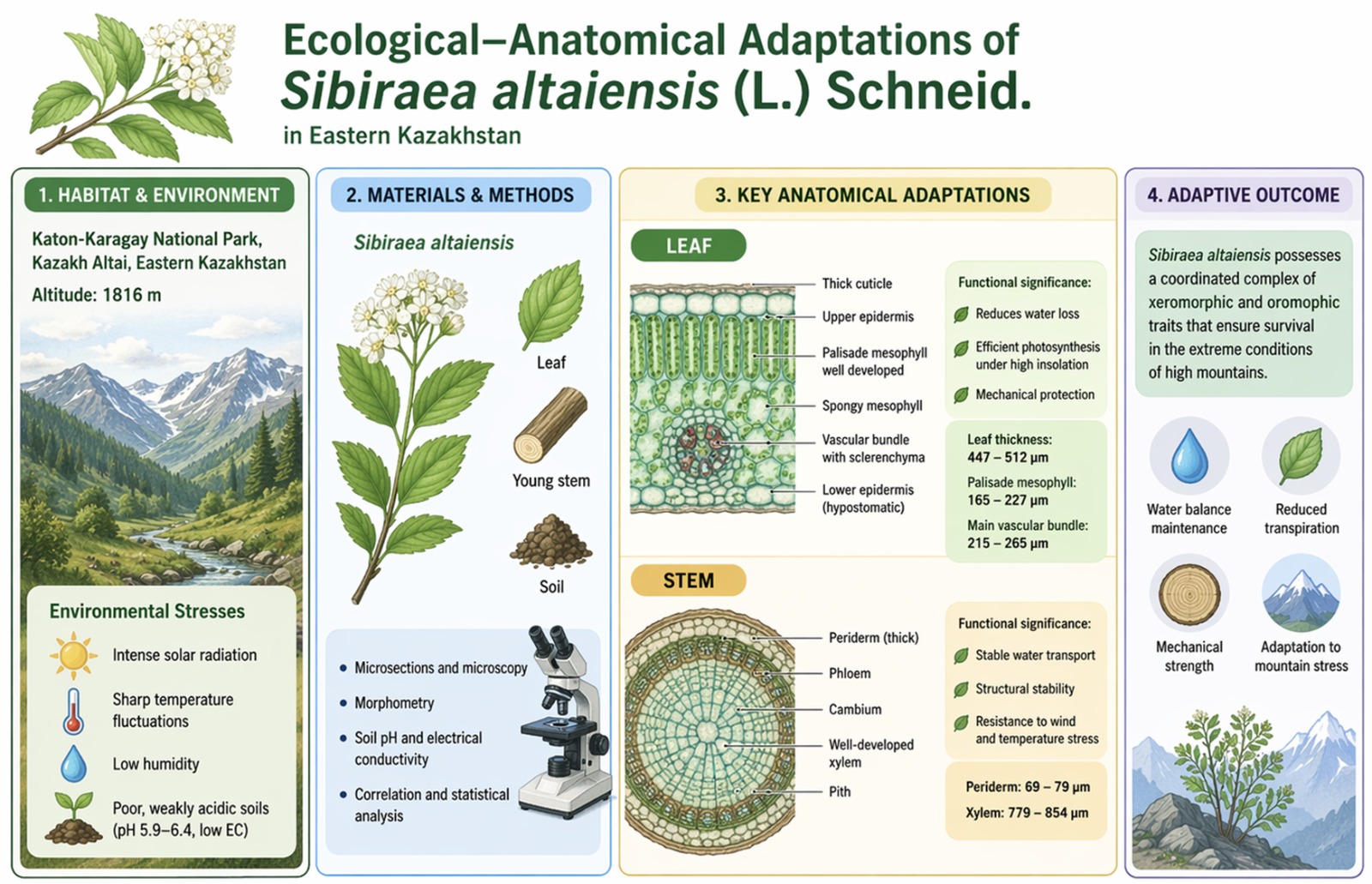
Sibiraea altaiensis (L.) Schneid. is a characteristic species of high-mountain ecosystems in Eastern Kazakhstan, Sibiraea altaiensis experiences intense solar radiation, sharp temperature fluctuations, low humidity, and nutrient-poor soils. This study presents a comprehensive ecological–anatomical analysis of the leaves and stems of S. altaiensis from natural populations of the Katon-Karagay National Park. Anatomical parameters were examined using classical microtechnical methods, morphometry, and statistical approaches. The leaf of S. altaiensis demonstrates a pronounced combination of xeromorphic and oromorphic traits. The leaf blade has a stable thickness, a well-developed cuticle, and a hypostomatic epidermis. A thickened palisade layer and a moderately variable spongy layer, reflecting adaptation to high insolation and limited moisture, characterize the dorsiventral mesophyll. The vascular bundles are reinforced with sclerenchyma, providing mechanical stability under strong winds. The stem is characterized by well-developed xylem, stable dimensions of vascular elements, and a thick periderm, which performs protective and mechanical functions. Correlation analysis revealed coherence among the main anatomical parameters, including leaf thickness, mesophyll structure, vascular bundle size, and xylem development. The weakly acidic, low-mineral soils of the habitats correspond to the moderate plasticity in mesophyll and conducting tissues. Thus, S. altaiensis exhibits a complex of anatomical and morphological adaptations enabling survival under extreme high-mountain conditions of the Kazakh Altai. These findings contribute to a better understanding of the adaptive evolution of Rosaceae taxa in Central Asia and are relevant for further taxonomic and conservation research.
References
1 Dolezal, J. et al. (2019). Disentangling evolutionary, environmental and morphological drivers of plant anatomical adaptations to drought and cold in Himalayan graminoids. Oikos, 128(11), 1576–1587. https://doi.org/10.1111/oik.06451 DOI: https://doi.org/10.1111/oik.06451
2 Shirmanov, M. V., & Polyakova, T. A. (2020). Historical Overview of Research on the Genus Spiraea L. (Rosaceae Juss.). Problems of Botany in Southern Siberia and Mongolia, 19(2), 140–145. DOI: https://doi.org/10.14258/pbssm.2020092
3 Killov, V. Yu., Stikhareva, T. N., Serafimovich, M. V., & Terekhova, S. V. (2014). Sibiraea altaiensis — A Promising Object for Forest Biotechnology and Phytochemistry in Kazakhstan. Editorial Board, 18, 105 p.
4 Orazayeva, M. K. (2018). Study of the endemic Sibiraea altaiensis in the West Altai State Nature Reserve. Master's Bulletin, 5–3 (80), 13-14.
5 Krykbayeva, R. N. (2022). The history of formation and development prospects of Katon-Karagay State National Natural Park. In Proceedings of Katon-Karagay State National Natural Park, 10–29. DOI: https://doi.org/10.55435/090320228
6 Song, J. H., Oak, M. K., & Hong, S. P. (2024). Leaf micromorphology in Rosaceae tribe Spiraeeae (subfamily Amygdaloideae) and its systematic and ecological implications. Botanical Journal of the Linnean Society, 205(2), 116–131. https://doi.org/10.1093/botlinnean/boae002 DOI: https://doi.org/10.1093/botlinnean/boae002
7 Kotukhov, Yu. A., Danilova, A. N., & Anufrieva, O. A. (2017). Sibiraea Altaiensis (laxm.) schneid. — a rare species of the flora of Kazakhstan. Botanical Research of Siberia and Kazakhstan, 23, 50–74.
8 Serafimovich, M. V., & Efimova, M. V. (2024). Altai endemic Sibiraea altaiensis (Laxm.) Schneid: possible uses and conservation methods. Biotechnology and Plant Breeding, 7(1), 35-42. DOI: https://doi.org/10.30901/2658-6266-2024-1-o3
9 Woo, J. Y. (1970). Techniques for Sectioning and Staining Tissue Cultures of Western White Pine (Vol. 116). US Department of Agriculture, Forest Service, Intermountain Forest & Range Experiment Station.
10 Brooks, J. H. (1969). Cytotaxonomy of the genus Echinochloa in Louisiana. Louisiana State University and Agricultural & Mechanical College.
11 Berlyn, G. P., & Miksche, J. P. (1976). Botanical microtechnique and cytochemistry (pp. viii+-326). DOI: https://doi.org/10.2307/2418781
12 Ruzin, S. E. (1999). Plant microtechnique and microscopy (Vol. 198, p. 322). New York: Oxford University Press.
13 Kiernan, J. (2015). Histological and histochemical methods. Scion publishing ltd.
14 Schneider, C. A., Rasband, W. S., & Eliceiri, K. W. (2012). NIH Image to ImageJ: 25 years of image analysis. Nature methods, 9(7), 671–675. DOI: https://doi.org/10.1038/nmeth.2089
15 Evert, R. F. (1992). Commentary: The Contributions of Katherine Esau. International Journal of Plant Sciences, 153(3, Part 2), v-ix. DOI: https://doi.org/10.1086/592825
16 Kaplan, D., & Specht, C. D. (2022). Kaplan's principles of plant morphology. CRC Press. DOI: https://doi.org/10.1201/9781315118642
17 Arinushkina, E. V. (1970). Handbook for soil chemical analyses. Moscow State University.
18 Noble, T. L., Lottermoser, B., & Parbhakar-Fox, A. (2016). pH testing methods for sulfidic mine wastes. In Environmental Indicators in Metal Mining (pp. 199–210). Cham: Springer International Publishing. DOI: https://doi.org/10.1007/978-3-319-42731-7_11
19 Rhoades, J. D., Chanduvi, F., & Lesch, S. M. (1999). Soil salinity assessment: Methods and interpretation of electrical conductivity measurements (Vol. 57). Food & Agriculture Org.
20 Galbraith, J. M. (2018). Human-altered and human-transported (HAHT) soils in the US soil classification system. Soil science and plant nutrition, 64(2), 190–199. DOI: https://doi.org/10.1080/00380768.2018.1442682
21 Shapiro, S. S., & Wilk, M. B. (1965). An analysis of variance test for normality (complete samples). Biometrika, 52(3-4), 591–611. DOI: https://doi.org/10.1093/biomet/52.3-4.591
22 Mann, H. B., & Whitney, D. R. (1947). On a test of whether one of two random variables is stochastically larger than the other. The annals of mathematical statistics, 50–60. DOI: https://doi.org/10.1214/aoms/1177730491
23 Zar, J. H. (1999). Biostatistical analysis. Pearson Education India.
24 Evans, J. D. (1996). Straightforward statistics for the behavioral sciences. Thomson Brooks/Cole Publishing Co.
25 Sokal, R. R. (1995). The principles and practice of statistics in biological research. Biometry, 451–554.
26 Levene, H. (1960). Robust tests for equality of variances. Contributions to probability and statistics, 278–292.
27 Crang R., Lyons-Sobaski Sh., & Wise R. (2018). Plant Anatomy. A concept-based approach to the structure of seed plants Springer Nature, 250 p.
28 Gibadulina, I. I., Larionov, M. V., & Maslennikova, N. N. (2022). Anatomical and Morphological Features of the Leaves of Tilia Cordata Mill. As an Indicator of the Adaptive Capabilities of the Species to the Conditions of the Urban Environment IOP Conference Series: Earth and Environmental Science 988(3) Article ID 032082. DOI: https://doi.org/10.1088/1755-1315/988/3/032082
29 Fahn, A. (1988). Secretory tissues in vascular plants. New phytologist, 108(3), 229–257. DOI: https://doi.org/10.1111/j.1469-8137.1988.tb04159.x
30 Ramírez-Díaz, M., Gutiérrez, J., & Terrazas, T. (2024). Leaf architecture and anatomy of eight species of Tilia (Malvaceae). Acta botánica mexicana, 131. DOI: https://doi.org/10.21829/abm131.2024.2332
31 Crang R., Lyons-Sobaski, & Wise R. (2018). Plant Anatomy. A concept-based approach to the structure of seed plants Springer Nature, 250 p. DOI: https://doi.org/10.1007/978-3-319-77315-5
32 Kulawik, P., Jamróz, E., Kruk, T., Szymkowiak, A., Tkaczewska, J., Krzyściak, P, & Milosavljević, V. (2023). Active edible multi-layer chitosan/furcellaran micro/nanoemulsions with plant essential oils and antimicrobial peptides: Biological properties and consumer acceptance. Food Control, 150, 109767. DOI: https://doi.org/10.1016/j.foodcont.2023.109767
33 Arinushkina, E. V. (1970). Handbook for soil chemical analyses. Moscow State University.
34 Strelnikov, B. G., & Gürdal, B. (2024). Anatomy and micromorphology of Tilia species from Turkey and its taxonomic implication. Microscopy Research and Technique, 87(11), P. 2625–2635. DOI: https://doi.org/10.1002/jemt.24634