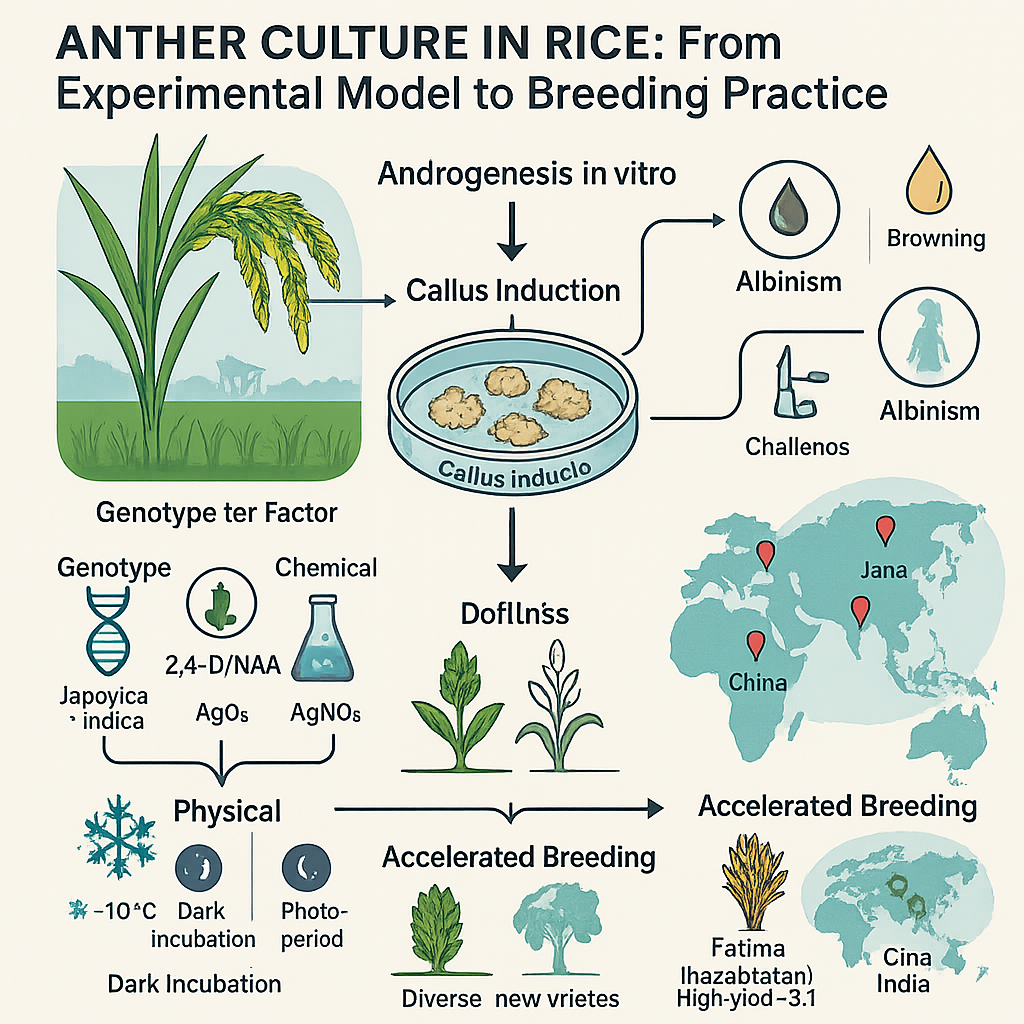
Anther culture in rice: from an experimental model to breeding practice
DOI:
https://doi.org/10.31489/2026feb1/72-83Keywords:
rice, male gametophyte, anther and microspore culture, androgenesis in vitro, biological, chemical, physical factorsAbstract
The anther culture method has become an effective tool in modern rice breeding, enabling a significant reduction in the breeding cycle through the rapid production of haploid and doubled haploid plants. Extensive global experience, particularly in major rice-producing countries such as China, Japan, and India, confirms the importance of androgenesis technology for developing new high-yielding and high-quality rice varieties. The efficiency of this method depends on multiple interacting factors, the most critical being genotype. Studies have shown that the japonica subspecies of rice is markedly more responsive and suitable for anther culture, whereas the indica subspecies is typically exhibits low callus induction and regeneration capacity. To overcome these limitations, inter-subspecific hybridization and optimization of culture protocols are commonly employed. This approach has also been successfully implemented in Kazakhstan, where several new rice lines and varieties have been developed. In particular, the cultivar Fatima demonstrates increased productivity (~5.1 t/ha) and valuable agronomic traits and has already been released for cultivation in the country’s major rice-growing regions. Moreover, anther culture has enabled Kazakhstani breeders to obtain doubled haploid lines surpassing their parental forms in several agronomic characteristics, such as the glutinous variety Violetta. In conclusion, anther culture in rice holds considerable potential for accelerating the development of homozygous lines and novel genotypes. The integration of this approach with molecular tools such as marker-assisted selection (MAS) and CRISPR/Cas9 genome editing offers new opportunities for targeted gene combination and for expediting the development of improved rice varieties with desired traits.
References
1 Tripathy, S. K., Lenka, D., Prusti, A. M., Mishra, D., Swain, D., & Behera, S. K. (2019). Anther culture in rice: Progress and breeding perspective. Applied Biological Research, 21(2), 87. https://doi.org/10.5958/0974-4517.2019.00012.0 DOI: https://doi.org/10.5958/0974-4517.2019.00012.0
2 Silva, T. D. (2010). Indica rice anther culture: can the impasse be surpassed? Plant Cell, Tissue and Organ Culture (PCTOC), 100(1), 1–11.
3 Mishra, R., & Rao, G. J. N. (2016). In-vitro androgenesis in rice: advantages, constraints and future prospects. Rice Science, 23(2), 57–68. DOI: https://doi.org/10.1016/j.rsci.2016.02.001
4 Mayakaduwa, D. M. R. G., & Silva, T. D. (2018). Anther culture as a supplementary tool for rice breeding. Rice Crop Current Developments, 1–16.
5 Ali, J., Nicolas, K. L. C., Akther, S., Torabi, A., Ebadi, A. A., Marfori-Nazarea, C. M., & Mahender, A. (2021). Improved anther culture media for enhanced callus formation and plant regeneration in rice (Oryza sativa L.). Plants, 10(5), 839. DOI: https://doi.org/10.3390/plants10050839
6 Islam, M. T., Arif, M. R., Hasan, M. T., & Robin, A. H. K. (2023). Anther culture in crop plants: progress and perspectives. Plant Breeding and Biotechnology, 11(2), 69–96.
7 Morinaga, T., & Fukushima, E. (1931). Preliminary report on the haploid plant of rice, Oryza sativa L. Proceedings of the Imperial Academy, 7(10), 383-384. DOI: https://doi.org/10.2183/pjab1912.7.383
8 Nakamura, S. (1933). The haploid plant in rice. Jap. Jour. Gen, 8, 223–227.
9 Niizeki, H., & Oono, K. (1968). Induction of haploid rice plant from anther culture. Proceedings of the Japan Academy, 44(6), 554–557.
10 Guha, S., Iyer, R. D., Gupta, N., & Swaminathan, M. S. (1970). Totipotency of gametic cells and the production of haploids in rice. Current Science, 39(8), 174–176.
11 Chu, C. (1975). Establishment of an efficient medium for another culture of rice through comparative experiments on the nitrogen sources. Scientia Sinica, 18, 223–231.
12 Chen, C. C. (1977). In vitro development of plants from microspores of rice. In vitro, 13(8), 484–489. DOI: https://doi.org/10.1007/BF02615140
13 Hu, H., & Zeng, J. Z. (1984). Development of new varieties via anther culture. Handbook of plant cell culture, 3, 65–90.
14 Niizeki, H., & Oono, K. (1968). Induction of haploid rice plant from anther culture. Proceedings of the Japan Academy, 44(6), 554–557. DOI: https://doi.org/10.2183/pjab1945.44.554
15 Zapata, F. J. (1985). Rice anther culture at IRRI. Biotechnology in International Agriculture Research. IRRI, 85–89.
16 Tripathy, S. K., Swain, D., Mohapatra, P. M., Prusti, A. M., Sahoo, B., Panda, S., & Behera, S. K. (2019). Exploring factors affecting anther culture in rice (Oryza sativa L.). Journal of Applied Biology and Biotechnology, 7(02), 87–92. DOI: https://doi.org/10.7324/JABB.2019.70216
17 Loo, S. W., & Xu, Z. H. (1991). Anther culture for rice improvement in China. In Rice, 151–159. Berlin, Heidelberg: Springer Berlin Heidelberg. DOI: https://doi.org/10.1007/978-3-642-83986-3_12
18 Kyum, M., Kaur, H., Kamboj, A., Goyal, L., & Bhatia, D. (2022). Strategies and prospects of haploid induction in rice (Oryza sativa). Plant Breeding, 141(1), 1–11. DOI: https://doi.org/10.1111/pbr.12971
19 Bukharbayeva, A. Zh., Akimbekova, G. U., & Kerimbek, G. E. (2023). Rice growing in Kazakhstan: internal reserves and competitiveness. Problems of AgriMarket, 1, 123–130. https://doi.org/10.46666/2023-1.2708-9991.14 DOI: https://doi.org/10.46666/2023-1.2708-9991.14
20 Lantos, C., Jancsó, M., Székely, Á., Szalóki, T., Venkatanagappa, S., & Pauk, J. (2023). Development of in vitro anther culture for doubled haploid plant production in indica rice (Oryza sativa L.) genotypes. Plants, 12(9), 1774. DOI: https://doi.org/10.3390/plants12091774
21 Herath, H. M. I., & Bandara, D. C. (2011). Anther culture performance in selected high yielding indica (of Sri Lanka) and japonica rice varieties and their inter sub-specific hybrids. Journal of the National Science Foundation of Sri Lanka, 39(2). DOI: https://doi.org/10.4038/jnsfsr.v39i2.3175
22 Patra, S., Mohanty, P., & Tripathy, S. K. (2019). Scope of androgenesis for genetic improvement in rice. Emergent Life Sciences Research, 5, 23–28. DOI: https://doi.org/10.31783/elsr.2019.512328
23 Guo, G., Liu, S., Zhang, S., Yang, L., Zong, Y., Halford, N. G., & Chen, Z. (2024). Generic Workflow of a Highly Effective and Easy Anther Culture Method for Both Japonica and Indica Rice. Plants, 13(17), 2531. DOI: https://doi.org/10.3390/plants13172531
24 Raina, S. K., & Zapata, F. J. (1997). Enhanced anther culture efficiency of indica rice (Oryza sativa L.) through modification of the culture media. Plant breeding, 116(4), 305–315. DOI: https://doi.org/10.1111/j.1439-0523.1997.tb01004.x
25 Silva, T. D., & Ratnayake, W. J. (2009). Anther culture potential of indica rice varieties, kuruluthuda and Bg 250.
26 Mayakaduwa, D. M. R. G., & Silva, T. D. (2017). A cytological indicator allows rapid assessment of microspore maturity, leading to improved in vitro anther response in Indica rice (Oryza sativa L.). In Vitro Cellular & Developmental Biology-Plant, 53(6), 591–597. DOI: https://doi.org/10.1007/s11627-017-9855-0
27 Mayakaduwa, D. M. R. G., & Silva, T. D. (2018). Anther culture as a supplementary tool for rice breeding. Rice Crop Current Developments, 1–16.
28 Germana, M. A. (2011). Anther culture for haploid and doubled haploid production. Plant Cell, Tissue and Organ Culture (PCTOC), 104(3), 283–300. DOI: https://doi.org/10.1007/s11240-010-9852-z
29 Tripathy, S. K. (2018). Anther culture for double haploid breeding in rice-a way forward. Rice Genomics and Genetics, 9.
30 Lentini, Z., Reyes, P., Martínez, C. P., & Roca, W. M. (1995). Androgenesis of highly recalcitrant rice genotypes with maltose and silver nitrate. Plant Science, 110(1), 127–138. DOI: https://doi.org/10.1016/0168-9452(95)04180-3
31 Gill, R., Kaur, N., Sindhu, A. S., Bharaj, T. S., & Gosal, S. S. (2003). Improved methods for anther and pollen culture in rice. Advances in rice genetics, 15, 503. DOI: https://doi.org/10.1142/9789812814319_0190
32 Matsushima, T., Kikuchi, S., Takaiwa, F., & OoNo, K. (1988). Regeneration of plants by pollen culture in rice (Oryza sativa L.). Plant tissue culture letters, 5(2), 78–81. DOI: https://doi.org/10.5511/plantbiotechnology1984.5.78
33 Gupta, H. S., & Borthakur, D. N. (1987). Improved rate of callus induction from rice anther culture following microscopic staging of microspores in iron alum-haematoxylin. Theoretical and Applied Genetics, 74(1), 95–99. DOI: https://doi.org/10.1007/BF00290090
34 Gao, R., Zong, Y., Zhang, S., Guo, G., Zhang, W., Chen, Z., & Li, Y. (2024). Efficient isolated microspore culture protocol for callus induction and plantlet regeneration in japonica rice (Oryza sativa L.). Plant Methods, 20(1), 76. DOI: https://doi.org/10.1186/s13007-024-01189-0
35 Lee, S. T., & Huang, W. L. (2014). Osmotic stress stimulates shoot organogenesis in callus of rice (Oryza sativa L.) via auxin signaling and carbohydrate metabolism regulation. Plant growth regulation, 73(2), 193–204. DOI: https://doi.org/10.1007/s10725-013-9880-x
36 Raina, S. K., & Irfan, S. T. (1998). High-frequency embryogenesis and plantlet regeneration from isolated microspores of indica rice. Plant Cell Reports, 17(12), 957–962. DOI: https://doi.org/10.1007/s002990050517
37 Shariatpanahi, M. E., Bal, U., Heberle‐Bors, E., & Touraev, A. (2006). Stresses applied for the re‐programming of plant microspores towards in vitro embryogenesis. Physiologia Plantarum, 127(4), 519–534. DOI: https://doi.org/10.1111/j.1399-3054.2006.00675.x
38 Chen, Q. F., Wang, C. L., Lu, Y. M., Shen, M., Afza, R., Duren, M. V., & Brunner, H. (2001). Anther culture in connection with induced mutations for rice improvement. Euphytica, 120(3), 401–408. DOI: https://doi.org/10.1023/A:1017518702176
39 Mkuya, M. S., Hua-min, S. I., Wen-zhen, L. I. U., & Zong-xiu, S. U. N. (2005). Effect of 137Cs gamma rays to panicles on rice anther culture. Rice Science, 12(4), 299.
40 Mayakaduwa, D. M. R. G., & Silva, T. D. (2018). Anther culture as a supplementary tool for rice breeding. Rice Crop Current Developments, 1–16. DOI: https://doi.org/10.5772/intechopen.76157
41 Silva, T. D. (2010). Indica rice anther culture: can the impasse be surpassed. Plant Cell, Tissue and Organ Culture (PCTOC), 100(1), 1–11. DOI: https://doi.org/10.1007/s11240-009-9616-9
42 Chen, X., Li, S., Zha, W., Li, C., Zhou, L., You, A., & Wu, Y. (2025). Advances in Anther Culture-Based Rice Breeding in China. Plants, 14(11), 1586. DOI: https://doi.org/10.3390/plants14111586
43 Kanaoka, Y., Kuniyoshi, D., Inada, E., Koide, Y., Okamoto, Y., Yasui, H., & Kishima, Y. (2018). Anther culture in rice proportionally rescues microspores according to gametophytic gene effect and enhances genetic study of hybrid sterility. Plant methods, 14(1), 102. DOI: https://doi.org/10.1186/s13007-018-0370-z
44 Rice variety Fatima. Retrieved from https://baibolsyn.kz/ru/semena/ris-variety-fatima/
45 (2016). Catalogue of rice and vegetable and melon varieties of Kuban selection. Krasnodar: EDVI.
46 Lantos, C., Jancsó, M., Székely, Á., Nagy, É., Szalóki, T., & Pauk, J. (2022). Improvement of anther culture to integrate doubled haploid technology in temperate rice (Oryza sativa L.) breeding. Plants, 11(24), 3446. DOI: https://doi.org/10.3390/plants11243446
47 Rout, P., Naik, N., Ngangkham, U., Verma, R. L., Katara, J. L., Singh, O. N., & Samantaray, S. (2016). Doubled Haploids generated through anther culture from an elite long duration rice hybrid, CRHR32: Method optimization and molecular characterization. Plant Biotechnology, 33(3), 177–186. DOI: https://doi.org/10.5511/plantbiotechnology.16.0719a
48 China Rice Data Center. Retrieved from https://ricedata.cn/variety/varis/613663.htm
49 Li, M. (1983). New rice varieties Zhonghua No.8 and No.9. Bull. Agric. Sci. Technol., 3(7), 9.
50 Li, M. (1988). Rice cultivar — Zhonghua 10. Bull. Agric. Sci. Technol., 1, 26.
51 Liu, J., Hu, D., Hong, L., Liu, B., Mao, Z., Li, Z., & Zhang, A. (1995). Breeding of photothermosensitive male sterile lines of japonica rice by flower culture technique. Beijing Agric. Sci., 4, 22–24.
52 Er, D. (1996). A new rice pollen cultivation-Huajing 45. Mod. Agric., 10, 11.
53 Jiang, J., Jin, C., Hou, C., Jin, X., & Yang, B. (2001). Progress in research and application of rice anther culture. Chin. Agric. Sci. Bull., 4, 49–52.
54 Jin, S., Jiang, H., Li, X., & Zhang, W. (2001). Breeding of the new rice variety Jiudao 26 (Jiuhua 3). Jilin Agric. Sci., 4, 27-28.
55 Zhonghua 15. ICS, CAAS. 1 January 2002. DOI: https://doi.org/10.1145/967135.967155
56 China Rice Data Center. Retrieved from https://ricedata.cn/variety/varis/605929.htm
57 Li, M. (2000). Rice variety Zhonghua 14 (93-108). China Rural. Sci. Technol., 7, 21.
58 Li, M., Zhang, L., Lin, Z., Zhang, Q., Kuang, B., & Li, W. (2003). Breeding of new rice variety Zhonghua 16. Crops, 4, 50.
59 Guan, S. (2000). Breeding and High Yield Cultivation Model of Longjing 10, a New Rice Flower Cultivation Variety. Chin. Agric. Sci. Bull., 3, 75-76.
60 Zhang, S. (2003). Characteristics and high-yield cultivation techniques of a new rice variety Longjing 12. Crops, 6, 37.
61 Li, Y., Zou, M., Sun, H., Niu, J., Wang, J., & Liang, Y. (2007). Breeding of new japonica rice variety Huayu 13 with high quality and high yield. Crop Res., 3, 285-286.
62 Shouyi, L., & Shouyin, H. (1991). Huayu 15, a high yielding rice variety bred by anther culture. In Rice, 230–247. Berlin, Heidelberg. DOI: https://doi.org/10.1007/978-3-642-83986-3_16
63 Ye, J., Ye, H., Zhai, R., Zhu, G., & Zhang, X. (2020). Zhejing 7A, a japonica rice sterile line bred by anther culture technology. J. Zhejiang Agric. Sci., 61, 1529–1530.
64 Huang, W., Yan, Y., Wang, K., Zhan, L., Hu, Z., & Wu, S. (2022). Breeding of a new japonica rice variety with fragrance and soft by anther culture technique and molecular marker-assisted selection method. Acta Agric. Shanghai, 38, 41–46.
65 (2001). Rice Restorer Line Shuhui 162. RRI, SAU. Retrieved from https://kns.cnki.net/kcms2/article/abstract? v=fSCzX0TVvUjHZGOyyaYAw_XuOwJaRwfQLbTyYFiwxe5DzlxsZTItMQ_4bKb_CQs5GVNjmOUU1H_n51O29VlFJVrOrfofP2gHG56smMmSSe1Fol3KurlECG2CgCVycaal-ywP9CQnRHMwC4C7EF6R7FT0gg-ysuF-EAfvPkMa2FX1X_23eAWcw==&uniplatform=NZKPT&language=CHS
66 Li, W., Chen, Q., Pan, R., Zhang, S., Qi, J., Lin, G., Jiang, S., Lin, L., Ji, B., & Zheng, X. (1998). Breeding of rice cytoplasmic male sterile line 1A. J. Fujian Agric. For. Univ., 2, 2–5.
67 Pan, R., Zheng, B., Mao, D., Guan, H., Chen, Z., Lin, L., Zhao, J., & Zhou, Y. (2009). Breeding of Quality Rice CMS Line Hua 2 A by Anther Culture. Hybrid. Rice, 24, 12–15.
68 Yang, X.R., & Fu, H.H. (1989). A high protein Indica rice. International Rice Research Newsletter, 14(3), 14-15.
69 Wang, P., Xiang, Y., Zhang, Z., Wang, M., Cai, P., & Zhang, Z. (2010). Breeding and Utilization of Indica Restorer Line Chuanhui 907 with High Combining Ability. Hybrid Rice, 25 (Suppl. S1), 195–197.
70 Wang, P., Zhang, Z., Xiang, Y., Wang, M., Cai, P., Zhang, Z., & Lin, Y. (2012). Breeding and Utilization of Indica Restorer Line Chuanhui 1618 with Good Grain Quality and High Combining Ability. Hybrid Rice, 27, 20–22.
71 Li, X., Pan, X., Chen, Z., Yu, H., Chen, Z., & Gu, M. (1995). Anther culture of photosensttive male sterile rice and the breeding of miai64s. J. Yangzhou Univ. (Agric. Life Sci. Ed.), 4, 7–12.
72 Li, W., Chen, Q., Qi, J., Pan, R., Jiang, S., Ji, B., Lin, G., Lin, L., Zhou, Y., Wu, R., & et al. (1996). Breeding report of photosensitive male sterile line Hs-1 in indica rice. J. Fujian Agric. For. Univ. (Nat. Sci. Ed.), 3, 4–10.
73 Li, W., Chen, Q., Pan, R., Zhang, S., Qi, J., Lin, G., Jiang, S., Lin, L., Ji, B., & Zheng, X. (1998). Breeding of rice cytoplasmic male sterile line 1A. J. Fujian Agric. For. Univ. (Nat. Sci. Ed.), 2, 2–5.
74 (2000). Research on the Breeding of Indica Dual-Purpose Nuclear Sterile 6442S and 1286S. RRI, JAAS.1.
75 Chen, Z., Lin, L., Zhou, Y., Pan, R., Mao, D., Wu, J., & Guan, H. (2005). Breeding of the Low-temperature Sensitive Genic Male Sterile Line, Jinshan S-1 by means of Anther Culture. Acta Agric. Univ. Jiangxiensis, 5, 648–652.
76 Pu, Z., Xiang, Y., Zhang, Z., Cai, P., Zhou, X., & Zhang, Z. (2007). Huaxiang 7, a NewIndica Hybrid Rice Combination. Hybrid Rice, 5, 85-86.
77 Feng, S., Jiang, X., Zhao, S., Hou, H., & Xiao, G. (2008). A Preliminary Study on Genetic Homogenization of Thermosensitive Genic Male Sterile(TGMS) Line Xiang 125S in Rice through Anther Culture. Hybrid Rice, 4, 62–64.
78 Pan, R., Zheng, B., Mao, D., Guan, H., Chen, Z., Lin, L., Zhao, J., & Zhou, Y. (2009). Breeding of Quality Rice CMS Line Hua 2 A by Anther Culture. Hybrid. Rice, 24, 12–15.
79 Xu, X., Xun, F., Ma, G., Zhou, H., Wang, C., Zhang, H., & Li, S. (2018). Breeding of Rice PTGMS Line V25S by Anther Culture. Hybrid Rice, 33, 10–12.
80 Liu, K., Li, S., Xu, H., Chen, Z., Yang, G., & You, A. (2019). Breeding of high-quality two-line sterile rice line EH1S using anther culture technology. Rural. Econ. Sci. -Technol., 30, 48-49.
81 (2007-2008). Central Rice Research Institute (CRRI) Annual Report. Retrieved from https://icar-nrri.in/annual-report/
82 Chung, G.S. (1987). Application of anther culture technique for rice (Oryza sativa L.) improvement. In: Korea-China Plant Tissue Culture Symposium. Beijing, China: Academia Sinica Publishers, 36–56.
83 (2008-2009). Central Rice Research Institute (CRRI) Annual Report. Retrieved from https://icar-nrri.in/annual-report/
84 (2009-2010). Central Rice Research Institute (CRRI) Annual Report. Retrieved from https://icar-nrri.in/annual-report/
85 Pauk, J., Janeso, M., & Simon-Kiss, I. (2009). Rice doubled haploids and breeding. In: Advances in Haploid Production in Higher Plants, Springer, Amsterdam, Netherlands, 189–197. DOI: https://doi.org/10.1007/978-1-4020-8854-4_16
86 Patil, V.D., Nerkar, Y.S., Misal, M.B., & Harkal, S.R. (1997). Parag 401, a semidwarf rice variety developed through anther culture. International Rice Research Newsletter, 22(2), 19.
87 Lee, Y.T., Lim, M.S., Kim, H.S., Shin, H.T., Kim, C.H., Bae, S.H., & Cho, C.I. (1989). An anther derived new high quality variety with disease and insect resistance ‘Hwacheongbyeo’. Research Report — Rural Development Administration Rice, 31(2), 27–34.
88 88. Senadhira, D., Gregorio, G.B., Mendoza, R.D., Roxas, J.P., Alejar, M.S, Reyes, R.Y., Patena, C.C., DelaCruz H.C., Padolina, T.F., Galvez, A.M., & Gamiao, B.P. (1996). New Rice Varieties that Defy Soil Salinity. University of the Philippines, Los Baños, Philippines.
89 Senadhira, D., Zapata-Arias, F.J., Gregorio, G.B., Alejar, M.S., Cruz, H.C.D.L., & Padolina, T.F. (2002). Development of the first salt-tolerant rice cultivar through indica/indica anther culture. Field Crops Res., 76, 103–110. DOI: https://doi.org/10.1016/S0378-4290(02)00032-1
90 Thomson, M.J., Ocampo, M.D., Egdane, J., Rahman, M.A., Sajise, A.G., Adorada, D.L., Tumimbang-Raiz, E., Blumwald, E., Seraj, Z.I., & Singh, R.K. (2010). Characterizing the saltol quantitative trait locus for salinity tolerance in rice. Rice, 3, 148–160. DOI: https://doi.org/10.1007/s12284-010-9053-8
91 Singh, R.B. (1998). Agricultural biotechnology in Asia-Pacific region. In: Agricultural Biotechnology in the Developing World. FAO Research & Technology Development Division, 53–55. Daya Publishing House, New Delhi, India.
92 Heszky, L.E., & Simon-Kiss, I. (1992). The first plant variety of biotechnology origin in Hungary, registered in 1992. Hungarian Agricultural Research, 1, 30–32.
93 (2025). SortCom. (n.d.). Rice varieties. Retrieved from https://sortcom.kz/rice/
94 Ma, H. (2019). Study on the Characteristics of Rice Albino Seedlings Induced by in Planta of Rice. Thesis of Master’s Study on the Characteristics of Rice Albino Seedlings Induced by in Planta of Rice.
95 Zeng, L., & Liu, Y. (2007). Research progress on browning in plant tissue culture. Anhui Agric. Sci. Bull., 14, 49-50.
96 Zhang, X. (2018). Study on the inhibiting effect of several anti-browning agents on the browning phenomenon of pistachio seed embryo culture. Sci. Technol. Tianjin Agric. For, 1, 7-8.
97 Zhang, K., Su, J., Xu, M., Zhou, Z., Zhu, X., Ma, X., & Fu, Y. (2020). A common wild rice-derived BOC1 allele reduces callus browning in indica rice transformation. Nature Communications, 11(1), 443. DOI: https://doi.org/10.1038/s41467-019-14265-0
98 He, M., Song, D., Zhang, L., & Huang, S. (2010). Common problems and prevention measures in rice anther culture. North Rice, 40, 50-51.
99 Islam, M. T., Arif, M. R., Hasan, M. T., & Robin, A. H. K. (2023). Anther culture in crop plants: progress and perspectives. Plant Breeding and Biotechnology, 11(2), 69–96. DOI: https://doi.org/10.9787/PBB.2023.11.2.69
100 Reflinur, Kim, B., Jang, S. M., Chu, S. H., Bordiya, Y., Akter, M. B., & Koh, H. J. (2014). Analysis of segregation distortion and its relationship to hybrid barriers in rice. Rice, 7(1), 3. DOI: https://doi.org/10.1186/s12284-014-0003-8
101 Sun, B., Ding, X., Ye, J., Dai, Y., Cheng, C., Zhou, J., & Chu, H. (2023). Unveiling the Genetic Basis Underlying Rice Anther Culturability via Segregation Distortion Analysis in Doubled Haploid Population. Genes, 14(11), 2086. DOI: https://doi.org/10.3390/genes14112086
102 Tripathy, S. K. (2018). Anther culture for double haploid breeding in rice-a way forward. Rice Genomics and Genetics, 9. DOI: https://doi.org/10.5376/rgg.2018.09.0001
103 Mayakaduwa, R., & Silva, T. (2023). Haploid induction in indica rice: exploring new opportunities. Plants, 12(17), 3118. DOI: https://doi.org/10.3390/plants12173118
104 Sharma, A., Pandey, H., Misra, V., Kumar, R., Vashishth, A., Devadas, V. S., & Chaturvedi, V. D. (2024). CRISPR/Cas9 and anther culture for precision double haploid line production in controlled environments. Plant Breeding. DOI: https://doi.org/10.1111/pbr.13227
105 Samantaray, S., Ali, J., Nicolas, K. L., Katara, J. L., Verma, R. L., Parameswaran, C., & Bhuyan, S. S. (2021). Doubled haploids in rice improvement: approaches, applications, and future prospects. In Rice improvement: physiological, molecular breeding and genetic perspectives (pp. 425–447). Cham: Springer International Publishing. DOI: https://doi.org/10.1007/978-3-030-66530-2_12