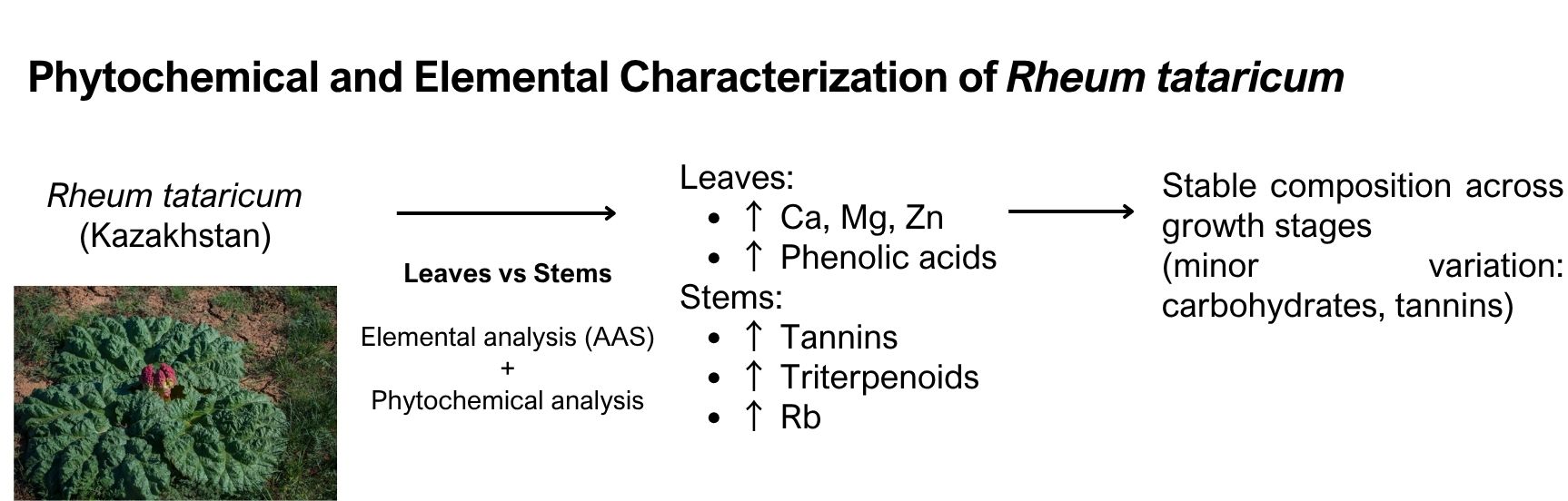
Phytochemical and Elemental Characterization of Rheum tataricum
DOI:
https://doi.org/10.31489/2026feb2/42-51Keywords:
Rheum tataricum, phytochemical analysis, elemental composition, pharmacological potential, Almaty regionAbstract
This study presents a phytochemical and elemental characterization of Rheum tataricum L. collected in the Almaty region of Kazakhstan, aimed at describing its compositional features as a potential source of plant secondary metabolites. Elemental analysis revealed high levels of calcium, magnesium, phosphorus, sulfur, and zinc in the leaves, whereas the stems contained elevated levels of rubidium and comparable amounts of potassium, sodium, and chlorine. Quantitative phytochemical screening demonstrated a generally stable accumulation of major metabolite groups, including anthraquinones, flavonoids, tannins, triterpenoids, and phenolic acids, across vegetative stages, with noticeable seasonal variation observed primarily for carbohydrates and tannins. The stems were characterized by higher contents of tannins and triterpenoids, whereas the leaves accumulated greater amounts of phenolic acids and micronutrients. These organ-specific and stage-dependent patterns reflect ecological adaptation to semi-desert conditions and suggest complex regulation of secondary metabolism in R. tataricum. The results highlight the phytochemical richness of this species; however, its bio-logical and pharmacological activities cannot be inferred from the present data and require confirmation through dedicated bioassays.
References
1 Yang, X., Li, Y., Zhang, L., Wang, J., & Chen, H. (2024). The phytochemistry and pharmacology of three Rheum species: A comprehensive review with future perspectives. Phytomedicine, 131, 155772. doi:10.1016/j.phymed.2024.155772 DOI: https://doi.org/10.1016/j.phymed.2024.155772
2 Kolodziejczyk-Czepas, J., & Liudvytska, O. (2021). Rheum rhaponticum and Rheum rhabarbarum: A review of phytochem-istry, biological activities and therapeutic potential. Phytochemistry Reviews, 20(3), 589–607. doi:10.1007/s11101-020-09715-3 DOI: https://doi.org/10.1007/s11101-020-09715-3
3 Tabin, S., Gupta, R., Kamili, A., & Parray, J. (2022). Medical and medicinal importance of Rheum spp. collected from different altitudes of the Kashmir Himalayan range. Cellular and Molecular Biomedical Reports, 2(3), 187–201. doi:10.55705/cmbr.2022.349901.1050 DOI: https://doi.org/10.55705/cmbr.2022.349901.1050
4 Salmukhanbetova, Z., & Dimeyeva, L. (2025). Phytocenotic and resource characteristics of Rheum tataricum L. f. in the Northern Aral region. Fundamental and Experimental Biology, 11830(2), 34–43. doi:10.31489/2025feb2/34-43 DOI: https://doi.org/10.31489/2025feb2/34-43
5 Aitzhan, M., Aimenova, Z., & Sumbembayev, A. (2024). Studying the species distribution of rhubarbs (Rheum L.) in Ka-zakhstan. BIO Web of Conferences, 100, 04034. doi:10.1051/bioconf/202410004034 DOI: https://doi.org/10.1051/bioconf/202410004034
6 Sumbembayev, A. A., Lagus, O. A., & Nowak, S. (2023). Seed morphometry of Rheum L. (Polygonaceae) species from Ka-zakhstan and its implications in taxonomy and species identification. Biodiversitas: Journal of Biological Diversity, 24(9). doi:10.13057/biodiv/d240908 DOI: https://doi.org/10.13057/biodiv/d240908
7 Dagarova, S. (2025). Research the seed surface of Rheum wittrockii Lundstr. from the flora of Kazakhstan. Discover Plants, 2(1), 299. doi:10.1007/s44372-025-00383-1 DOI: https://doi.org/10.1007/s44372-025-00383-1
8 Sitpayeva, G. T., Otradnykh, I. G., & Syedina, I. A. (2021). Collection of rare plant species of Kazakhstan in the conditions of the botanical garden of Almaty. Problems of Botany of Southern Siberia and Mongolia, 20(1), 404–408. doi:10.14258/pbssm.2021081 DOI: https://doi.org/10.14258/pbssm.2021081
9 Amangeldinova, M., et al. (2024). Simultaneous quantitative screening of 53 phytochemicals from Rheum tataricum L. roots: A comparative study of supercritical CO₂, subcritical ethanol, and ultrasound-assisted extraction for enhanced antioxidant and antibacterial activities, and molecular docking study. Frontiers in Plant Science, 15, 1513875. doi:10.3389/fpls.2024.1513875 DOI: https://doi.org/10.3389/fpls.2024.1513875
10 Golubkina, N., et al. (2022). Biochemical characteristics and elemental composition peculiarities of Rheum tataricum L. in semi-desert conditions and of European garden rhubarb. International Journal of Plant Biology, 13(3), 368–380. doi:10.3390/ijpb13030031 DOI: https://doi.org/10.3390/ijpb13030031
11 Terletskaya, N., et al. (2024). Comparative analysis of the anatomical and morphological features of Rheum tataricum L. plants from different ecopopulations. Eurasian Journal of Ecology, 79(2), 127–134. doi:10.26577/EJE.2024.v79.i2-012 DOI: https://doi.org/10.26577/EJE.2024.v79.i2-012
12 Turgunbayeva, A. A., et al. (2025). Isolation and identification of secondary metabolites in Rheum tataricum L.fil. growing in Kazakhstan and surveying of its anticancer potential. Molecules, 30(14), 2978. doi:10.3390/molecules30142978 DOI: https://doi.org/10.3390/molecules30142978
13 Sagyndykova, M. S., Imanbayeva, A. A., Lukmanov, A. B., & Gassanova, G. G. (2021). Resources of Rheum tataricum on the territory of Atyrau region. Bulletin of Karaganda University. Biology, Medicine and Geography Series, 103(3), 119–124. doi:10.31489/2021bmg3/119-124 DOI: https://doi.org/10.31489/2021bmg3/119-124
14 Khaja, U. M., Chopra, C., Sehgal, A., Singh, R., & Ganie, S. A. (2025). Unveiling the cancer-fighting potential of Rheum species (rhubarb): Phytochemistry, ethnopharmacology, and mechanistic insights into the anticancer effects of key anthraquinones. Phytomedicine Plus, 5(3), 100831. doi:10.1016/j.phyplu.2025.100831 DOI: https://doi.org/10.1016/j.phyplu.2025.100831
15 Minkayeva, A. A., et al. (2025). Comparative investigation of Rheum tataricum and Rheum palmatum. International Journal of Biology and Chemistry, 18(1). doi:10.26577/IJBCh202518113 DOI: https://doi.org/10.26577/IJBCh202518113
16 Singh, P. K., Singh, J., Medhi, T., & Kumar, A. (2022). Phytochemical screening, quantification, FT-IR analysis, and in silico characterization of potential bio-active compounds identified in HR-LC/MS analysis of the polyherbal formulation from Northeast India. ACS Omega, 7(37), 33067–33078. doi:10.1021/acsomega.2c03117 DOI: https://doi.org/10.1021/acsomega.2c03117
17 Nortjie, E., Basitere, M., Moyo, D., & Nyamukamba, P. (2022). Extraction methods, quantitative and qualitative phytochemical screening of medicinal plants for antimicrobial textiles: A review. Plants, 11(15), 2011. doi:10.3390/plants11152011 DOI: https://doi.org/10.3390/plants11152011
18 Youl, O., et al. (2023). Phytochemical screening, polyphenol and flavonoid contents, and antioxidant and antimicrobial activities of Opilia amentacea Roxb. (Opiliaceae) extracts. Applied Biosciences, 2(3), 493–512. doi:10.3390/applbiosci2030031 DOI: https://doi.org/10.3390/applbiosci2030031
19 Das, B., Saha, P., & Maity, N. (2023). Quantitative estimation of quercetin of some selected edible plants of West Bengal by high-performance thin-layer chromatography densitometry method. Asian Journal of Pharmaceutical Research and Health Care, 15(3), 254–261. doi:10.4103/ajprhc.ajprhc_70_23 DOI: https://doi.org/10.4103/ajprhc.ajprhc_70_23
20 Sarr, A., et al. (2022). Role of condensed tannins in the antioxidant activity of seeds of Cola nitida (Vent.) Schott & Endl. (Malvaceae). European Journal of Medicinal Plants, 26–33. doi:10.9734/ejmp/2022/v33i121111 DOI: https://doi.org/10.9734/ejmp/2022/v33i121111
21 Yue, F., Zhang, J., Xu, J., Niu, T., Lü, X., & Liu, M. (2022). Effects of monosaccharide composition on quantitative analysis of total sugar content by phenol-sulfuric acid method. Frontiers in Nutrition, 9, 963318. doi:10.3389/fnut.2022.963318 DOI: https://doi.org/10.3389/fnut.2022.963318
22 Godlewska, K., Pacyga, P., Najda, A., & Michalak, I. (2023). Investigation of chemical constituents and antioxidant activity of biologically active plant-derived natural products. Molecules, 28(14), 5572. doi:10.3390/molecules28145572 DOI: https://doi.org/10.3390/molecules28145572
23 Dai, L., et al. (2024). Changes in the nutrients, phytochemical profile and antioxidant activity of Rheum officinale Baill. leaf blades during different growth periods. Frontiers in Nutrition, 11, 1387947. doi:10.3389/fnut.2024.1387947 DOI: https://doi.org/10.3389/fnut.2024.1387947
24 Korus, A., & Korus, J. (2024). Enhancing nutritional value of rhubarb (Rheum rhaponticum L.) products: The role of fruit and vegetable pomace. Agriculture, 14(10), 1784. doi:10.3390/agriculture14101784 DOI: https://doi.org/10.3390/agriculture14101784
25 Zou, J., Wu, W., Wang, F., & Hou, K. (2024). The foundation of the rhubarb industry economy: Investigating metabolite disparities of rhubarb between varieties and growing environments on the Tibetan Plateau. Frontiers in Pharmacology, 15, 1461523. doi:10.3389/fphar.2024.1461523 DOI: https://doi.org/10.3389/fphar.2024.1461523
26 Deng, T., et al. (2023). Rhein for treating diabetes mellitus: A pharmacological and mechanistic overview. Frontiers in Pharmacology, 13, 1106260. doi:10.3389/fphar.2022.1106260 DOI: https://doi.org/10.3389/fphar.2022.1106260
27 Zhao, L., & Zheng, L. (2023). A review on bioactive anthraquinone and derivatives as the regulators for ROS. Molecules, 28(24), 8139. doi:10.3390/molecules28248139 DOI: https://doi.org/10.3390/molecules28248139
28 Miao, H., Wang, K. -E., Li, P., & Zhao, Y. -Y. (2025). Rhubarb: Traditional uses, phytochemistry, multiomics-based novel pharmacological and toxicological mechanisms. Drug Design, Development and Therapy, 19, 9457–9480. doi:10.2147/DDDT.S557114 DOI: https://doi.org/10.2147/DDDT.S557114