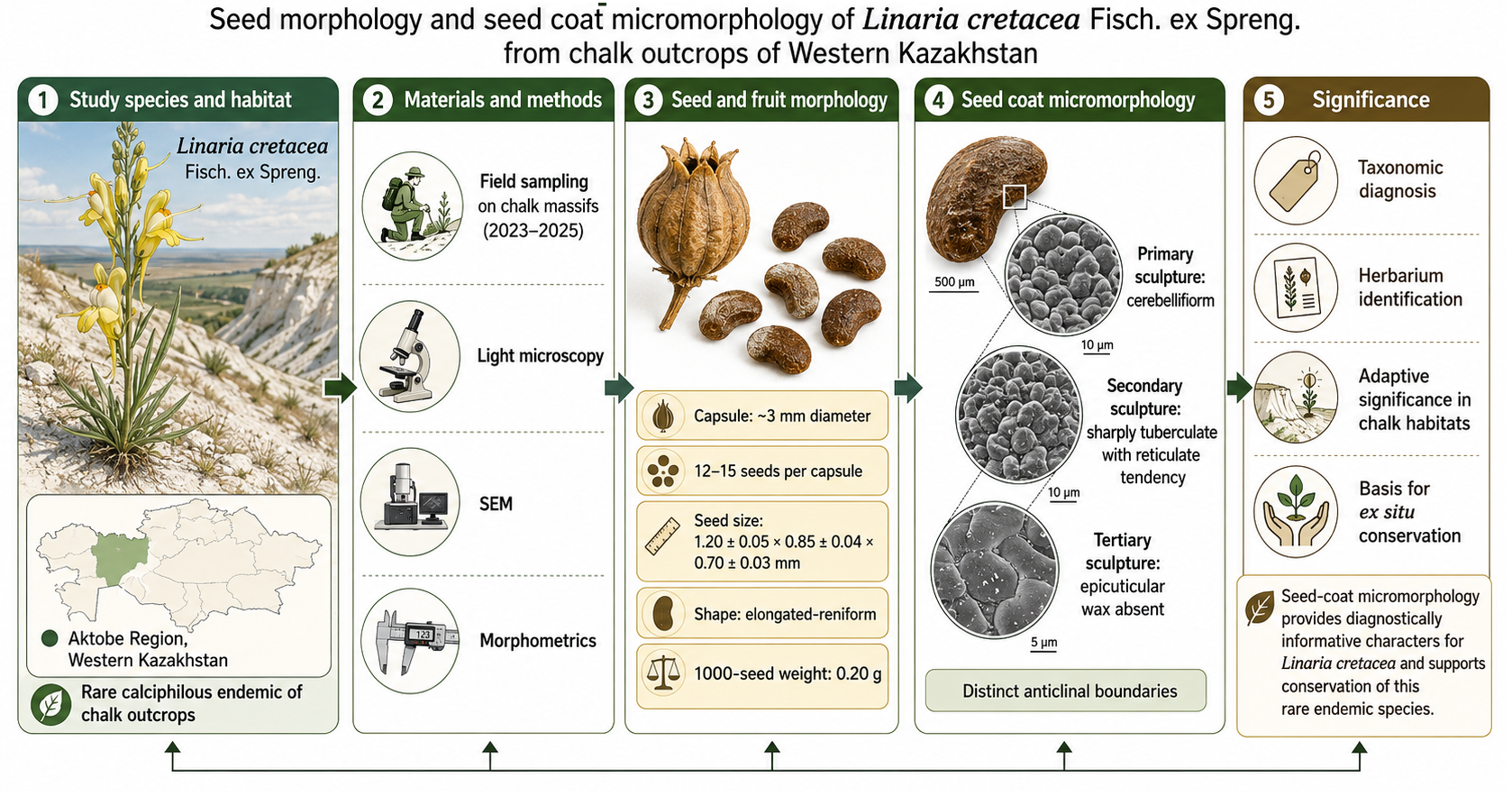
Seed morphology and seed coat micromorphology of Linaria cretacea Fisch. ex Spreng. from chalk outcrops of Western Kazakhstan
DOI:
https://doi.org/10.31489/2026feb3/5-16Keywords:
Linaria cretacea, Kazakhstan, calciphilous species, endemic species, seed morphology, scanning electron microscopy, light microscopy, featuresAbstract
The investigation of seed morphology and seed-coat micromorphology is important for taxonomy, ecology, and the conservation of rare endemic plants, particularly species restricted to specialized habitats such as chalk outcrops. In calciphilous plants with narrow distribution ranges, seed-coat micromorphology can serve as a useful diagnostic feature for species identification, clarification of taxonomic relationships, and the development of ex situ conservation measures. This study examined the morphological characteristics of the seeds and fruits of Linaria cretacea Fisch. ex Spreng., a rare calciphilous endemic species restricted to chalk outcrops in Western Kazakhstan, using scanning electron microscopy (SEM) and light microscopy. Macro- and microimages of the seeds were obtained, and their main morphometric parameters, including length, width, thickness, and shape index, were measured. Seed-coat sculpture was described at the primary, secondary, and tertiary levels following the classifications proposed by W. Barthlott and W. Stearn. The results showed that L. cretacea from the Aktobe Region is characterized by a cerebelliform primary sculpture with clearly defined anticlinal boundaries, a sharply tuberculate secondary sculpture with reticulate elements, and the absence of epicuticular wax. Comparison of the seed-coat traits identified in this study with published descriptions of the closely related species L. vulgaris and L. genistifolia revealed a set of diagnostically significant micromorphological differences. The possible adaptive role of seed-coat structure in chalk habitats with low water-retention capacity is also discussed. The findings are of both systematic and practical value, particularly for the identification of herbarium specimens and the development of protection and ex situ conservation protocols for this rare species..
References
1 Güldenstädt J.A. Reisen durch Rußland und im Caucasischen Gebürge / J.A. Güldenstädt. — St. Petersburg: Kaiserliche Akademie der Wissenschaften, 1787–1791. — Bd. I–II.
2 Гильденштедт И.А. Дневник путешествия в Россию в 1773–1774 гг. / И.А. Гильденштедт // Записки Одесского общества истории и древностей. — 1879. — Т. 11. — С. 180–229.
3 Черняев В.М. О произведениях растительного царства Курской губернии / В.М. Черняев // Журнал Министерства внутренних дел. — 1836. — Ч. 22, № 12. — С. 505–514.
4 Литвинов Д.И. О реликтовом характере флоры каменистых склонов в Европейской России / Д.И. Литвинов // Труды Ботанического музея Императорской Академии наук. — 1902. — Вып. 1. — С. 76–109.
5 Литвинов Д.И. О значении произрастания сосны и торфяной березки на меловых горах Центрально-Чернозёмного округа / Д.И. Литвинов // Бюллетень Общества естествоиспытателей при ВГУ. — 1927. — Т. 2, № 1. — С. 54–56.
6 Попов М.Г. Происхождение и эволюция покрытосеменных растений / М.Г. Попов // Филогения, флорогенетика, флорография, систематика: Избранные труды. — Киев: Наукова думка, 1983. — Ч. 2. — С. 281–290.
7 Сагалаев В.А. Флора степей и пустынь Юго-Востока европейской России, её генезис и современное состояние: автореф. дис. д-ра биол. наук / В.А. Сагалаев. — Москва, 2000. — 42 с.
8 Сукачёв В.Н. О болотной и меловой растительности Юго-Восточной части Курской губернии / В.Н. Сукачёв // Труды Общества испытателей природы при Императорском Харьковском университете. — 1902. — Т. 37. — С. 227–258.
9 Голицын С.В. «Сниженные альпы» и меловые иссопники Среднерусской возвышенности: автореф. дис. д-ра биол. наук / С.В. Голицын. — Воронеж, 1965. — 16 с.
10 Клоков М.В. Основные этапы развития равнинной флоры европейской части СССР / М.В. Клоков // Материалы по истории флоры и растительности СССР. — 1963. — Вып. 4. — С. 376–406.
11 Талиев В.И. Вегетация меловых обнажений Южной России / В.И. Талиев // Труды Общества испытателей природы при Императорском Харьковском университете. — 1904. — Т. 39, Вып. 1. — С. 81–254.
12 Талиев В.И. Дополнение к описанию меловой флоры / В.И. Талиев // Труды Общества испытателей природы при Императорском Харьковском университете. — 1905. — Т. 40, Вып. 1. — С. 1–282.
13 Талиев В.И. Дополнения к флоре меловых гор Южной России / В.И. Талиев // Труды Общества испытателей природы при Императорском Харьковском университете. — 1907. — Т. 40, Вып. 2. — С. 154–231.
14 Kozo-Poljanski B.M. Glaziale Pflanzenrelikte auf dem Orel-Kurskischen Plateau im Süden der Mittelrussischen Hochebene. Teil 1 / B.M. Kozo-Poljanski // Vegetationsbilder. — Jena: Fischer, 1928. — Reihe 19, H. 1/2. — Taf. 1–12.
15 Kozo-Poljanski B.M. Glaziale Pflanzenrelikte auf dem Orel-Kurskischen Plateau im Süden der Mittelrussischen Hochebene. Teil 2 / B.M. Kozo-Poljanski // Vegetationsbilder. — Jena: Fischer, 1929. — Reihe 19, H. 7/8. — Taf. 37–48.
16 Козо-Полянский Б.М. В стране живых ископаемых / Б.М. Козо-Полянский. — Москва, 1931. — 184 с.
17 Котов М.И. Ботанико-географический очерк растительности меловых обнажений на р. Оскол и её притоках / М.И. Котов // Журнал Русского ботанического общества. — 1927. — Т. 12, № 1-2. — С. 249–266.
18 Лавренко Е.М. Об эволюционных центрах флоры и возрасте украинского эндемизма / Е.М. Лавренко // Die Quartärperiode. — 1932. — Lieferung 4. — S. 27–43.
19 Golovanov Ya.M. Vegetation of chalk outcrops of Sub-Ural plateau and adjacent territories / Ya.M. Golovanov, S.M. Yamalov, M.V. Lebedeva, A.Yu. Korolyuk, L.M. Abramova, N.A. Dulepova // Vegetation of Russia. — 2021. — No. 40. — Р. 3–42. https://doi.org/10.31111/vegrus/2021.40.3
20 Меликян А.П. Семейство Illiciaceae / А.П. Меликян; под ред. А.Л. Тахтаджяна // Сравнительная анатомия семян. — Ленинград: Наука, 1988. — Т. 2: Двудольные: Magnoliidae, Ranunculidae.
21 Меликян А.П. Семейство Winteraceae / А.П. Меликян, Е.Н. Немирович-Данченко; под ред. А.Л. Тахтаджяна // Сравнительная анатомия семян. — Ленинград: Наука, 1988. — Т. 2: Двудольные: Magnoliidae, Ranunculidae. — С. 44–47.
22 Данилова М.Ф. Сравнительная анатомия семян / М.Ф. Данилова; под ред. А.Л. Тахтаджяна. — СПб: Мир и Семья, 1996. — Т. 5: Двудольные: Rosidae I. — 240 с.
23 Barthlott W. Epidermal and seed surface characters of plants: Systematic applicability and some evolutionary aspects / W. Barthlott // Nordic Journal of Botany. — 1981. — Vol. 1, No. 3. — P. 345–355. https://doi.org/10.1111/j.1756-1051.1981.tb00704.x
24 Barthlott W. Microstructural features of seed surfaces / W. Barthlott; Eds. V.H. Heywood, D.M. Moore // Current Concepts in Plant Taxonomy. — London: Academic Press, 1984. — P. 95–105.
25 Stearn W.T. Botanical Latin: History, Grammar, Syntax, Terminology and Vocabulary / W.T. Stearn. — Portland: Timber Press, 1992. — 546 p.
26 Segarra-Moragues J.G. Seed morphology of Linaria species from eastern Spain: identification of species and taxonomic implications / J.G. Segarra-Moragues, I. Mateu // Botanical Journal of the Linnean Society. — 2001. — Vol. 137, No. 3. — P. 275–284. https://doi.org/10.1111/j.1095-8339.2001.tb01121.x
27 Sutton D.A. A Revision of the Tribe Antirrhineae / D.A. Sutton. — London: Oxford University Press for the British Museum (Natural History), 1988. — 322 p.