Identification of promising wheat lines resistant to tan spot (Pyrenophora tritici-repentis)
DOI:
https://doi.org/10.31489/2026feb1/63-71Keywords:
wheat, tan spot, resistance genes, molecular screening, resistance, NDVI, AUDPCAbstract
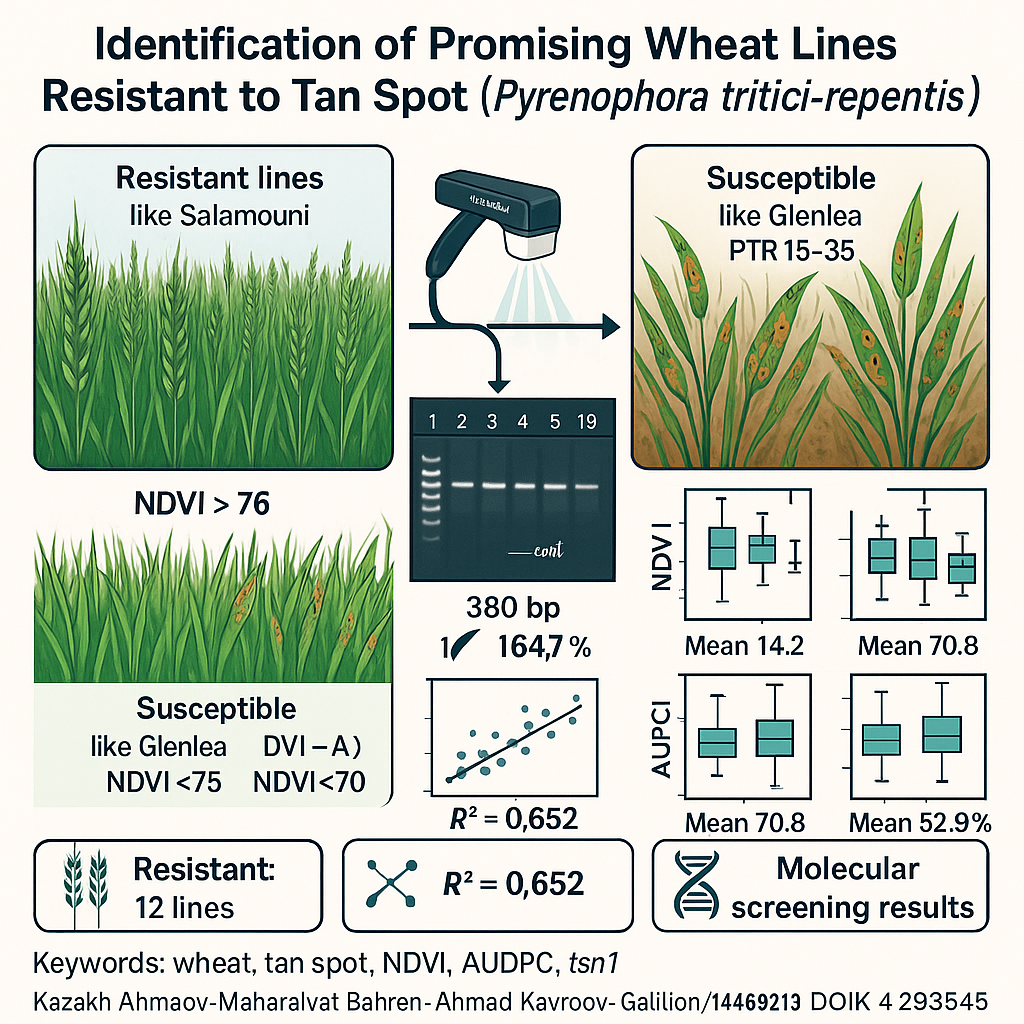
Wheat tan spot (yellow spot) is one of the most widespread and dangerous fungal diseases of wheat, caused by the phytopathogenic fungus Pyrenophora tritici-repentis. The aim of the study is to identify resistance to tan spot in promising wheat lines based on phenotypic indicators and molecular screening. A comprehensive assessment of wheat samples was carried out by the biomass index (NDVI), resistance to pathogens (PTR, AUDPC) and molecular markers. It was found that NDVI varies from 65 to 82, while high values (> 75) correlate with resistance (R² = 0.652), and low values (<70) — with susceptibility (S). Resistant samples (12 pcs., PTR = 5–10), including the Salamouni variety, and susceptible ones (7 samples, PTR = 15–35) were identified. As a result of molecular screening, PCR analysis of all studied genotypes showed the presence of the recessive gene tsn1 in 11 wheat genotypes (64.7 %). The integral indicator AUDPC (mean=70.8) demonstrated high variability (CV>50 %) and extreme values (up to 165). Statistical analysis confirmed the stability of NDVI (CV=6.5–6.7 %) and significant variability of PTR/AUDPC, reflecting mixed resistance. The results emphasize the need for an in-depth study of the relationship of molecular markers with resistance to tan spot.
References
1 Food and Agriculture Organization of the United Nations (2020). World Food Situation — FAO Cereal Supply and Demand Brief. Rome, Italy.
2 United States Department of Agriculture (USDA) (2020). World Agricultural Production. Circular Series WAP 9–20. Foreign Agricultural Service, Gobal Market Analysis. Washington, DC, USA.
3 Kolmer, J.A. (2005). Tracking wheat rust on a continental scale. Current Opinion Plant Biology, 8, 441–449.
4 Hovmøller, M.S., Walter, S., & Justesen, A.F. (2010). Escalating threat of wheat rusts. Science, 329, 369.
5 El Jarroudi, M., Kouadio, L., Giraud, F., Delfosse, P., & Tychon, B. (2014). Brown rust disease control in winter wheat: II. Exploring the optimization of fungicide sprays through a decision support system. Environmental Science Pollution Research, 21, 4809–4818.
6 Beddow, J.M., Pardey, P.G., Chai, Y., Hurley, T.M., Kriticos, D.J., Braun, H. -J., Park, R.F., Cuddy, W.S., & Yonow, T. (2015). Research investment implications of shifts in the global geography of wheat stripe rust. Nat. Plants, 1, 15132.
7 El Jarroudi, M., Kouadio, L., Beyer, M., Junk, J., Ho Mann, L., Tychon, B., Maraite, H., Bock, C.H., & Delfosse, P. (2015). Economics of a decision–support system for managing the main fungal diseases of winter wheat in the Grand-Duchy of Luxembourg. Field Crops Res., 172, 32–41.
8 Ali, S., Rodriguez-Algaba, J., Thach, T., Sørensen, C.K., Hansen, J.G., Lassen, P., Nazari, K., Hodson, D.P., Justesen, A.F., & Hovmøller, M.S. (2017). Yellow rust epidemics worldwide were caused by pathogen races from divergent genetic lineages. Front. Plant Sci., 8, 1057.
9 Faris, J.D., Liu, Z., & Xu, S.S. (2013). Genetics of tan spot resistance in wheat. Theoretical and Applied Genetics, 126, 2197–2217. https://doi.org/10.1007/s00122-013- 2157-y
10 Mofat, C.S., See, P.T., & Oliver, R.P. (2014). Generation of a ToxA knockout strain of the wheat tan spot pathogen Pyrenophora tritici-repentis. Molecular Plant Pathology, 15, 918–926. https://doi.org/10.1111/mpp.12154
11 Lamari, L., Strelkov, S.E., Yahyaoui, A., Orabi, J., & Smith, R.B. (2003). The identification of two new races of Pyrenophora tritici-repentis from the host center of diversity confirms a one-to-one relationship in tan spot of wheat. Phytopathology, 93, 391–396. https:// doi.org/10.1094/PHYTO.2003.93.4.391
12 Anderson, J.A., Efertz, R.J., Faris, J.D., Francl, L.J., & Meinhardt, S.W. (1999). Genetic analysis of sensitivity to Pyrenophora tritici-repentis necrosis-inducing toxin in durum and common wheat. Phytopathology, 89, 293–297. https://doi.org/10.1094/PHYTO.1999.89.4.293
13 Faris, J.D., Anderson, J.A., Francl, L.J., & Jordahl, J.G. (1996). Chromosomal location of a gene conditioning insensitivity in wheat to a necrosis-inducing culture filtrate from Pyrenophora tritici-repentis. Phytopathology, 86, 459–463. https://doi.org/10.1094/Phyto-86-459
14 Gamba, F.M., Bassi, F.M., & Finckh, M.R. (2017). Race structure of Pyrenophora tritici-repentis in Morocco. Phytopathologia Mediterranea, 56, 119–126. https://doi.org/10.14601/Phytopathol_Mediterr-18830
15 Saari, E. E., & Prescott, L. M. (1975). A scale for appraising the foliar intensity of wheat diseases. Plant Dis. Rep., 59, 377–380.
16 Kremneva, O. Yu., & Volkova, G. V. (2007). Diagnostics and methods for assessing wheat resistance to the causative agent of yellow leaf spot. Methodological recommendations. Moscow.
17 Wilcoxson, R. D., Atif, A. H., & Skowmand, B. (1974). Slow rusting of wheat varieties in the field correlated with stem rust severity on detached leaves in the greenhouse. Plant disease reporter, 58(12), 1085–1087.
18 Riede, C.R., & Anderson, J.A. (1996). Linkage of RFLP markers to an aluminum tolerance gene in wheat. Crop Science, 36, 905–909.